
As the Parker Solar Probe ventures closer to the sun, we are learning new things about our home star.
In a new study, physicists led by the University of Iowa report the first definitive measurements of the sun’s electric field, and how the electric field interacts with the solar wind, the fast-flowing current of charged particles that can affect activities on Earth, from satellites to telecommunications.
The physicists calculated the distribution of electrons within the sun’s electric field, a feat made possible by the fact that the Parker Solar Probe jetted within 0.1 astronomical units (AU), or a mere 9 million miles, from the sun — closer than any spacecraft has approached. From the electrons’ distribution, the physicists were able to discern the size, breadth, and scope of the sun’s electric field more clearly than had been done before.
“The key point I would make is you can’t make these measurements far away from the sun. You can only make them when you get close,” says Jasper Halekas, associate professor in the Department of Physics and Astronomy at Iowa and the study’s corresponding author. “It’s like trying to understand a waterfall by looking at the river a mile downstream. The measurements we made at 0.1 AU, we’re actually in the waterfall. The solar wind is still accelerating at that point. It’s really just an awesome environment to be in.”
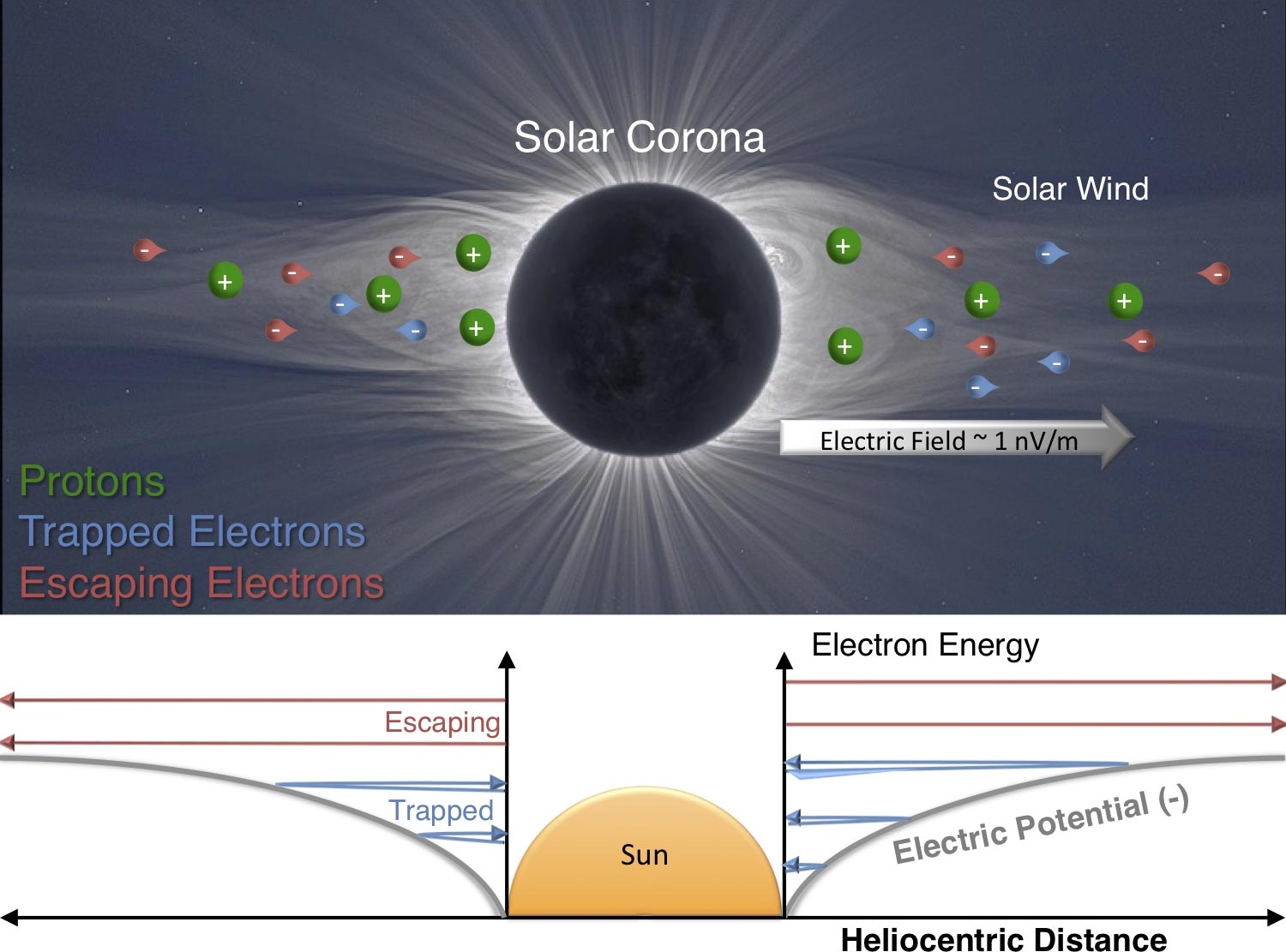
The sun’s electric field arises from the interaction of protons and electrons generated when hydrogen atoms are stripped apart in the intense heat generated by fusion deep within the sun. In this environment, electrons, with masses 1,800 times less than that of protons, are blown outward, less constrained by gravity than their weightier proton siblings. But the protons, with their positive charge, exert some control, reining in some electrons due to the familiar attraction forces of oppositely charged particles.
Balancing Forces: Electrons vs. Protons
“Electrons are trying to escape, but protons are trying to pull them back. And that is the electric field,” says Halekas, a co-investigator for the Solar Wind Electrons, Alphas, and Protons instrument aboard the Parker Solar Probe, the NASA-led mission that launched in August 2018. “If there were no electric field, all the electrons would rush away and be gone. But the electric field keeps it all together as one homogenous flow.”
Now, imagine the sun’s electric field as an immense bowl and the electrons as marbles rolling up the sides at differing speeds. Some of the electrons, or marbles in this metaphor, are zippy enough to cross over the lip of the bowl, while others don’t accelerate enough and eventually roll back toward the bowl’s base.
“We are measuring the ones that come back and not the ones that don’t come back,” Halekas says. “There’s basically a boundary in energy there between the ones that escape the bowl and the ones that don’t, which can be measured. Since we’re close enough to the sun, we can make accurate measurements of electrons’ distribution before collisions occur further out that distort the boundary and obscure the imprint of the electric field.”
New Insights on the Solar Wind’s Acceleration
From those measurements the physicists can learn more about the solar wind, the million-mile-per-hour jet of plasma from the sun that washes over the Earth and other planets in the solar system. What they found is the sun’s electric field exerts some influence over the solar wind, but less than had been thought.
“We can now put a number on how much of the acceleration is provided by the sun’s electric field,” Halekas says. “It looks like it’s a small part of the total. It’s not the main thing that gives the solar wind its kick. That then points to other mechanisms that might be giving the solar wind most of its kick.”
Reference: “The sunward electron deficit: A telltale sign of the sun’s electric potential” by J. S. Halekas, L. Bercic, P. Whittlesey, D. E. Larson, R. Livi, M. Berthomier, J. C. Kasper, A. W. Case, M. L. Stevens, S. D. Bale, R. J. MacDowall and M. P. Pulupa, 14 July 2021, The Astrophysical Journal.
DOI: 10.3847/1538-4357/ac096e
Contributing authors include Laura Bercic, from University College London; Phyllis Whittlesey, Davin Larson, Marc Pulupa, and Stuart Bale, from the University of California, Berkeley; Matthieu Berthomier, from the University of Paris-Saclay; Justin Kasper, of the University of Michigan and the Smithsonian Astrophysical Observatory; Anthony Case and Michael Stevens, of the Smithsonian Astrophysical Observatory; and Robert MacDowall, of NASA Goddard Space Flight Center.
NASA funded the research.
Never miss a breakthrough: Join the SciTechDaily newsletter.
Follow us on Google and Google News.