
Close Menu
    Facebook X (Twitter) Instagram
    SciTechDaily
    • Biology
    • Chemistry
    • Earth
    • Health
    • Physics
    • Science
    • Space
    • Technology
    Facebook X (Twitter) Pinterest YouTube RSS
    SciTechDaily
    Home»Biology»Leptocephalus, The Transparent Eel Larva
    Biology

    Leptocephalus, The Transparent Eel Larva

    By SciTechDailyJanuary 12, 20138 Comments2 Mins Read
    Facebook Twitter Pinterest Telegram LinkedIn WhatsApp Email Reddit
    Share
    Facebook Twitter LinkedIn Pinterest Telegram Email Reddit
    Credit: Mie Prefecture Fisheries Research Institute
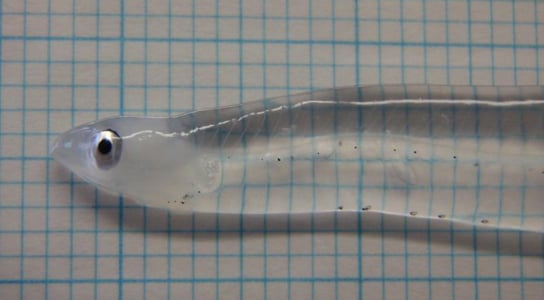
    Transparent Fish (Leptocephalus). Credit: Mie Prefecture Fisheries Research Institute

    The marine eels and other members of the Superorder Elopomorpha have a leptocephalus larval stage, which are flat and transparent. This group is quite diverse, containing 801 species in 24 orders, 24 families, and 156 genera. They arose in the Cretaceous period 140 million years ago.

    Fish with a leptocephalus larva stage include eels like the conger, moray eel, and garden eel. The conger eel is the one whose larva was captured by the Mie Prefecture Fisheries Research Institute in Japan.
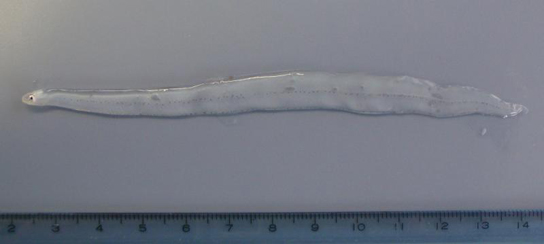
    Credit: Mie Prefecture Fisheries Research Institute
    Credit: Mie Prefecture Fisheries Research Institute

    Leptocephali have laterally compressed bodies that contain jelly-like substances on the inside, with a thin layer of muscle with visible myomeres on the outside. They have a simple tube as a gut. They have dorsal and anal fins, but they lack pelvic fins. They also don’t have any red blood cells, which they only begin producing when they change into the juvenile glass eel stage. They also possess fang-like teeth that are present until metamorphosis, when they are lost.

    Leptocephali differ from fish larvae because of their size and their long larval periods, which last between three months to more than a year. Their anguilliform swimming motions allow them to move forwards and backward. They appear to feed on marine snow, tiny free-floating particles in the ocean.

    Never miss a breakthrough: Join the SciTechDaily newsletter.
    Follow us on Google and Google News.

    Marine Biology
    Share. Facebook Twitter Pinterest LinkedIn Email Reddit

    Related Articles

    Colossal Eyes Give Giant Squids an Advantage When Fighting Sperm Whales

    Bottlenose Dolphins Use Signature Whistles to Greet Others

    Marine Bacteria Use Bioluminescence to Lure Zooplankton and Fish

    Study Shows That Cephalopods Travel Faster in Air Than in Water

    Researchers Discover ‘Supergiant’ Amphipods in the Kermadec Trench

    Jellyfish Bloom in Marine Ecologies As Ocean Health Declines

    Jacques Cousteau Predicted Detrimental Change in Coral Reefs

    Mesodinium Chamaeleon Is A Unique Life Form That is Half Plant Half Animal

    Brainless, Faceless Fish Found in Scottish Waters

    8 Comments

    1. Madanagopal.V.C on January 12, 2013 10:01 pm

      The transparent Eel larva reminds me of the transparent jelly fish which also belongs to the cretaceous period 140 million years ago. Probably there were not much predators for these fishes in the early period, they themselves feeding on free floating particles. Even human beings at the embryological stage are transparent only. They add pigments and hair later on to face the environment in their later life. Red blood corpuscles are required to transport oxygen from lungs whereas the fish can breath through their gills by drinking dissolved oxygen in water.

      Reply
    2. jake on January 19, 2016 5:00 pm

      can it develope inside you possibly

      Reply
      • Evan on May 6, 2016 1:31 pm

        Not at all. No more than kittens or oranges can develop inside you.

        They have to breathe, live in seawater, and can only eat bits of plankton and other marine debris. Unless you also have a large ocean and sunlight inside you, you can not host these. If you swallowed one, you would digest it (and people do eat eel!)

        They do superficially look vaguely like certain parasitic worms, so I can see the reason for your question, but they are not biologically parasites.

        Reply
    3. Scaredy kat on February 21, 2017 4:47 am

      But is there actually risk of mistakingly consuming one? Are they actually present and have been found in drinking water?

      Reply
      • D Van Wyck on May 28, 2017 9:19 am

        Even if you did accidentally swallow one….it wouldn’t hurt you in any way. And NO…they have not been found in drinking water. That’s just another “Fake News” article. The Transparent Eel are found in the Ocean.

        Reply
    4. Em on December 28, 2018 9:06 am

      I found one of these on the beach. Are they very hard to take care of? I was thinking of taking it back with me.

      Reply
    5. dulshan on October 22, 2019 10:52 am

      there was one of those things in my water cup

      Reply
    6. Aleksandra on March 9, 2022 7:39 pm

      So today I received my “new” washing machine that I ordered online. I opened it and to my surprise it was already used and returned once. I was moving it around and realized that there is still water inside from the previous customer. The manual and some of the items that came with it were all covered with some kind of mold. I later tried to clean it and see if I can use it. When I poured down some bleach into the designated area with a small hole (1/3 of an inch), something popped out of it. At first I thought it as just a bubble from the bleach, but I looked again and it looked like it had eyes. My mum confirmed it too and when I googled it and I saw this picture and am currently in shock. Is I possible that this thing was in my washing machine??

      Reply
    Leave A Reply Cancel Reply

    • Facebook
    • Twitter
    • Pinterest
    • YouTube

    Don't Miss a Discovery

    Subscribe for the Latest in Science & Tech!

    Trending News

    New Pill Lowers Stubborn Blood Pressure and Protects the Kidneys

    Humans May Have Hidden Regenerative Powers, New Study Suggests

    Scientists Just Solved the Mystery of Why Crabs Walk Sideways

    Doctors Are Surprised by What This Vaccine Is Doing to the Heart

    This Popular Supplement May Boost Your Brain, Not Just Your Muscles

    Scientists Say This Simple Supplement May Actually Reverse Heart Disease

    Warming Oceans Could Trigger a Dangerous Methane Surge

    This Simple Movement Could Be Secretly Cleaning Your Brain

    Follow SciTechDaily
    • Facebook
    • Twitter
    • YouTube
    • Pinterest
    • Newsletter
    • RSS
    SciTech News
    • Biology News
    • Chemistry News
    • Earth News
    • Health News
    • Physics News
    • Science News
    • Space News
    • Technology News
    Recent Posts
    • AI Learns To Work Backward and Reveal Hidden Forces in Nature
    • Scientists Warn of Rising Male Childlessness As Global Fertility Changes
    • New Discovery Challenges Decades-Old Theory of DNA Damage and Aging
    • Scientists Just Rewrote Biology: “Hidden” Mechanism Could Transform Diabetes Treatment
    • Scientists Solve 320-Million-Year Mystery of Reptile Skin Armor
    Copyright © 1998 - 2026 SciTechDaily. All Rights Reserved.
    • Science News
    • About
    • Contact
    • Editorial Board
    • Privacy Policy
    • Terms of Use

    Type above and press Enter to search. Press Esc to cancel.