
Close Menu
    Facebook X (Twitter) Instagram
    SciTechDaily
    • Biology
    • Chemistry
    • Earth
    • Health
    • Physics
    • Science
    • Space
    • Technology
    Facebook X (Twitter) Pinterest YouTube RSS
    SciTechDaily
    Home»Chemistry»Levitation That’s No Trick: Scientists to Perform “Touchless” Chemical Reactions
    Chemistry

    Levitation That’s No Trick: Scientists to Perform “Touchless” Chemical Reactions

    By American Chemical SocietyJuly 5, 2020No Comments2 Mins Read
    Facebook Twitter Pinterest Telegram LinkedIn WhatsApp Email Reddit
    Share
    Facebook Twitter LinkedIn Pinterest Telegram Email Reddit
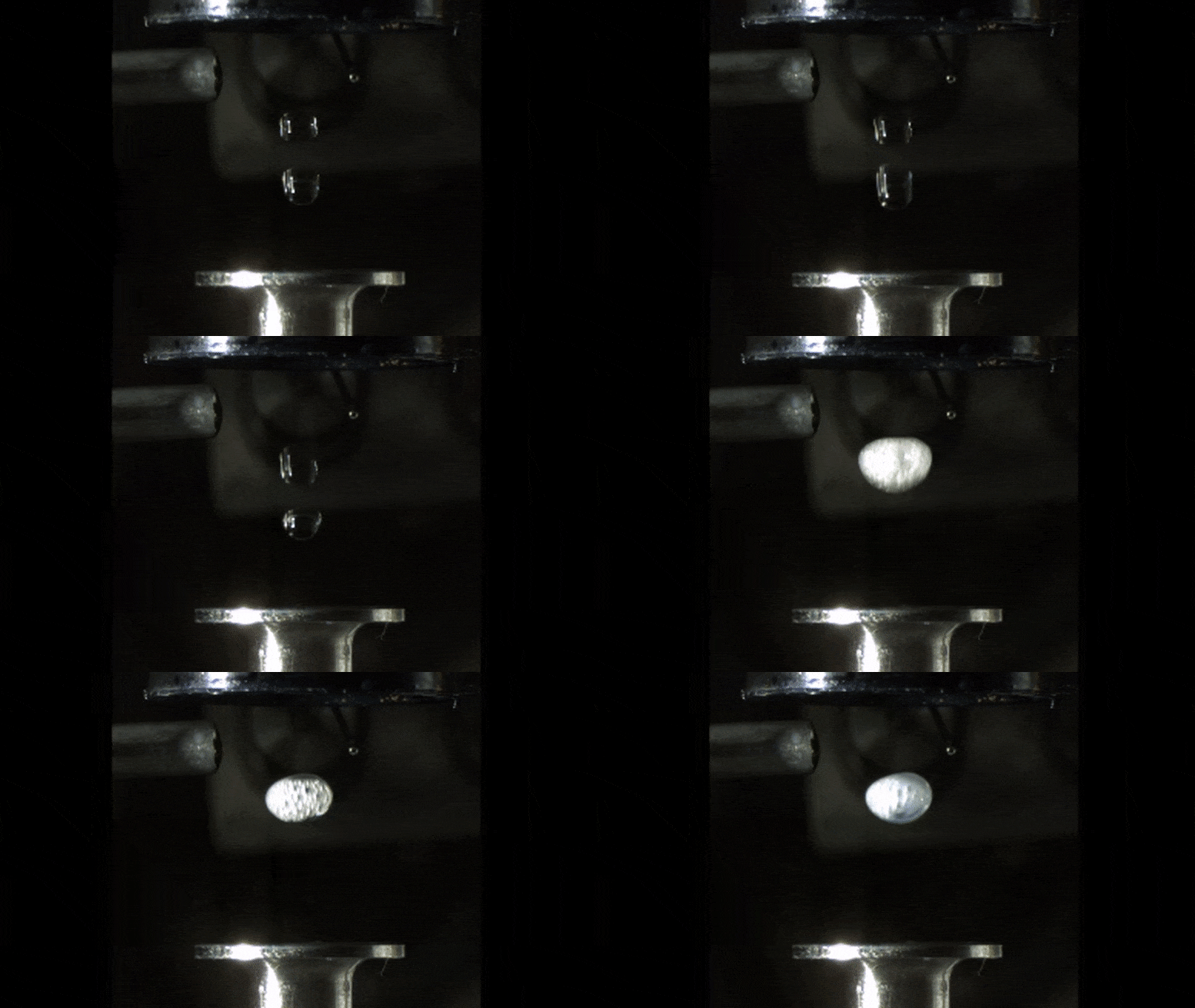
    Levitating Droplets Chemical Reaction
    Levitating droplets

    Levitation has long been a staple of magic tricks and movies. But in the lab, it’s no trick. Scientists can levitate droplets of liquid, though mixing them and observing the reactions has been challenging. The pay-off, however, could be big as it would allow researchers to conduct contact-free experiments without containers or handling that might affect the outcome. Now, a team reporting in ACS’ Analytical Chemistry has developed a method to do just that.

    Scientists have made devices to levitate small objects, but most methods require the object to have certain physical properties, such as electric charge or magnetism. In contrast, acoustic levitation, which uses sound waves to suspend an object in a gas, doesn’t rely on such properties. Yet existing devices for acoustic levitation and mixing of single particles or droplets are complex, and it is difficult to obtain measurements from them as a chemical reaction is happening. Stephen Brotton and Ralf Kaiser wanted to develop a versatile technique for the contactless control of two chemically distinct droplets, with a set of probes to follow the reaction as the droplets merge.
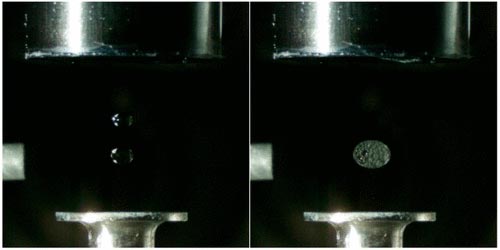
    Levitating Droplets Chemical Reaction
    Levitating droplets of acidic and basic solutions (left) merge into a larger droplet (right), in which carbon dioxide bubbles form as a product of the reaction. Credit: Analytical Chemistry 2020, DOI: 10.1021/acs.analchem.0c00929

    The team made an acoustic levitator and suspended two droplets in it, one above the other. Then, they made the upper droplet oscillate by varying the amplitude of the sound wave. The oscillating upper droplet merged with the lower droplet, and the resulting chemical reaction was monitored with infrared, Raman and ultraviolet-visible spectroscopies. The researchers tested the technique by combining different droplets. In one experiment, for example, they merged an ionic liquid with nitric acid, causing a tiny explosion. The new levitation method could help scientists study many different types of chemical reactions in areas such as material sciences, medicinal chemistry and planetary science, the researchers say.

    Reference: “Controlled Chemistry via Contactless Manipulation and Merging of Droplets in an Acoustic Levitator” by Stephen J. Brotton and Ralf I. Kaiser, 1 June 2020, Analytical Chemistry.
    DOI: 10.1021/acs.analchem.0c00929

    The authors acknowledge funding from the Office of Naval Research.

    Never miss a breakthrough: Join the SciTechDaily newsletter.
    Follow us on Google and Google News.

    American Chemical Society Biophysics Chemical Engineering
    Share. Facebook Twitter Pinterest LinkedIn Email Reddit

    Related Articles

    Origami Reinvented: Chemical Engineers Unfold the Future of Glass Sculpture and Catalysis

    Outsmarting Cheaters: Doping by Athletes Tougher to Hide With New Detection Method

    Converting Sunlight into Ionic Electricity for Direct Solar Desalination

    MIT Researchers Develop New Strategy for Stronger Polymers

    MIT Engineers Harness Stomach Acid to Power Tiny Sensors

    New Nanoparticle Catalysts Improve Reactivity with Much Less Platinum

    MIT Engineers Develop Coated Tissue Scaffolds That Help Stimulate New Bone Growth

    The Prospects for the Development of Clean Fuels Are Improving

    Graphene’s Behavior Can Be Strongly Affected by an Underlying Material

    Leave A Reply Cancel Reply

    • Facebook
    • Twitter
    • Pinterest
    • YouTube

    Don't Miss a Discovery

    Subscribe for the Latest in Science & Tech!

    Trending News

    Popular Sugar-Free Sweetener Linked to Liver Disease, Study Warns

    What Is Hantavirus? The Deadly Disease Raising Alarm Worldwide

    Scientists Just Discovered How the Universe Builds Monster Black Holes

    Scientists Unveil New Treatment Strategy That Could Outsmart Cancer

    A Simple Vitamin May Hold the Key to Treating Rare Genetic Diseases

    Scientists Think the Real Fountain of Youth May Be Hiding in Your Gut

    Ravens Don’t Follow Wolves, They Predict Them

    This Common Knee Surgery May Be Doing More Harm Than Good

    Follow SciTechDaily
    • Facebook
    • Twitter
    • YouTube
    • Pinterest
    • Newsletter
    • RSS
    SciTech News
    • Biology News
    • Chemistry News
    • Earth News
    • Health News
    • Physics News
    • Science News
    • Space News
    • Technology News
    Recent Posts
    • Popular Supplement Ingredient Linked to Shorter Lifespan in Men
    • Scientists May Have Found a Way To Repair Nerve Damage in Multiple Sclerosis
    • GLP-1 Weight Loss Linked To Dramatically Lower Risk of Sleep Apnea, Kidney Disease and More
    • Scientists Uncover the Surprising Source of Strange Clouds Near the Milky Way’s Supermassive Black Hole
    • This Dazzling Green Snake Was Hiding in Plain Sight for Decades
    Copyright © 1998 - 2026 SciTechDaily. All Rights Reserved.
    • Science News
    • About
    • Contact
    • Editorial Board
    • Privacy Policy
    • Terms of Use

    Type above and press Enter to search. Press Esc to cancel.