
Close Menu
    Facebook X (Twitter) Instagram
    SciTechDaily
    • Biology
    • Chemistry
    • Earth
    • Health
    • Physics
    • Science
    • Space
    • Technology
    Facebook X (Twitter) Pinterest YouTube RSS
    SciTechDaily
    Home»Health»Light from Phones or Tablets Suppresses Melatonin Production in Young Teens
    Health

    Light from Phones or Tablets Suppresses Melatonin Production in Young Teens

    By Brown UniversityAugust 26, 2015No Comments3 Mins Read
    Facebook Twitter Pinterest Telegram LinkedIn WhatsApp Email Reddit
    Share
    Facebook Twitter LinkedIn Pinterest Telegram Email Reddit
    Light from Phones or Tablets Disturbs the Sleep of Young Teens
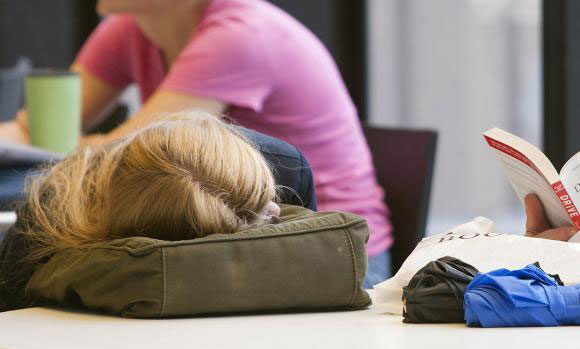
    Researchers found that nighttime light exposure from phones or tablets significantly suppresses melatonin production, affecting the sleep biology of teenagers.

    A new study from Brown University examines the effect of light exposure at night on the biology of teen sleep, revealing that light from phones or tablets suppressed their production of the sleep-timing hormone melatonin significantly.

    Brown University — A new study has an important implication for tweens and young teens as they head back to school: Taking a gadget to bed could really hurt their sleep.

    Enough light exposure at night can keep anyone from falling asleep as quickly as they otherwise would have. But the new research, published online in the Journal of Clinical Endocrinology & Metabolism, finds that the sleep biology of boys and girls aged 9 to 15 who were in the earlier stages of puberty were especially sensitive to light at night compared to older teens. In lab experiments, an hour of nighttime light exposure suppressed their production of the sleep-timing hormone melatonin significantly more than the same light exposure did for teens aged 11 to 16 who were farther into puberty.

    The brighter the light in the experiments, the more melatonin was suppressed. Among 38 children in early to middle puberty an hour of 15 lux of light (think dim “mood” lighting) suppressed melatonin by 9.2 percent, 150 lux (normal room light) reduced it by 26 percent, and 500 lux (as bright as in a supermarket) reduced it by 36.9 percent. The 29 teens in the late or post-puberty stage were also affected, but not as much. Exposure to 15 lux did not suppress melatonin at all, 150 lux reduced it 12.5 percent, and 500 lux reduced it by 23.9 percent.

    The effects were the same for boys and girls.

    “Small amounts of light at night, such as light from screens, can be enough to affect sleep patterns,” said study senior author Mary Carskadon, professor of psychiatry and human behavior in the Alpert Medical School of Brown University and director of chronobiology and sleep research at the E.P. Bradley Hospital in East Providence, R.I. “Students who have tablets or TVs or computers — even an ‘old-school’ flashlight under the covers to read — are pushing their circadian clocks to a later timing. This makes it harder to go to sleep and wake up at times early the next morning for school.”

    Carskadon, lead author Stephanie Crowley of Rush University Medical Center, and their co-authors said children and their parents should limit the use of screens at bedtime, even though it has become pervasive. One study found that 96 percent of teens use at least one form of technology in the hour before going to bed.

    In addition to Carskadon and Crowley, the study’s other authors are Christine Acebo from Brown University and Sean Cain and Angus Burns from Monash University in Melbourne, Australia.

    This research was supported by the National Institute of Mental Health (grants MH52415 and MH01358) and the National Heart Lung and Blood Institute (HL105395).

    Reference: “Increased sensitivity of the circadian system to light in early/mid puberty” by Stephanie J. Crowley, Sean W. Cain, Angus C. Burns, Christine Acebo and Mary A. Carskadon, 1 November 2015, JCEM.
    DOI: 10.1210/jc.2015-2775

    Never miss a breakthrough: Join the SciTechDaily newsletter.
    Follow us on Google and Google News.

    Brown University Chronobiology Sleep Science Teenager
    Share. Facebook Twitter Pinterest LinkedIn Email Reddit

    Related Articles

    This Study Finally Explains Why You Can’t Stop Eating at Night

    Teenagers Beware: Poor Sleep Quality May Increase Risk of Multiple Sclerosis

    Why Do Humans Sleep? Scientists Find Clues for Solving This Age-Old Mystery

    MIT Scientists Use Optogenetics to Trigger REM Sleep

    New Study Shows Suppressing a Protein Reduces Cancer Spread in Mice

    Study Shows Low level Drinking Not Associated With Higher Risk of Poor Birth Outcomes

    Research Reveals How Tumor Cells Move Throughout the Body

    Lack of Sleep Leads to Eating and Weight Gain

    Disrupted Sleep Patterns Linked to Alzheimer’s

    Leave A Reply Cancel Reply

    • Facebook
    • Twitter
    • Pinterest
    • YouTube

    Don't Miss a Discovery

    Subscribe for the Latest in Science & Tech!

    Trending News

    Researchers Have Found a Dietary Compound That Increases Longevity

    Scientists Baffled by Bizarre “Living Fossil” From 275 Million Years Ago

    Your IQ at 23 Could Predict Your Wealth at 27, Study Finds

    320 Light-Years Away, a Planet Confirms a Fundamental Cosmic Assumption

    The Crown Jewel of Dentistry? Breakthrough Tech Could Transform Tooth Repair

    Python Blood Could Hold the Secret to Weight Loss Without Side Effects

    Naturally Occurring Bacteria Completely Eradicate Tumors in Mice With a Single Dose

    New “Nanozyme Hypothesis” Could Rewrite the Story of Life’s Origins

    Follow SciTechDaily
    • Facebook
    • Twitter
    • YouTube
    • Pinterest
    • Newsletter
    • RSS
    SciTech News
    • Biology News
    • Chemistry News
    • Earth News
    • Health News
    • Physics News
    • Science News
    • Space News
    • Technology News
    Recent Posts
    • Prehistoric “Vomit Fossil” Reveals Never-Before-Seen Flying Reptile
    • Scientists Discover Bizarre Crocodile Relative That Walked on Two Legs
    • How Quantum Mechanics Went From Baffling Theory to Revolutionizing Modern Technology
    • Scientists May Have Found the Key to Jupiter and Saturn’s Moon Mystery
    • Scientists Uncover Hidden Clues to the Origin of the Genetic Code
    Copyright © 1998 - 2026 SciTechDaily. All Rights Reserved.
    • Science News
    • About
    • Contact
    • Editorial Board
    • Privacy Policy
    • Terms of Use

    Type above and press Enter to search. Press Esc to cancel.