
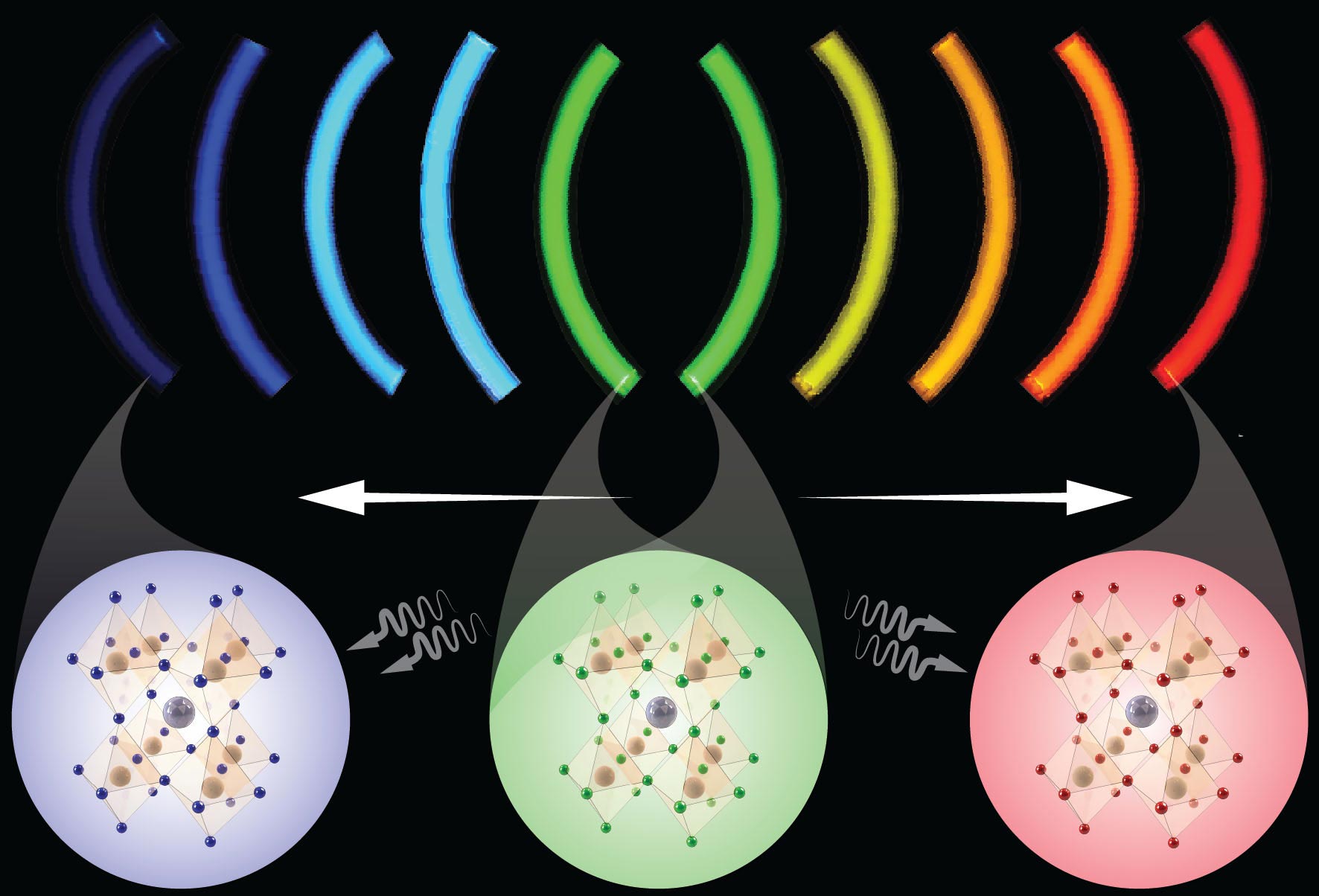
Scientists have discovered a groundbreaking way to fine-tune quantum dots using light instead of traditional chemical methods.
This approach is not only faster and more energy-efficient but also delivers precise control over the material’s optical properties.
Light-Powered Quantum Dot Tuning
Researchers at North Carolina State University have developed a new technique that uses light to adjust the optical properties of quantum dots. This method is faster, more energy-efficient, and environmentally sustainable, all while maintaining material quality.
“The discovery of quantum dots earned the Nobel Prize in chemistry in 2023 because they are used in so many applications,” says Milad Abolhasani, corresponding author of a paper on the work and ALCOA Professor of Chemical and Biomolecular Engineering at NC State. “We use them in LEDs, solar cells, displays, quantum technologies, and so on. To tune their optical properties, you need to tune the bandgap of quantum dots – the minimum energy required to excite an electron from a bound state to a free-moving state – since this directly determines the color of light they emit.
“Existing methods for bandgap tuning of perovskite quantum dots rely on chemical modifications or high-temperature reactions, both of which are energy-intensive and can introduce inconsistencies in the final material properties,” Abolhasani says.
A New, Light-Driven Approach
“Our new approach uses light to drive the reaction, which requires less energy and allows us to be incredibly precise.”
For this work, the researchers started out with green-emitting perovskite quantum dots and placed them in a solution containing either chlorine or iodine. This solution is then run through a microfluidic system that incorporates a light source.
The Role of Microfluidics
The microfluidic environment enables precise reaction control by ensuring uniform light exposure across small solution volumes, approximately 10 microliters per reaction droplet. This is important because the small volume solution allows the light to penetrate the entire sample, and the resulting photochemical reactions take place very rapidly throughout the sample.
The light then triggers reactions that make the green-emitting perovskite quantum dots move closer to the blue end of the spectrum when chlorine is present in the solvent, and closer to the red end of the spectrum when iodine is present in the solvent.
Speed and Efficiency Benefits
“We can control the bandgap by controlling the amount of energy we introduce into the sample, and we control the amount of energy by controlling the light,” Abolhasani says. “This allows us to tune the bandgap very precisely.
“And while we are processing small reaction volumes, the process itself happens very quickly, which means that you ultimately end up producing perovskite quantum dots with tuned bandgaps more efficiently than was possible with previous techniques,” Abolhasani explains.
A More Sustainable Future
“This is a sustainable way to produce high-quality perovskite quantum dots using light. We’re now in the process of scaling up to create perovskite quantum dots for use in optoelectronic devices.”
Reference: “Photo-Induced Bandgap Engineering of Metal Halide Perovskite Quantum Dots In Flow” by Pragyan Jha, Nikolai Mukhin, Arup Ghorai, Hamed Morshedian, Richard B. Canty, Fernando Delgado-Licona, Emily E. Brown, Austin J. Pyrch, Felix N. Castellano and Milad Abolhasani, 11 February 2025, Advanced Materials.
DOI: 10.1002/adma.202419668
The first author of the paper is Pragyan Jha, a Ph.D. student at NC State. The paper was co-authored by Nikolai Mukhin, Fernando Delgado-Licona, Emily Brown, and Austin Pyrch, Ph.D. students at NC State; Arup Ghorai and Richard Canty, postdoctoral researchers at NC State; Hamed Morshedian, a former master’s student at NC State; and Felix Castellano, Goodnight Innovation Distinguished Chair of Chemistry at NC State.
This work was done with support from NC State’s Center for Accelerated Photocatalysis (CAPS), which was funded by the National Science Foundation’s Centers for Chemical Innovation Program under grant 2420490. CAPS is part of NC State’s Integrative Sciences Initiative. The work received additional support from NSF under grant 1940959 and the University of North Carolina Research Opportunities Initiative program.
Never miss a breakthrough: Join the SciTechDaily newsletter.
Follow us on Google and Google News.