
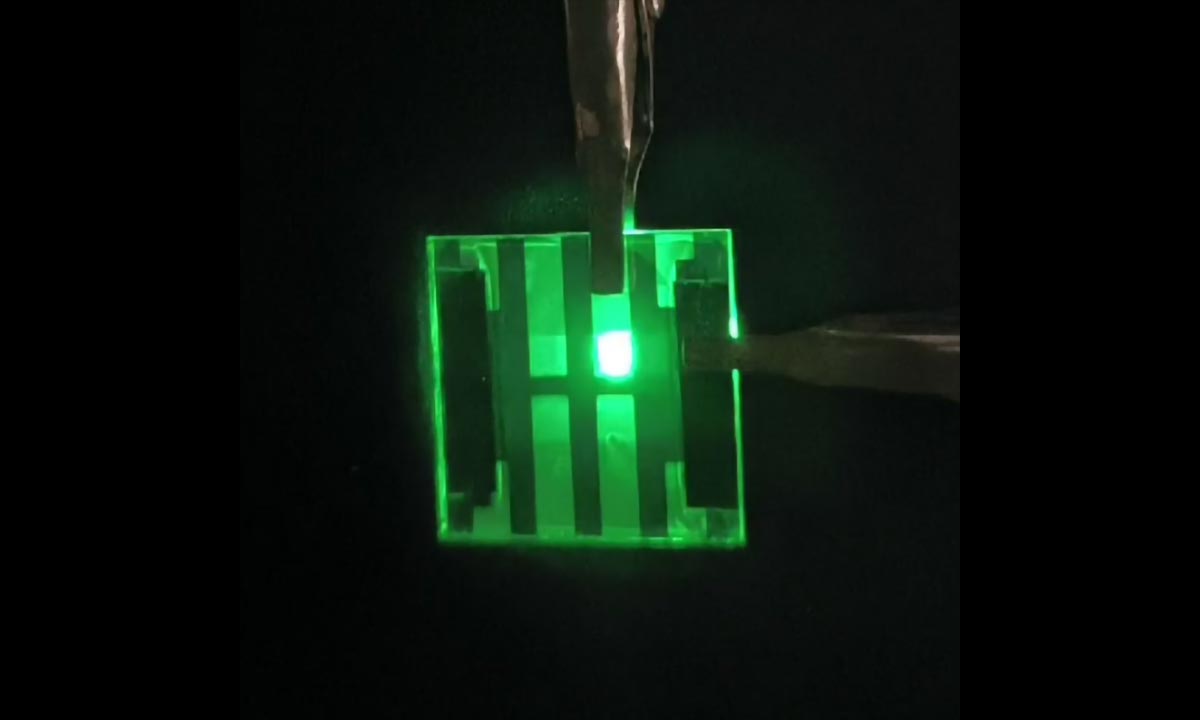
Scientists have created a light as thin as paper that emits a gentle, natural glow similar to sunlight.
By using a precise mix of quantum dots, the team reproduced the full color range of daylight. The design could lead to more comfortable, eye-friendly lighting and next-generation display screens.
Paper-Thin Breakthrough in LED Technology
Light bulbs come in all kinds of designs—globes, spirals, candle-shaped tips, and long tubes—but few are truly slim. Now, scientists reporting in ACS Applied Materials & Interfaces have developed a light-emitting diode (LED) so thin it resembles a sheet of paper. This ultra-flat LED produces a soft, sunlike glow and could play a major role in future displays for phones, computers, and other lighting technologies, all while reducing light exposure that can interfere with healthy sleep.
“This work demonstrates the feasibility of ultra-thin, large-area quantum dot LEDs that closely match the solar spectrum,” says Xianghua Wang, a corresponding author of the study. “These devices could enable next-generation eye-friendly displays, adaptive indoor lighting, and even wavelength-tunable sources for horticulture or well-being applications.”
Chasing Natural Light: The Quest for Sunlike Illumination
Many people prefer indoor lighting that feels natural and creates a relaxing atmosphere. In earlier work, scientists achieved this using flexible LEDs that incorporated red and yellow phosphorescent dyes to produce a soft, candle-like glow. A newer approach replaces these dyes with quantum dots—tiny particles that turn electrical energy into colored light.
While other researchers have used quantum dots to make white LEDs, matching the complete range of colors found in sunlight has been difficult, particularly in the yellow and green regions where the sun’s light is strongest. To overcome this challenge, Lei Chen and colleagues designed quantum dots that could reproduce that natural radiance when used in a thin, white quantum dot LED (QLED). Working with Wang’s group, they also identified an approach to create a conductive material that operates efficiently at relatively low voltage.
Engineering a Solar-Spectrum QLED
The team began by producing red, yellow-green, and blue quantum dots coated with zinc-sulfur shells, then determined the exact blend of the three colors needed to best replicate the spectrum of sunlight. They constructed their QLED on an indium tin oxide glass substrate, layering conductive polymers, the quantum dot mixture, metal oxide particles, and finally a coating of either aluminum or silver. The quantum dot layer measured only a few dozen nanometers in thickness—far thinner than typical color conversion layers—resulting in a white QLED with an overall thickness comparable to wallpaper.
Brighter, Healthier Light With Less Blue
In initial tests, the thin QLED performed best under an 11.5-volt (V) power supply, giving off the maximum bright, warm white light. The emitted light had more intensity in red wavelengths and less intensity in blue wavelengths, which is better for sleep and eye health, according to the researchers. Objects illuminated by the QLED should appear close to their true colors, scoring over 92% on the color rendering index.
In subsequent experiments, the researchers fabricated 26 white QLED devices using the same quantum dots but different electrically conductive materials to optimize the operating voltage. These light sources required only 8 V to reach maximum light output, and about 80% exceeded the target brightness for computer monitors.
Reference: “Sunlike Full-Spectrum Electroluminescent White Light-Emitting Diodes Based on Cu(In,Ga)S2 Quantum Dots Coated with Multiple ZnS Shells” by Fanghai Liu, Hui Jiang, Zhanchuang Lu, Yanpeng Gao, Jiafa Li, Lin Zhou, Syed Aamir Hussain, Ping Chen, Xianghua Wang and Lei Chen, 12 September 2025, ACS Applied Materials & Interfaces.
DOI: 10.1021/acsami.5c10632
The authors acknowledge funding from the National Natural Science Foundation of China, the Natural Science Foundation of Anhui Province, and the Major Science and Technology Special Project of Zhongshan City.
Never miss a breakthrough: Join the SciTechDaily newsletter.
Follow us on Google and Google News.
2 Comments
So not “natural sunlight ” at all but totally artificial sunlight.
Sounds pretty good to me.