

A rare fossil in Dominican amber unveils a miniature, ancient “dirt ant” once native to the Caribbean.
Ants are a common sight wherever soil is found, but one group is so expertly camouflaged that they have earned the exclusive name “dirt ants” (Basiceros).
A newly uncovered fossil is now offering new insight into just how far these elusive ants once roamed.
In a study published in the Proceedings of the Royal Society B, biologists from the New Jersey Institute of Technology (NJIT) have documented the first fossilized Basiceros dirt ant discovered in the Caribbean. The specimen, an adult worker, was preserved in 16-million-year-old amber from the Dominican Republic.
Discovery expands Basiceros history
According to researchers, the fossilized adult worker ant belongs to a newly identified species named Basiceros enana, which is significantly smaller than its living counterparts. This discovery provides direct evidence that this secretive ant lineage once lived on the Caribbean islands but later disappeared from the region during the Miocene epoch (23 to 5.3 million years ago).
“Dirt ants are rare finds in the wild. Finding one today is exciting given how well they stay hidden, but captured in amber, it’s like finding a diamond,” said Gianpiero Fiorentino, corresponding author of the study and Ph.D. candidate at NJIT’s Barden Lab. “This fossil is singularly distinct from all its modern relatives and reshapes the evolutionary history of Basiceros.”
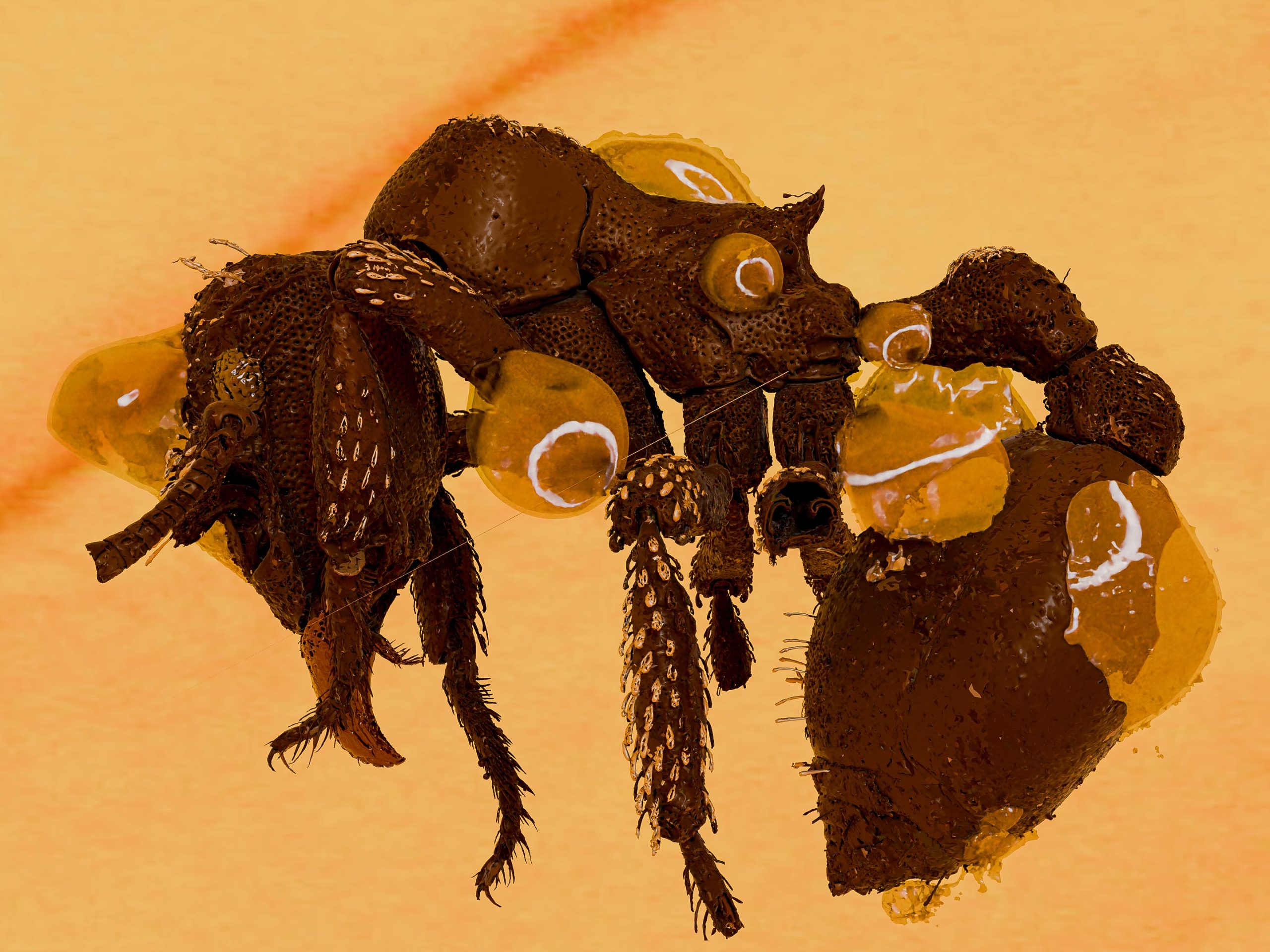
Previously, Basiceros ants were only documented in neotropical rainforests spanning from Costa Rica to southern Brazil, where they are recognized for their skillful camouflage using dirt-binding hairs on their bodies. With nine known living species in the genus, this surprising fossil find now prompts new questions about how these ants came to occupy their current range.
“Often lineages will have what appear to be fairly straightforward biogeographic histories. If you find a group of animals that only live in South America up to Costa Rica today, you really have no reason to expect that their early relatives lived in the Caribbean,” said Phil Barden, the paper’s senior author and associate professor of biology at NJIT. “A fossil like this underscores how the distribution of living species can belie the complex evolutionary history of life on our planet.”
Advanced imaging reveals new details
To investigate this previously unknown part of Basiceros’ history, researchers used high-resolution imaging and 3D reconstruction at NJIT and the Okinawa Institute of Science and Technology Graduate University in Japan to closely examine Basiceros enana. “The use of Micro-CT scanning really amplified this study, enabling us to capture features that were virtually impossible to see otherwise,” said Fiorentino.
The team analyzed the fossil’s physical traits and compared them with those of all existing dirt ant species. They also performed molecular dating to determine its place in the ant’s evolutionary timeline. “Because amber preserves entire organisms in three dimensions, we can extract a ton of data from even a tiny ant,” Barden explained.
Artistic rendition of Basiceros enana preserved in Dominican amber from CT-scan data. Specialized hairs used for picking up dirt can be seen highlighted in yellow covering the ants’ legs and head. Credit: Gianpiero Fiorentino (NJIT)
At just 5.13 millimeters in length, Basiceros enana is significantly smaller than its modern counterparts, some of which grow up to nearly 9 millimeters. This makes it the smallest known member of the genus so far.
“Our results show that the embiggening of these ants was relatively rapid,” explained Fiorentino. “They almost doubled in size in the span of 20 million years. Previous hypotheses suggested that these ants were ancestrally large and shrank over time, so this flips that on its head and really illustrates how important fossils can be to understanding the evolution of a lineage.”
Ancient crypsis adaptations
However, Basiceros enana also suggests some of the same adaptations that make modern dirt ants nearly invisible to predators and prey in their environment (an ability known as crypsis) were already in place at least 16 million years ago.
These features include two layers of specialized hairs (or setae) for adhering soil and leaf litter particles against their bodies: longer erect “brush hairs” and shorter, appressed “holding hairs” that trap particles against their exoskeleton, or cuticle.
“What this shows is that playing dead and hiding pays off,” said Fiorentino. “Uncovering a unique fossil like this helps us understand how long organisms may have been employing this strategy, though the presence of these characteristics does not necessarily guarantee they behaved in this way.”
The fossil ant also possesses other distinctive morphological characteristics like today’s dirt ants, including an upturned propodeal spine, a trapezoid-like head structure, as well as predatory features such as mandibles with 12 triangular teeth.
Why did they disappear?
Despite these specialized adaptations, the ancient Caribbean dirt ants ultimately vanished from the region during significant ecological changes of the Miocene.
“The presence of Basiceros in Dominican amber suggests ancient land bridges may have provided pathways for these ants to traverse from the mainland to the Caribbean,” Barden said. “This fossil is a piece of a larger puzzle that will help us understand why some groups of organisms undergo extinction and others stick it out for millions of years.”
“Their extinction could have come down to a loss of available niches or interspecific competition. These ants are predators, and an overall trend that we see from the Caribbean is a loss of predator ant diversity,” said Fiorentino. “Over a third of ant genera have gone extinct on the island of the modern-day Dominican Republic since the formation of Dominican amber.
“Understanding what has driven this pattern of local extinction is crucial to mitigating modern human-driven extinction and protecting biodiversity.”
Reference: “A fossil-informed pattern of body size increase and local extinction in Basiceros dirt ants (Hymenoptera: Formicidae)” by Gianpiero Fiorentino, Rodolfo Probst, Adrian Richter, Evan P. Economo and Phillip Barden, 16 April 2025, Proceedings B.
DOI: 10.1098/rspb.2024.2171
Never miss a breakthrough: Join the SciTechDaily newsletter.
Follow us on Google and Google News.