
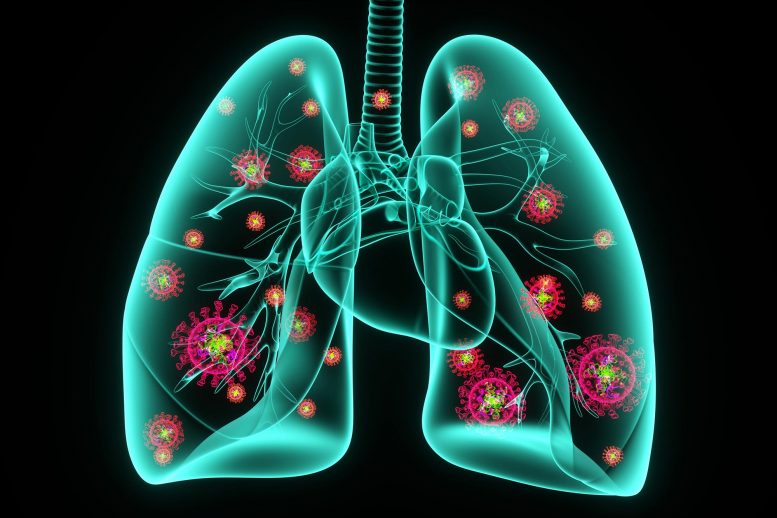
COVID-19 pneumonia spreads like multiple wildfires, leaving destroyed lung tissue in its wake.
- ‘This effort truly represents a “moonshot” in COVID-19 research’
- Scientists identify targets to treat COVID-19 pneumonia and reduce severity
- Clinical trials with new experimental drug to begin early in 2021
- Goal is to develop treatments that make COVID-19 no worse than a common cold
- First comparison between immune mechanisms driving COVID-19 pneumonia with other pneumonias
Bacteria or viruses like influenza that cause pneumonia can spread across large regions of the lung within hours. In the modern intensive care unit, these bacteria or viruses are usually controlled either by antibiotics or by the body’s immune system within the first few days of the illness. But in a study published in Nature on January 11, investigators at Northwestern Medicine show COVID-19 pneumonia is different.
Instead of rapidly infecting large regions of the lung, the virus-causing COVID-19 sets up shop in multiple small areas of the lung. It then hijacks the lungs’ own immune cells and uses them to spread across the lungs over a period of many days or even weeks, like multiple wildfires spreading across a forest. As the infection slowly moves across the lungs, it leaves damage in its wake and continuously fuels the fever, low blood pressure, and damage to the kidneys, brain, heart, and other organs in patients with COVID-19.
The severe complications of COVID-19 compared with other pneumonias might be related to the long course of disease rather than more severe disease, the study authors said.
This is the first study in which scientists analyzed immune cells from the lungs of COVID-19 pneumonia patients in a systematic manner and compared them to cells from patients with pneumonia from other viruses or bacteria.
Drug Trial To Treat Newly Discovered Targets in COVID-19 Pneumonia
As a result of the detailed analysis, researchers identified critical targets to treat severe SARS-CoV-2 pneumonia and lessen its damage. The targets are the immune cells: macrophages and T cells. The study suggests macrophages – cells typically charged with protecting the lung – can be infected by SARS-CoV-2 and can contribute to spreading the infection through the lung.
Northwestern Medicine will test an experimental drug to treat these targets in COVID-19 pneumonia patients in a clinical trial early in 2021. The drug to be tested quiets the inflammatory response of these immune cells, thus enabling the initiation of the repair process in the injured lung.
Aim To Make COVID-19 Like a Bad Cold
“Our goal is to make COVID-19 mild instead of severe, making it comparable to a bad cold,” said study co-senior author Dr. Scott Budinger, chief of pulmonary and critical care medicine at Northwestern University Feinberg School of Medicine and Northwestern Medicine.
“This effort truly represents a ‘moonshot’ in COVID-19 research,” said study co-senior author Dr. Richard Wunderink, professor of pulmonary and critical care medicine at Feinberg and medical director of Northwestern Medicine’s ICU.
COVID-19 Unlikely To Completely Disappear
COVID-19, like influenza, is unlikely to ever go away, even if much of the population is vaccinated, said senior co-author Dr. Ben Singer, assistant professor of pulmonary and critical care medicine at Feinberg and a Northwestern Medicine physician.
“Already, researchers at Northwestern and elsewhere are anticipating mechanisms by which this RNA virus, which mutates quickly, will evade current vaccines,” Singer said. “This study will help us develop treatments to reduce the severity of COVID-19 in those who develop it.”
Mortality in COVID-19 Patients on Ventilators Lower Than Regular Pneumonia Patients
The study also revealed why the mortality among patients on a ventilator for COVID-19 was lower than patients on a ventilator due to regular pneumonia, the study reports. An intense conflagration in the lungs (regular pneumonia) has a higher risk of death. Those with COVID-19 pneumonia are sick for a long time, but the inflammation in their lungs is not as severe as regular pneumonia.
“If patients with COVID-19 are carefully managed and the health care system isn’t overwhelmed, you can get them through it,” Budinger said. “These patients are very sick. It takes a really long time for them to get better. But If you have enough beds and health care providers, you can keep the mortality to 20%. When health systems are overwhelmed mortality rates double up to 40%.”
For the study, scientists performed a high-resolution analysis of the lung fluid of 86 COVID-19 patients on a ventilator and compared it with lung fluid from 256 patients on a ventilator who had other types of pneumonia. Because of the safety concerns, only a handful of groups around the world performed analysis of the immune response in the lungs of patients with COVID-19. As a result, important information about what was killing patients with severe COVID-19 was missing.
Northwestern Scientists, Studying Pneumonia for Years, Poised for COVID Lung Research
The study performed at Northwestern Medicine is unique because Wunderink and colleagues have been studying pneumonia for years before the pandemic. As a result, when the COVID-19 pandemic hit, they were prepared to collect fluid from the lungs of these patients in a safe and systematic manner and compare it with fluid collected from other ICU patients with pneumonia collected before the pandemic. This research infrastructure allowed them to show that pneumonia in patients with COVID-19 is different from other pneumonia, and more importantly, how it is different.
Scientists took cells from patients’ lung fluid and looked at the RNA and the proteins those cells express, enabling them to identify how these immune cells drive inflammation.
”This level of resolution could never be achieved without directly sampling lung fluid,” said study co-senior author Dr. Alexander Misharin, an assistant professor of pulmonary and critical care medicine at Feinberg and a Northwestern Medicine physician.
The complex nature of the study, in which samples from patients were analyzed with the most sophisticated technologies available in Northwestern’s state-of-the-art research labs, required the concerted effort of more than 100 researchers.
Reference: “Circuits between infected macrophages and T cells in SARS-CoV-2 pneumonia” by Rogan A. Grant, Luisa Morales-Nebreda, Nikolay S. Markov, Suchitra Swaminathan, Melissa Querrey, Estefany R. Guzman, Darryl A. Abbott, Helen K. Donnelly, Alvaro Donayre, Isaac A. Goldberg, Zasu M. Klug, Nicole Borkowski, Ziyan Lu, Hermon Kihshen, Yuliya Politanska, Lango Sichizya, Mengjia Kang, Ali Shilatifard, Chao Qi, Jon W. Lomasney, A. Christine Argento, Jacqueline M. Kruser, Elizabeth S. Malsin, Chiagozie O. Pickens, Sean B. Smith, James M. Walter, Anna E. Pawlowski, Daniel Schneider, Prasanth Nannapaneni, Hiam Abdala-Valencia, Ankit Bharat, Cara J. Gottardi, G. R. Scott Budinger, Alexander V. Misharin, Benjamin D. Singer, Richard G. Wunderink and The NU SCRIPT Study Investigators, 11 January 2021, Nature.
DOI: 10.1038/s41586-020-03148-w
First authors are Rogan Grant, Luisa Morales-Nebreda, and Nikolay Markov. Grant is a graduate student in the Northwestern University Interdepartmental Neuroscience program; Dr. Luisa Morales-Nebreda is a pulmonary and critical care fellow in the Physician Scientist Training Program at Northwestern; Nikolay Markov is a computational postdoctoral fellow in the division of pulmonary and critical care medicine.
The work was done as part of a consortium of investigators participating in the Successful Clinical Response in Pneumonia Therapy Systems Biology Center funded by the National Institute of Allergy and Infectious Diseases led by Wunderink.
The research was supported by a NUCATS COVID-19 Rapid Response Grant and grants T32AG020506-18, by T32HL076139 and F32HL151127, HL145478, HL147290, HL147575, GM129312, HL134800, U19AI135964, P01AG049665, P01AG04966506S1, R01HL147575, I01CX001777, U19AI135964, P01AG049665, R56HL135124, R01HL153312, K08HL128867, U19AI135964, R01HL149883, and P01AG049665 from the National Institutes of Health. It also was funded by a GlaxoSmithKline Distinguished Scholar in Respiratory Health grant from the CHEST Foundation.
Never miss a breakthrough: Join the SciTechDaily newsletter.
Follow us on Google and Google News.
1 Comment
This is serious???
“the mortality among patients on a ventilator for COVID-19 was lower than patients on a ventilator due to regular pneumonia, the study reports”