
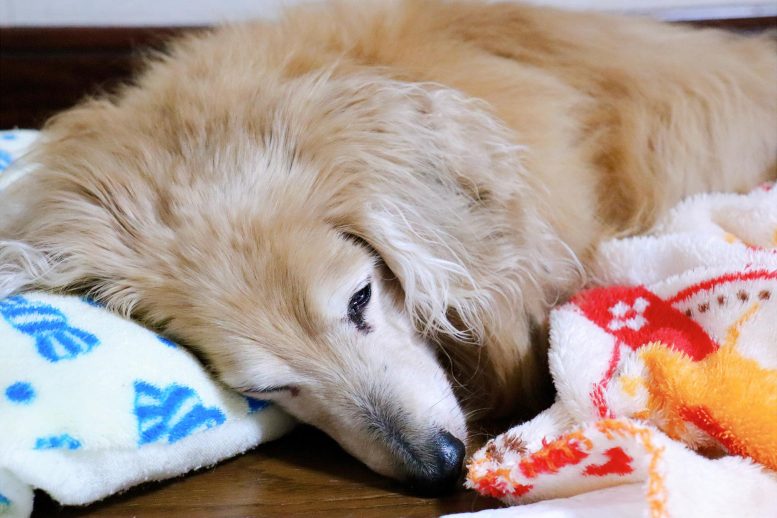
Dogs with higher dementia scores and worse performance in problem-solving task show changes in brain waves symptomatic of shallow sleep.
A study found that dogs with canine cognitive dysfunction syndrome (CCDS) exhibit changes in sleep patterns and brain waves similar to human Alzheimer’s patients, indicating shallower sleep and disrupted sleep rhythms.
In people with Alzheimer’s, the earliest symptoms are commonly disruptions in sleep rhythms. These include daytime sleepiness, showing agitation or confusion around dusk, staying awake longer, and waking up often at night. These changes are thought to result from damage to sleep-regulating areas in the brain. Alzheimer patients tend to spend less time in both REM (rapid eye movement) sleep, in which most dreaming occurs, and non-REM (NREM) sleep. But they show the greatest reduction in so-called slow-wave sleep (SWS) – a stage of non-dreaming deep sleep, characterized by slow ‘delta’ brain waves (0.1 to 3.5 Hz) – when day-time memories are consolidated.
Now, scientists have shown that the same reduction in sleep time and delta brain waves occurs in dogs with the canine equivalent of dementia, canine cognitive dysfunction syndrome (CCDS). These dogs thus sleep less and less deeply. The results were published on April 28, 2023, in the journal Frontiers in Veterinary Science.
“Our study is the first to evaluate the association between cognitive impairment and sleep using polysomnography – the same technique as used in sleep studies in people – in aged dogs,” said senior author Dr. Natasha Olby, a professor of veterinary neurology and neurosurgery at North Carolina State University.
Old Dogs With or Without Dementia
Olby and colleagues studied 28 female and male senior mixed- and full-breed dogs between 10.4 and 16.2 years of age, which corresponds to between 81% and 106% of their average lifespan, depending on size. Their owners were asked to fill in a questionnaire about their canine companions, to rate the severity of symptoms of CCDS like disorientation, poor social interactions, and house soiling. The researchers also examined the dogs for possible orthopedic, neurological, biochemical, and physiological co-morbidities.
Based on the results, eight dogs (28.5%) were classified as normal, while another eight (28.5%), four (14.3%), and eight (28.5%) had mild, moderate, or severe CCDS, respectively.
The researchers then performed a series of cognitive tests on the dogs, to measure their attention, working memory, and executive control. For example, in the ‘detour task’, a dog had to retrieve a treat from a horizontal transparent cylinder by accessing it from either end – this task is then made more difficult by blocking off her or his preferred side so they have to show cognitive flexibility to detour to the other end of the cylinder.
Sleep Clinic for Dogs
Then, first author Dr. Alejandra Mondino (a postdoctoral fellow in Olby’s research group) and colleagues performed a polysomnography studies in a quiet room with dim light and white noise in a ‘sleep clinic’. The dogs were allowed to spontaneously take an afternoon noon nap, while electrodes measured their brain waves, the electrical activity of the muscles and heart, and eye movements. These measurements lasted up to two hours, but were stopped if the dogs became anxious, attempted to leave the room, or removed the electrodes. 26 (93%) dogs entered drowsiness, 24 (86%) entered NREM sleep, while 15 (54%) entered REM sleep.
The results showed that dogs with higher dementia scores, and dogs who did worse on the detour task, took longer to fall asleep and spent less time sleeping, and this was true for both NREM and REM sleep.
Dogs with poorer memory scores showed changes, such as fewer slow oscillations in their electroencephalograms, during REM sleep, indicating that they slept less deeply during this phase.
“In people, slow brain oscillations are characteristic of SWS and linked to the activity of the so-called ‘glymphatic system, a transport system that removes protein waste products from the cerebrospinal fluid,” said Olby.
“The reduction in slow oscillations in people with Alzheimer’s, and the associated reduced removal of these toxins, has been implicated in their poorer memory consolidation during deep sleep.”
In contrast, dogs with poorer memory had more pronounced fast beta waves, between 15.75 and 19 Hz. Strong beta waves are typical of wakefulness in healthy people and dogs, so are not a normal phenomenon during sleep – again indicating that dogs with CCDS sleep less deeply.
Day Sleeping Versus Night Sleeping
Dogs that did worse at the ‘sustained gaze’ task, which measures attention span, showed tighter coupling in delta waves between the two brain hemispheres – a result that has also been found in people with dementia.
The authors concluded that the dogs with CCDS showed changes in the sleep-wakefulness cycle during the experiments that resemble those found in people with Alzheimer’s. But they caution that it’s still unknown if these changes also occur during when dogs sleep at night instead of in the afternoon.
“Our next step will be to follow dogs over time during their adult and senior years to determine if there are any early markers in their sleep-wakefulness patterns, or in the electrical activity of their brain during sleep, that could predict the future development of cognitive dysfunction,” said Olby.
Reference: “Sleep and cognition in aging dogs. A polysomnographic study” by Alejandra Mondino, Magaly Catanzariti, Diego Martin Mateos, Michael Khan, Claire Ludwig, Anna Kis, Margaret E. Gruen and Natasha J. Olby, 28 April 2023, Frontiers in Veterinary Science.
DOI: 10.3389/fvets.2023.1151266
Never miss a breakthrough: Join the SciTechDaily newsletter.
Follow us on Google and Google News.