
Close Menu
    Facebook X (Twitter) Instagram
    SciTechDaily
    • Biology
    • Chemistry
    • Earth
    • Health
    • Physics
    • Science
    • Space
    • Technology
    Facebook X (Twitter) Pinterest YouTube RSS
    SciTechDaily
    Home»Biology»Listen to the Strange “Singing” of a Possible New Species of Mammal Found in Africa’s Montane Forests
    Biology

    Listen to the Strange “Singing” of a Possible New Species of Mammal Found in Africa’s Montane Forests

    By University of HelsinkiDecember 28, 20201 Comment2 Mins Read
    Facebook Twitter Pinterest Telegram LinkedIn WhatsApp Email Reddit
    Share
    Facebook Twitter LinkedIn Pinterest Telegram Email Reddit
    Tree Hyrax
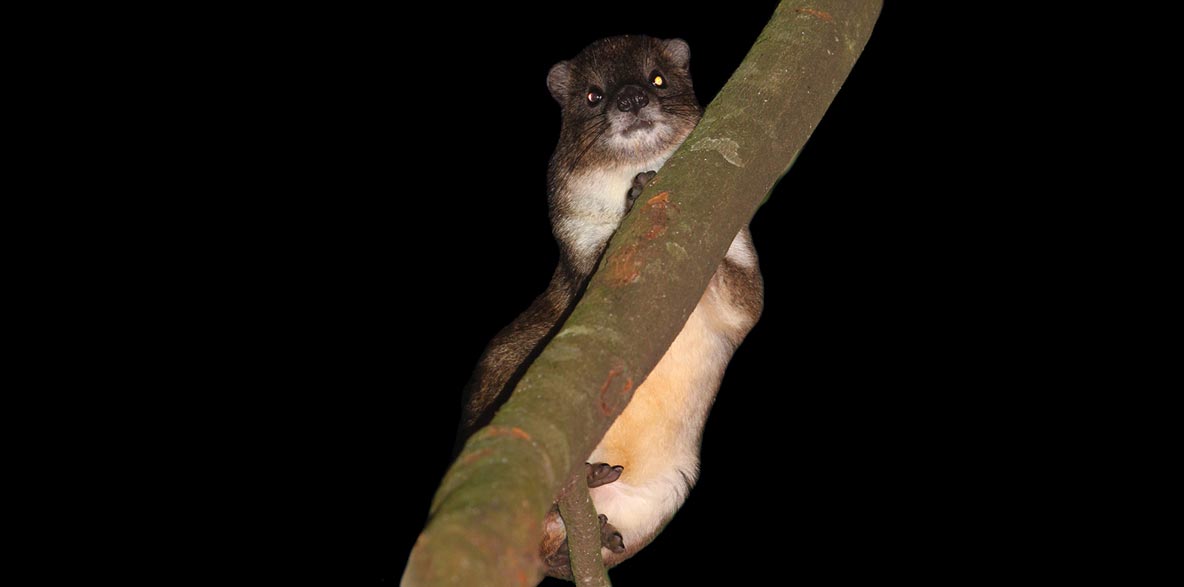
    Tree hyrax from Taita Hills, Kenya. Credit: Hanna Rosti

    A research team from the University of Helsinki has discovered a tree hyrax in the Taita Hills, Kenya, which may belong to a species previously unknown to science.

    The discovery, which was part of a study of the vocalizations of nocturnal animals in the Taita Hills, was published in mid-December in the scientific journal Diversity.

    Very little is known about the diversity and ecology of tree hyraxes because these animals, which look like large guinea pigs but are distant relatives of elephants, are mainly active at night in the tree canopies in Africa’s tropical forests. These animals are known to be able to scream with the strength of more than one hundred decibels, but the ‘strangled thwack’ calls that have been recorded in Taita’s forests have not been described anywhere else.

    The re­cord­ings re­veal that the Taita tree hyraxes sing

    The tree hyrax song may continue for more than twelve minutes, and it consists of different syllables that are combined and repeated in various ways.

    “The singing animals are probably males attempting to attract females that are willing to mate,” postulates Hanna Rosti, who spent three months in Taita’s forests, following the nocturnal mammals and recording their vocalizations.

    Vocal sample — The ‘strangled thwack’ scream of the tree hyrax:

    https://scitechdaily.com/images/Strangled-Thwack.mp3

    Vocal sample — The song of the tree hyrax:

    https://scitechdaily.com/images/Tree-Hyrax-Song.mp3

    The results suggest that the two populations of dwarf galago in the Taita Hills may belong to different species. The calls of the animals of the smaller population are very similar to those of the Kenya coast dwarf galago, a species that has previously been thought to live only in coastal, low elevation forests. The peculiar calls of the second population cannot yet be linked with certainty to any known species.

    “The taxonomy of many nocturnal mammals remains poorly known, and many populations have not been studied at all yet,” says researcher Henry Pihlström, who reviewed the complex taxonomy of tree hyraxes and galagos for the published study.

    Reference: “Vocalization Analyses of Nocturnal Arboreal Mammals of the Taita Hills, Kenya” by Hanna Rosti, Henry Pihlström, Simon Bearder, Petri Pellikka
    and Jouko Rikkinen, 13 December 2020, Diversity.
    DOI: 10.3390/d12120473

    Never miss a breakthrough: Join the SciTechDaily newsletter.
    Follow us on Google and Google News.

    Biodiversity New Species Popular University of Helsinki
    Share. Facebook Twitter Pinterest LinkedIn Email Reddit

    Related Articles

    New Species of Bizarre, Extinct Lizard – So Strange It Was Misidentified as a Hummingbird-Sized Dinosaur

    Large New Amphibious Centipede Species Discovered in Okinawa and Taiwan

    “Spectacular” New Species of Bat Discovered in African “Sky Island”

    Remarkable New Species of Snake Found Hidden in a Biodiversity Collection – Occupies Its Own Branch on Snake Tree of Life

    New Centipede Discovered on Top of Food Chain in Hellish Ecosystem of a Sulfur-Soaked Romanian Cave

    Scientists Say Gentoo Penguins Are Four Species, Not One

    New Species Found in the Hottest Place on Earth

    New Green Pit Viper From India Named After Salazar Slytherin From Harry Potter

    Incredible New Species Discovered in Abyssal Deep Sea Canyons Off Ningaloo

    1 Comment

    1. John Metz on December 29, 2020 10:08 am

      The second recording sounds like it’s an imitation of the local bird calls. As if it evolved in an area where more birds are available for it to imitate.

      Reply
    Leave A Reply Cancel Reply

    • Facebook
    • Twitter
    • Pinterest
    • YouTube

    Don't Miss a Discovery

    Subscribe for the Latest in Science & Tech!

    Trending News

    These Toads Are Surviving a Deadly Fungus – Scientists May Finally Know Why

    These Brain Cells May Explain Why We Eventually Have To Sleep

    Tomatoes Contain an Invisible Ingredient With Surprising Effects on Liver Health

    World’s First Heat-Powered Cooling System Turns Waste Heat Into Cold

    Antarctica Gained a Record 695 Billion Tons of Ice in Just Two Years

    Don’t Miss: A Brilliant Venus and Glowing Harvest Moon Light Up the Sky

    New Twist on the Einstein Problem Reveals Unexpected Physics

    JWST Captures Stunning Evidence of How Supermassive Black Holes Feed

    Follow SciTechDaily
    • Facebook
    • Twitter
    • YouTube
    • Pinterest
    • Newsletter
    • RSS
    SciTech News
    • Biology News
    • Chemistry News
    • Earth News
    • Health News
    • Physics News
    • Science News
    • Space News
    • Technology News
    Recent Posts
    • Scientists Discover a Hidden Defect That Could Explain Why IBD Keeps Coming Back
    • Millions Take Blood Pressure Drugs, but Many May Be Missing Their Heart-Protective Benefits
    • Could Alien Life Be Conscious in Ways We Can’t Imagine?
    • Scientists Develop a Fruit Wash That Removes Pesticide Residues and Keeps Produce Fresh Longer
    • Scientists May Have Finally Explained Why Astronauts Get Constipated in Space
    Copyright © 1998 - 2026 SciTechDaily. All Rights Reserved.
    • Science News
    • About
    • Contact
    • Editorial Board
    • Privacy Policy
    • Terms of Use

    Type above and press Enter to search. Press Esc to cancel.