
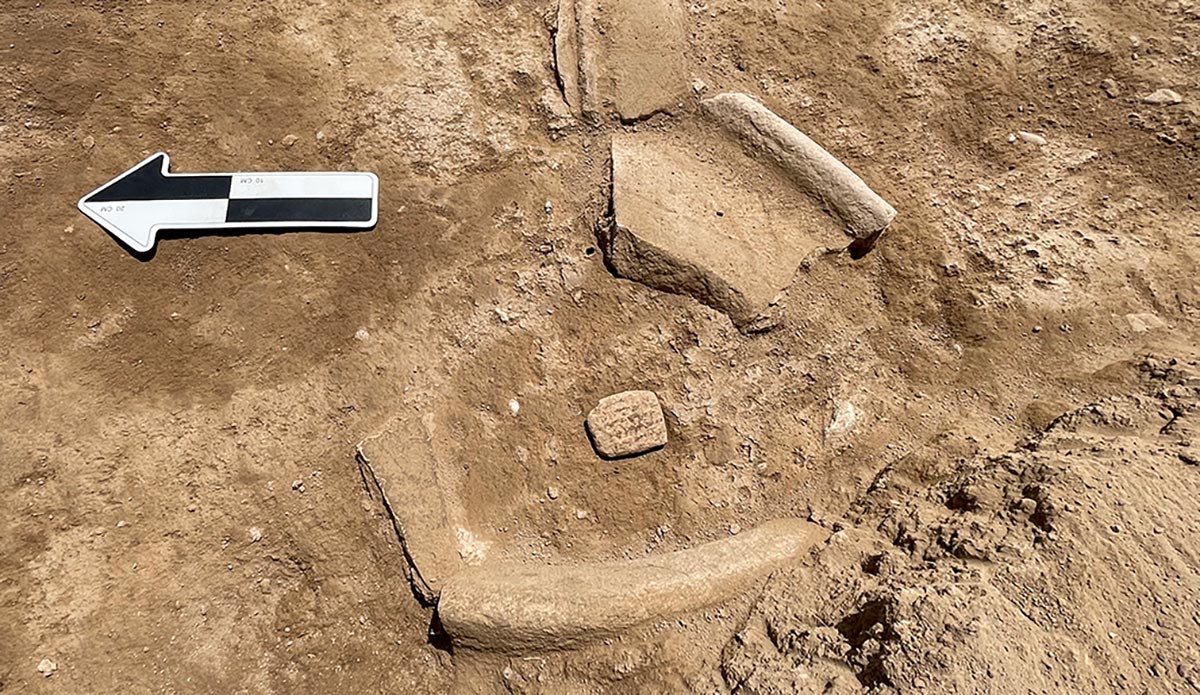
New findings at Kurd Qaburstan, including clay tablets and monumental ruins, reveal insights into Middle Bronze Age life and may link the site to the ancient city of Qabra.
New discoveries at the ancient Mesopotamian site of Kurd Qaburstan by University of Central Florida (UCF) associate professor Tiffany Earley-Spadoni and her research team are offering valuable insights into the Middle Bronze Age city and the hidden history of Mesopotamia.
Among the findings are clay tablets inscribed with ancient cuneiform writing—the first of their kind uncovered in this region—along with a game board and large structural remains. These artifacts are still under analysis, but early interpretations suggest they reveal important details about the daily lives of the city’s inhabitants and the significant historical events they experienced.
Kurd Qaburstan, located in the Erbil region of northeast Iraq, has been the focus of meticulous excavation by Earley-Spadoni and her team as they work to uncover culturally significant remnants from around 1800 BCE.
A significant portion of human development and history may be traced back to the ancient civilization of Mesopotamia, in and around present-day Iraq.
The study of these new tablets could reveal important details about the city’s connections with its neighbors during the Middle Bronze Age and its historical significance. For example, by studying people’s names, word choice and writing styles, scholars may better understand literacy in the region and the city’s cultural identity, Earley-Spadoni says in her fieldwork summary.
A Hidden History
The Middle Bronze Age in northern Iraq is poorly understood due to limited prior research and the inherent biases of the available historical sources, she says.
“We hope to find even more historical records that will help us tell the story of [the city] from the perspective of its own people rather than relying only on accounts written by their enemies,” Earley-Spadoni says. “While we know a great deal about the development of writing in southern Iraq, far less is known about literacy in northern Mesopotamian cities, especially near Erbil where Kurd Qaburstan is located.”
Mesopotamia, with its dense network of ancient cities in the fertile plains along the Tigris and Euphrates rivers near the Persian Gulf, is often regarded as the birthplace of urban civilization. These cities, preserved as towering tells, mounds formed by centuries of accumulated cultural debris, have captivated scholars for generations.
“We know quite a bit about Mesopotamian cities in the south, and that’s considered the traditional heartland of cities,” Earley-Spadoni says. “When people think about where cities first arose, they imagine cities in southern Iraq, like Uruk. We seek to fill in this gap in the scholarship by investigating a large urban site, one of the few that’s ever been investigated in northern Iraq.”
New Areas Uncovered, New Questions Raised
Earley-Spadoni and researchers have been working in two primary areas: the northwest residential neighborhoods and a newly discovered administrative complex identified as a lower town palace, which was theorized to exist based on findings made in 2022.
Researchers used technologies such as magnetometry, which allows researchers to peer through the ground to see architectural plans, to help excavate the site.
The research is valuable its own right and helps shed light on regional history and worldwide heritage, she says.
“The focus of the research is the organization of ancient cities, and it’s specifically the organization of Kurd Qaburstan,” Earley-Spadoni says. “You may have heard of King Hammurabi, who erected the famous law code. So, this is about that same time almost 4,000 years ago. We decided that this would be an interesting place to investigate what it was like to be an everyday person at a city during the Middle Bronze Age, which has been an understudied topic. People like to excavate palaces and temples, and very few residential areas have been excavated.”
Excavations in the palace revealed monumental architecture, human remains, and evidence of destruction, suggesting a significant historical event. The complex, identified through geophysical surveys, is being excavated to establish its characteristics and better understand its function.
In the northwest neighborhoods, exterior courtyards, clay drainpipes, and household refuse were uncovered. Excavated pottery included everyday items such as cups, plates, bowls and storage jars. Some of the pottery was surprisingly well-decorated and carefully made, hinting that private wealth may have been more common than expected, Earley-Spadoni says in her fieldwork summary report.
Animal bones found with the pottery suggest that residents enjoyed a varied diet, including domesticated meat and wild game. This level of dietary diversity is unexpected for non-elite populations in Mesopotamian cities, based on limited current evidence.
These findings may challenge ideas about sharp divisions between elite and non-elite lifestyles in ancient cities. The material culture and dietary practices reflect a community where some people lived relatively well and suggest that further research and analysis are needed to answer lingering questions, Earley-Spadoni says.
“We’re studying this ancient city to learn very specific things about the ancient inhabitants,” she says. “First, to what degree did they plan their environment, or was it just the result of an organic process? We also want to know how social inequality worked in this ancient city. Were there very poor people and very rich people? Or was there possibly a middle class?”
Encouraging Findings and a Promising Future
The city’s historical importance could be even greater if it is identified as Qabra, a major regional center referenced in Old Babylonian monuments like the famed Stele of Dadusha, according to Earley-Spadoni.
There are many clues that give credence to the theory that Kurd Qaburstan was the prominent city of Qabra that has been referenced in Old Babylonian steles – or ancient monumental slabs. One such clue is that there are ample signs pointing to Kurd Qaburstan serving as a major regional administrative hub, she says.
“Kurd Qaburstan is believed to be ancient Qabra, an important regional center mentioned in the records of other city-states,” Earley-Spadoni says. “The presence of writing, monumental architecture, and other administrative artifacts in the lower town palace further supports this identification since the site must have been an important city of its time.”
The tablets are still being interpreted but there are some early encouraging findings that help illuminate the greater identity of the people of Kurd Qaburstan and the era they inhabited, she says.
“The first of the three tablets was discovered in a trash-filled deposit along with building rubble and human remains,” she says. “Its context suggests dramatic events, possibly evidence of ancient warfare. We hope our work in 2025 will tell us more about this story.”
The research and excavation efforts are funded through the U.S. National Science Foundation and in partnership with the Kurdistan Region of Iraq. The work occurred from May to July 2024, with previous work conducted from 2013 to 2023 by a team from Johns Hopkins University that included Earley-Spadoni.
Never miss a breakthrough: Join the SciTechDaily newsletter.
Follow us on Google and Google News.
1 Comment
Now Iraq, then Iran.