
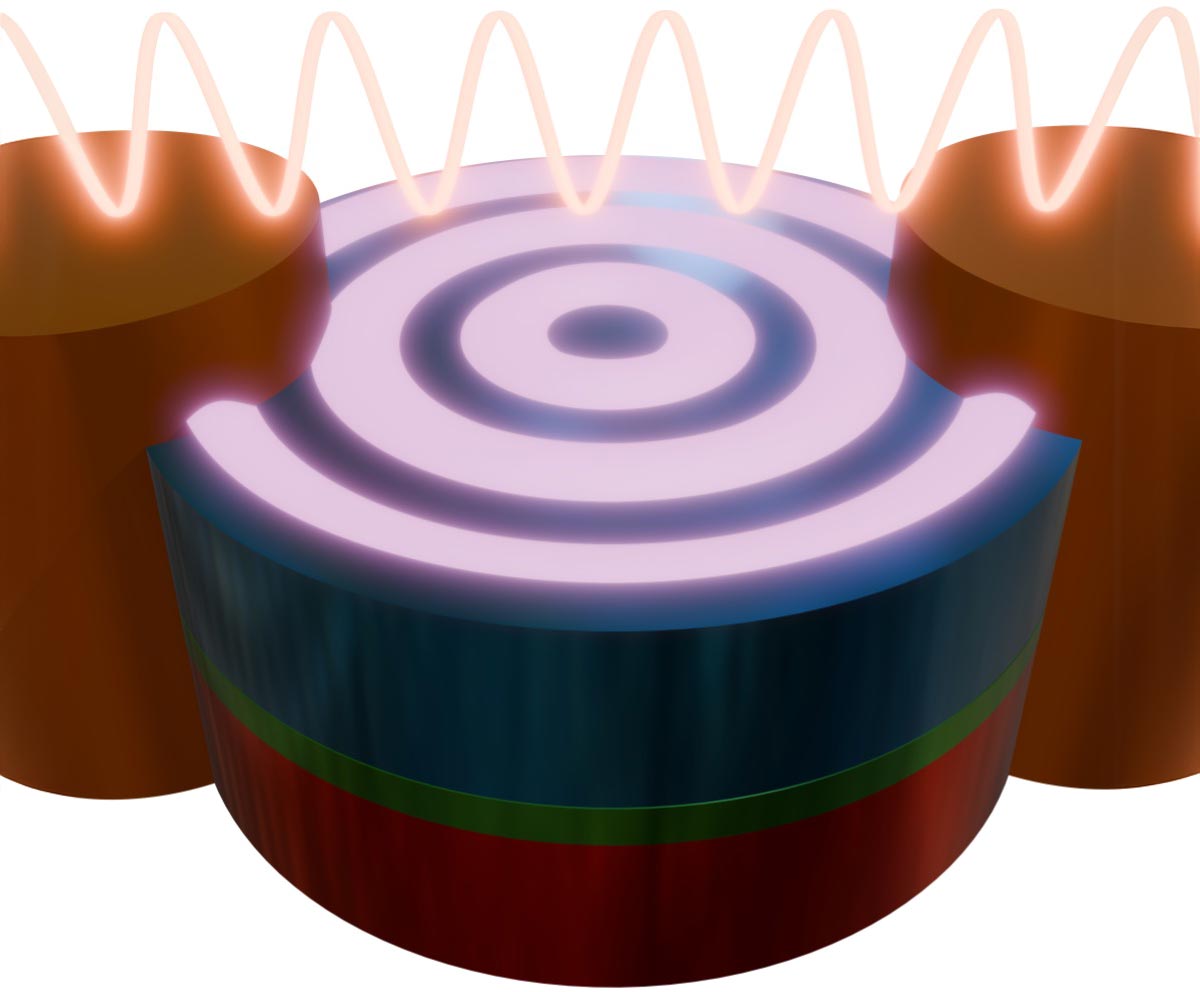
Researchers have developed a groundbreaking method to create more compact and energy-efficient computing devices using magnonic circuits.
By utilizing alternating currents to generate and steer spin waves in synthetic ferrimagnetic vortex pairs, this new approach promises significant advancements over traditional CMOS technology, potentially leading to the next generation of computing systems.
Breakthrough in Computing Miniaturization and Efficiency
The central processing units (CPUs) in our laptops, desktops, and phones rely on billions of transistors built with complementary metal oxide semiconductor (CMOS) technology. As the demand to shrink these devices grows, physical constraints and concerns about their long-term viability have emerged. Moreover, their significant energy consumption and losses are driving the search for alternative computing architectures.
Harnessing Spin Waves for Future Technology
One of the promising candidates is magnons, the quanta of spin waves. “Imagine a calm lake. If we let a stone fall into water, the resulting waves will propagate away from the point of generation. Now, we replace the lake with a magnetic material and the stone with an antenna. The propagating waves are called spin waves and can be used to transfer energy and information from one point to another with minimal losses,” says Sabri Koraltan from the University of Vienna, first author of the recent study published in the journal Science Advances on September 25.
Once generated, the spin waves can be used for magnonic devices to perform classical and unconventional computing tasks.
“To reduce the footprint of magnonic devices, we need to use spin waves with short wavelengths, which are difficult to generate using state-of-the-art nano antennas due to limited efficiency,” adds Sebastian Wintz from Helmholtz-Zentrum Berlin and the coordinator of the research project. Nano antennas can only be fabricated in clean rooms, highly specialized nanofabrication facilities, using advanced lithography techniques.
Innovating With Synthetic Ferrimagnetic Vortex Pairs
In a major leap forward, the researchers from Austria and Germany came up with a much simpler solution: the electric current flows directly through a magnetic stack with swirling magnetic patterns.
“Our research shows that by using a lateral alternating current geometry in synthetic ferrimagnetic vortex pairs, we can achieve spin-wave emission with an efficiency that surpasses conventional methods by several orders of magnitude,” says Sabri Koraltan. Synthetic ferrimagnetic systems have opposite magnetization patterns.
If the upper layer has a clockwise rotating vortex, the lower layer has an anticlockwise sense of rotation. This enables the efficient excitation of the magnetization pattern using the magnetic fields generated by the alternating currents.
“Using our high-resolution ‘Maxymus’ x-ray microscope, based at the BESSY II electron synchrotron in Berlin, we were even able to observe the predicted spin waves at nanoscale wavelengths and Gigahertz frequencies,” adds Sebastian Wintz.
“Moreover, by incorporating special materials, which can change their magnetization when a strain is applied, we have demonstrated that the direction of these spin waves can be dynamically steered by simply adjusting the magnitude of the applied current. This can be regarded as an important step towards active magnonic devices,” completes Sabri Koraltan.
“Our new generation of micromagnetic simulation software, magnum.np, allowed us to perform large-scale simulations, which were crucial to understand the main mechanisms behind this efficient and controllable spin-wave excitation,” adds Dieter Süss, head of the Physics of Functional Materials Department at the University of Vienna.
The ability to redirect spin waves on demand opens up new possibilities for creating reprogrammable magnonic circuits, which could lead to more adaptable and energy-efficient computing systems. The findings, published in Science Advances represent a major advancement in finding new ways to generate magnons for possible next-generation magnon based technologies.
Reference: “Steerable current-driven emission of spin waves in magnetic vortex pairs” by Sabri Koraltan, Katrin Schultheiss, Florian Bruckner, Markus Weigand, Claas Abert, Dieter Suess and Sebastian Wintz, 25 September 2024, Science Advances.
DOI: 10.1126/sciadv.ado8635
Never miss a breakthrough: Join the SciTechDaily newsletter.
Follow us on Google and Google News.
2 Comments
The ability to redirect spin waves on demand opens up new possibilities for creating reprogrammable magnonic circuits, which could lead to more adaptable and energy-efficient computing systems. Swirling Magnons Set to Revolutionize Computing.
VERY GOOD!!!
Scientific research guided by correct theories can help people avoid detours, failures, and exaggeration. The physical phenomena observed by researchers in experiments are always appearances, never the natural essence of things. The natural essence of things needs to be extracted and sublimated based on mathematical theories via appearances , rather than being imagined arbitrarily.
Everytime scientific revolution, the scientific research space brought by the new paradigm expands exponentially. Physics should not ignore the analyzable physical properties of topological vortices.
(1) Traditional physics: based on mathematical formalism, experimental verification and arbitrary imagination.
(2) Topological Vortex Theory: Although also based on mathematics (such as topology), it focuses more on non intuitive geometry and topological structures, challenging traditional physical intuition.
Extension of the Standard Model: Topological Vortex Theory points out the limitations of the Standard Model in describing the large-scale structure of the universe, proposes the need to consider non-standard model components such as dark matter and dark energy, and suggests that topological vortex fields may be key to understanding these phenomena.
Topological vortex theory heralds innovative technologies such as topological electronics, topological smart batteries, topological quantum computing, etc., which may bring low-energy electronic components, almost inexhaustible currents, and revolutionary computing platforms, etc.
Topology tells us that topological vortices and antivortices can form new spacetime structures via the synchronous effect of superposition, deflection, or twisting of them. In fact, mathematics does not tell us that there must be God particles, ghost particles, fermions, or bosons present. If physics and mathematics go their separate ways, physics will be no different from theology.
Today, so-called official (such as PRL, Nature, Science, PNAS, etc.) in physics stubbornly believes that two sets of cobalt-60 rotating in opposite directions can become two sets of objects that mirror each other, is a typical case that pseudoscience is rampant and domineering. Please witness the exemplary collaboration between theoretical physicists and experimentalists (https://scitechdaily.com/microscope-spacecrafts-most-precise-test-of-key-component-of-the-theory-of-general-relativity/#comment-854286).
Let us continue to witness together the dirtiest and ugliest era in the scientific and humanistic history of human society. The laws of nature will not change due to misleading of so-called academic publications.
When physics and mathematics diverge, arbitrary imagination will make physics no different from theology.