
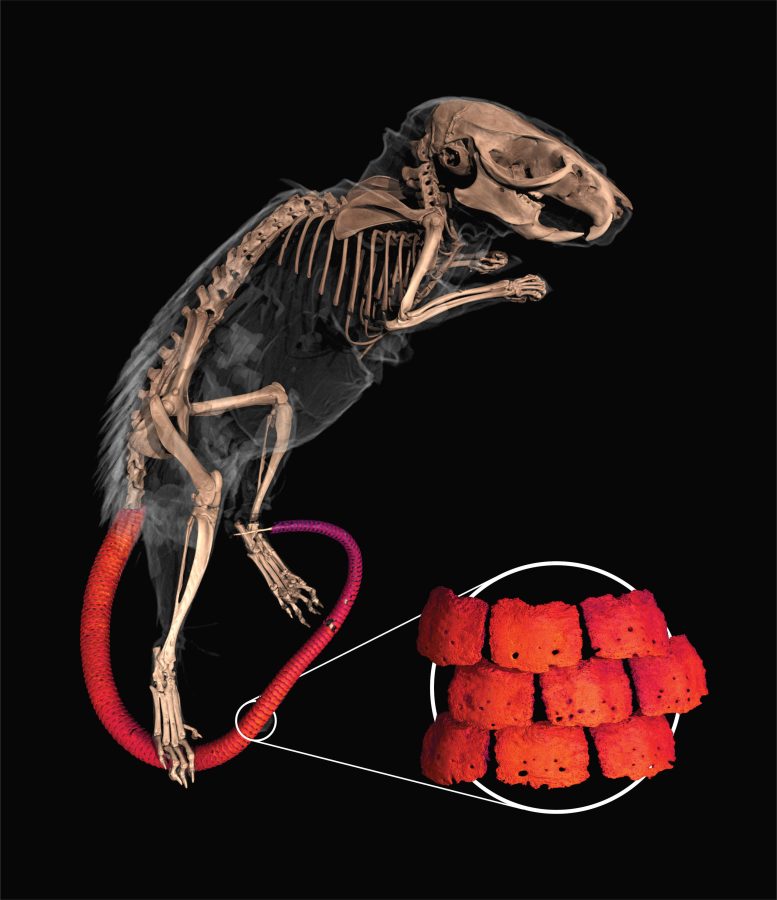
Scientists have found that spiny mice possess hidden bony plates under their tail skin. This feature, overlooked for decades, appears in all spiny mouse species and likely serves as a defense mechanism.
Unlike crocodiles, turtles, lizards, dinosaurs, and fish that possess bony plates and scales, mammals have long since exchanged their ancestral armor for an insulating layer of hair.
Armadillos, boasting a defensive and supple shell of overlapping bones, are thought to be the sole living anomaly. However, a new study published in the journal iScience unexpectedly shows that African spiny mice generate similar structures beneath their tail’s skin, which until now had gone largely undetected.
The discovery was made during routine CT scanning of museum specimens for the openVertebrate program, an initiative to provide 3D models of vertebrate organisms for researchers, educators, and artists.
“I was scanning a mouse specimen from the Yale Peabody Museum, and the tails looked abnormally dark,” said co-author Edward Stanley, director of the Florida Museum of Natural History’s digital imaging laboratory.
He initially assumed the discoloration was caused by an imperfection introduced during the specimen’s preservation. But when he analyzed the X-Rays several days later, Stanley observed an unmistakable feature he was intimately familiar with.
“My entire PhD was focused on osteoderm development in lizards. Once the specimen scans had been processed, the tail was very clearly covered in osteoderms.”
Spiny mice osteoderms have been observed at least once before and were noted by German biologist Jochen Niethammer, who compared their architecture to medieval stonework in an article published in 1975. Niethammer correctly interpreted the plates as being a type of bone but never followed up on his initial observations, and the group was largely overlooked for several decades — until scientists discovered another, seemingly unrelated peculiarity of spiny mice.
The Regenerative Abilities of Spiny Mice
A study from 2012 demonstrated spiny mice can completely regenerate injured tissue without scarring, an ability common in reptiles and invertebrates but previously unknown in mammals. Their skin is also particularly fragile, tearing at roughly one-fourth the amount of force required to injure the skin of a common mouse. But spiny mice can heal twice as fast as their relatives.
Researchers hoping to find a model for human tissue regeneration have begun mapping the genetic pathways that give spiny mice their extraordinary powers of healing. One such researcher, Malcolm Maden, just so happened to have a lab in the building across from Stanley’s office.
“Spiny mice can regenerate skin, muscle, nerves, spinal cord, and perhaps even cardiac tissue, so we maintain a colony of these rare creatures for research,” said Maden, a biology professor at the University of Florida and lead author on the study.
Maden and his colleagues analyzed the development of spiny mice osteoderms, confirming they were in fact similar to those of armadillos but had most likely evolved independently. Osteoderms are also distinct from the scales of pangolins or the quills of hedgehogs and porcupines, which are composed of keratin, the same tissue that makes up hair, skin, and nails.
There are four genera of spiny mice, which all belong to the subfamily Deomyinae. However, aside from similarities in their DNA and potentially the shape of their teeth, scientists have been unable to find a single feature shared among species of this group that distinguishes them from other rodents.
Stanley, suspecting their differences might only be skin deep, scanned additional museum specimens from all four genera. In each, he found spiny mice tails were covered in the same sheath of bone. The closest relatives of Deomyinae — gerbils — lacked osteoderms, meaning the trait had likely evolved just once, in the ancestor of erstwhile disparate spiny mice.
The ubiquity of osteoderms in the group indicates they serve an important protective function. Just what that function might be wasn’t immediately apparent, however, due to yet another peculiar attribute of spiny mice: Their tails are uncharacteristically detachable. Tail loss is so common in some spiny mouse species that nearly half the individuals of a given population have been shown to lack them in the wild.
“This was a real head-scratcher,” Stanley said. “Spiny mice are famously able to deglove their tails, meaning the outer layer of skin comes off, leaving behind the muscle and bone. Individuals will often chew off the remainder of the tail when this happens.”
Despite their powers of regeneration, tail shedding is a trick that spiny mice can only perform once. Unlike some lizards, they can’t regrow their tails, and not every part of the tail separates easily.
A Unique Adaptation for Survival
To find out why rodents that seem ambivalent about keeping their tails would go through the trouble of covering them in armor, the authors turned to a group of similarly odd fish-tale geckos from Madagascar. Most geckos lack osteoderms, but as their name implies, fish-tale geckos are covered in thin, overlapping plates, and just like spiny mice, they have incredibly fragile skin that sheds at the slightest provocation.
According to Stanley, the osteoderms in fish-tale geckos and spiny mice possibly function like a type of escape mechanism.
“If a predator bites down on the tail, the armor might keep the teeth from sinking into the tissue beneath, which doesn’t detach,” he said. The outer skin and its complement of bone plating pull away from the tail when attacked, affording the mouse a quick escape.
Reference: “Osteoderms in a mammal the spiny mouse Acomys and the independent evolution of dermal armor” by Malcolm Maden, Trey Polvadore, Arod Polanco, W. Brad Barbazuk and Edward Stanley, 24 May 2023, iScience.
DOI: 10.1016/j.isci.2023.106779
Never miss a breakthrough: Join the SciTechDaily newsletter.
Follow us on Google and Google News.