
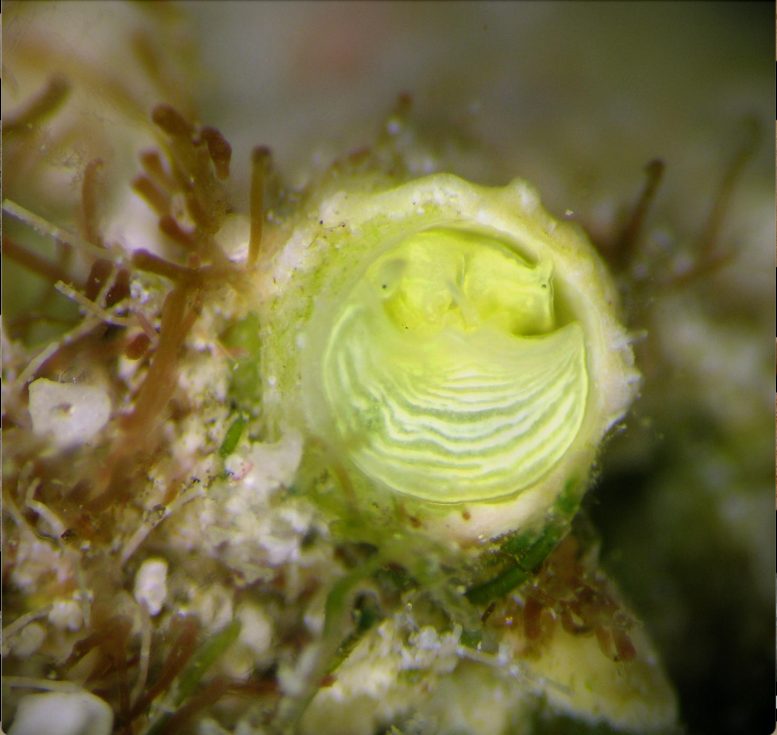
The Marine Snails’ Bright Citrus Coloring Might Help Ward Off Predators
The “Margaritaville” in Jimmy Buffett’s famous song isn’t a real place, but it’s long been associated with the Florida Keys. This string of tropical islands is home to the only living coral barrier reef in the continental US, along with many animals found nowhere else in the world. One of them is a newly-discovered, bright yellow snail, named in honor of Margaritaville. The lemon- (or, key-lime-) colored snail, along with its lime-green cousin from Belize, is the subject of a study published in the journal PeerJ.
A Closer Look at Worm Snails
These marine snails are distant relatives of the land-dwelling gastropods you might find leaving slimy trails in your garden. Nicknamed “worm snails,” they spend most of their lives in one place.
“I find them particularly cool because they are related to regular free-living snails, but when the juveniles find a suitable spot to live, they hunker down, cement their shell to the substrate, and never move again,” says Rüdiger Bieler, curator of invertebrates at the Field Museum in Chicago and the study’s lead author. “Their shell continues to grow as an irregular tube around the snail’s body, and the animal hunts by laying out a mucus web to trap plankton and bits of detritus.”
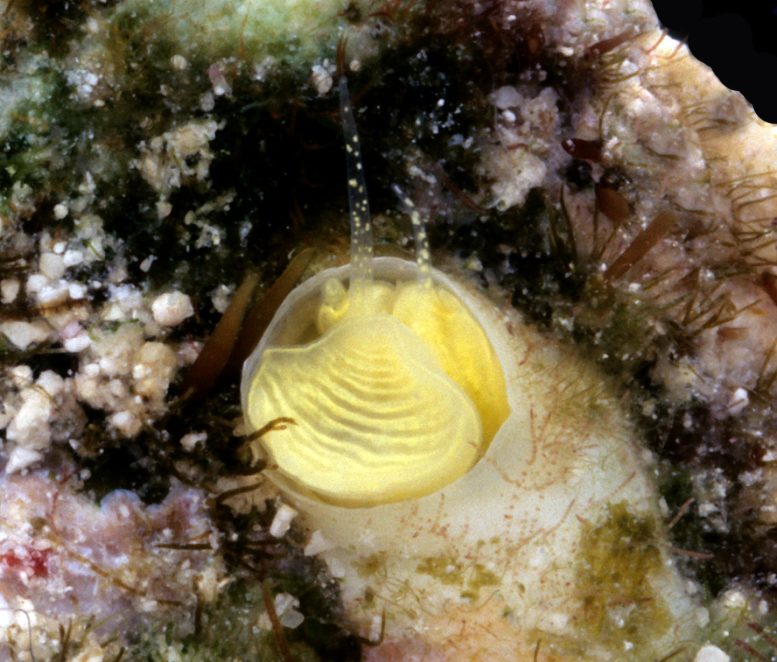
Bieler has spent the past four decades studying invertebrate animals living in the Western Atlantic, but these particular snails “are so small and so well-hidden that we’ve not encountered them before during our scuba diving surveys. We had to look very closely,” he says. The new species belongs to the same family of marine snails as the invasive “Spider-Man” snail that the same team described from the Vandenberg shipwreck off the Florida Keys in 2017.
Discoveries in Color and Genetics
He and his colleagues, including fellow Field Museum curator Petra Sierwald, came across the lemon-yellow snails in the Florida Keys National Marine Sanctuary, and they found a similar, lime-colored snail in Belize. “Many snails are polychromatic– within the same species, you get different colors,” says Bieler. “In a single population, even a single little cluster, one might be orange, one might be gray. I think they do it to confuse fish and not give them a clear target, and some have warning coloration.”
“Initially, when I saw the lime-green one and the lemon-yellow one, I figured they were the same species,” says Bieler. “But when we sequenced their DNA, they were very different.”
Based on these molecular data, Bieler, Sierwald, and their co-authors Timothy Collins, Rosemary Golding, Camila Granados-Cifuentes, John Healy, and Timothy Rawlings, placed the snails in a new genus, Cayo, after the Spanish word for a small, low island. The yellow snail was named Cayo margarita after the citrusy drinks in Jimmy Buffet’s “Margaritaville.” The lime snail’s name, Cayo galbinus, means “greenish-yellow.”
Similar Traits and Biodiversity Importance
The Cayo snails have a key trait in common with another worm snail genus, Thylacodes, for which the team described a new species from Bermuda and named Thylacodes bermudensis. While only distantly related, these snails all have brightly colored heads poking out of their tubular shells. “Our thought is this is a warning color,” says Bieler. “They have some nasty metabolites in their mucus. That also might help explain why they’re able to have exposed heads– on the reef, everybody is out to eat you, and if you don’t have any defensive mechanism, you will be overgrown by the corals and sea anemones and all the stuff around you. It seems like the mucus might help deter the neighbors from getting too close.”
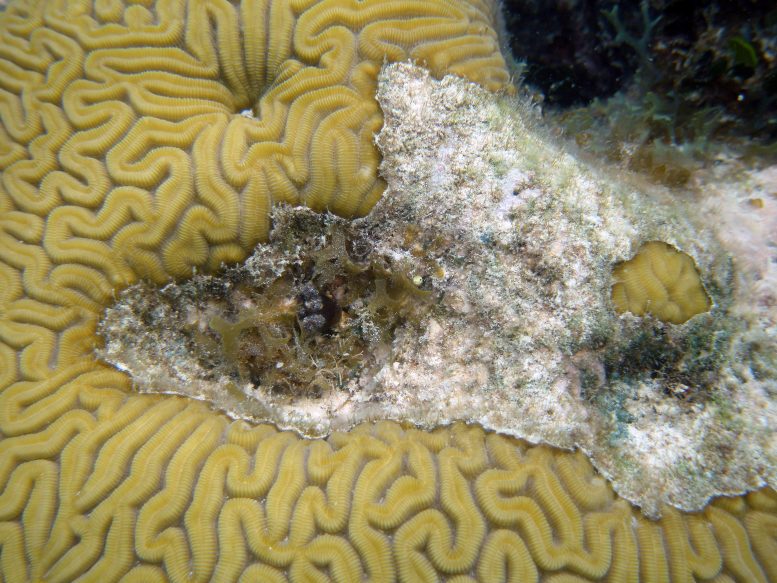
Bieler says that the study is important because it helps illuminate the biodiversity of coral reefs, which are under severe threat due to climate change. “There have been increases in global water temperatures, and some species can handle them much better than others,” says Bieler. The Cayo snails have a tendency to live on pieces of dead coral, and as more coral is killed off, the snails might spread.
Moreover, says Bieler, “it’s another indication that right under our noses, we have undescribed species. This is in snorkeling depth in a heavily touristed area, and we’re still finding new things all around us.”
Reference: “Replacing mechanical protection with colorful faces–twice: parallel evolution of the non-operculate marine worm-snail genera Thylacodes (Guettard, 1770) and Cayo n. gen. (Gastropoda: Vermetidae)” by Rüdiger Bieler, Timothy M. Collins, Rosemary Golding, Camila Granados-Cifuentes, John M. Healy, Timothy A. Rawlings and Petra Sierwald, 9 October 2023, PeerJ.
DOI: 10.7717/peerj.15854
This study was contributed to by scientists at the Field Museum, Florida International University, Queensland Museum, and Cape Breton University.
Never miss a breakthrough: Join the SciTechDaily newsletter.
Follow us on Google and Google News.