
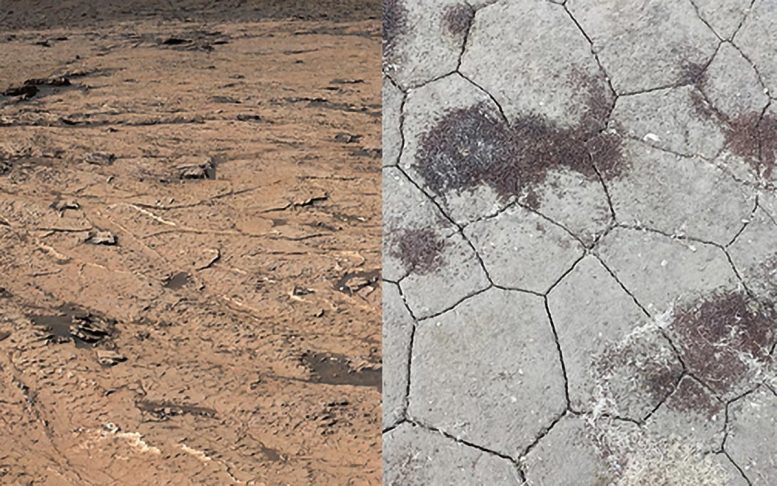
NASA’s Mars Curiosity rover finds evidence of high-frequency wet-dry cycling in the Gale Crater.
New observations of mud cracks made by NASA’s Mars Curiosity rover show that high-frequency, wet-dry cycling occurred in early Martian surface environments, indicating that the red planet may have once seen seasonal weather patterns or even flash floods. The research was published recently in the scientific journal Nature.
“These exciting observations of mature mud cracks are allowing us to fill in some of the missing history of water on Mars. How did Mars go from a warm, wet planet to the cold, dry place we know today? These mud cracks show us that transitional time, when liquid water was less abundant but still active on the Martian surface,” said Nina Lanza, principal investigator of the ChemCam instrument onboard the Curiosity rover.
“These features also point to the existence of wet-dry environments that on Earth are extremely conducive to the development of organic molecules and potentially life. Taken as a whole, these results a giving us a clearer picture of Mars as a habitable world.”
Climate Fluctuations and Environment Transitions on Mars
The presence of long-term wet environments, such as evidence of ancient lakes on Mars, is well-documented, but far less is known about short-term climate fluctuations.
After years of exploring terrain largely comprised of silicates, the rover entered a new area filled with sulfates, marking a major environment transition. In this new environment, the research team found a change in mud crack patterns, signifying a change in the way the surface would have dried. This indicates that water was still present on the surface of Mars episodically, meaning water could have been present for a time, evaporated, and repeated until polygons, or mud cracks, formed.
“A major focus of the Curiosity mission, and one of the main reasons for selecting Gale Crater, is to understand the transition of a ‘warm and wet’ ancient Mars to a ‘cold and dry’ Mars we see today,” said Patrick Gasda of the Laboratory’s Space Remote Sensing and Data Science group and coauthor of the paper. “The rover’s drive from clay lakebed sediments to drier non-lakebed and sulfate-rich sediments is part of this transition.”
Earth-Like Mud Crack Patterns and Implications for Life
On Earth, initial mud cracks in mud form a T-shaped pattern, but subsequent wetting and drying cycles cause the cracks to form more of a Y-shaped pattern, which is what Curiosity observed. Additionally, the rover found evidence that the mud cracks were only a few centimeters deep, which could mean that wet-dry cycles were seasonal, or may have even occurred more quickly, such as in a flash flood.
These findings could mean that Mars once had an Earth-like wet climate, with seasonal or short-term flooding, and that Mars may have been able to support life at some point.
“What’s important about this phenomenon is that it’s the perfect place for the formation of polymeric molecules required for life, including proteins and RNA, if the right organic molecules were present at this location,” Gasda said “Wet periods bring molecules together while dry periods drive reactions to form polymers. When these processes occur repeatedly at the same location, the chance increases that more complex molecules formed there.”
For more on this discovery:
- New Evidence of an Environment Conducive to the Emergence of Life
- Cracks in Ancient Martian Mud Discovered by Mars Curiosity Rover
Reference: “Sustained wet–dry cycling on early Mars” by W. Rapin, G. Dromart, B. C. Clark, J. Schieber, E. S. Kite, L. C. Kah, L. M. Thompson, O. Gasnault, J. Lasue, P.-Y. Meslin, P. J. Gasda and N. L. Lanza, 9 August 2023, Nature.
DOI: 10.1038/s41586-023-06220-3
Funding: NASA’s Mars Exploration Program and in France is conducted under the authority of CNES. Mastcam mosaics were processed by the Mastcam team at Malin Space Science Systems. Edwin Kite funding by NASA grant 80NSSC22K0731. Lucy Thompson funding as MSL team member is provided by the CSA.
Never miss a breakthrough: Join the SciTechDaily newsletter.
Follow us on Google and Google News.