
Close Menu
    Facebook X (Twitter) Instagram
    SciTechDaily
    • Biology
    • Chemistry
    • Earth
    • Health
    • Physics
    • Science
    • Space
    • Technology
    Facebook X (Twitter) Pinterest YouTube RSS
    SciTechDaily
    Home»Space»Mars Unveils Its Nighttime Secret: Mesmerizing Green Glow Discovered
    Space

    Mars Unveils Its Nighttime Secret: Mesmerizing Green Glow Discovered

    By European Space Agency (ESA)November 17, 20231 Comment7 Mins Read
    Facebook Twitter Pinterest Telegram LinkedIn WhatsApp Email Reddit
    Share
    Facebook Twitter LinkedIn Pinterest Telegram Email Reddit
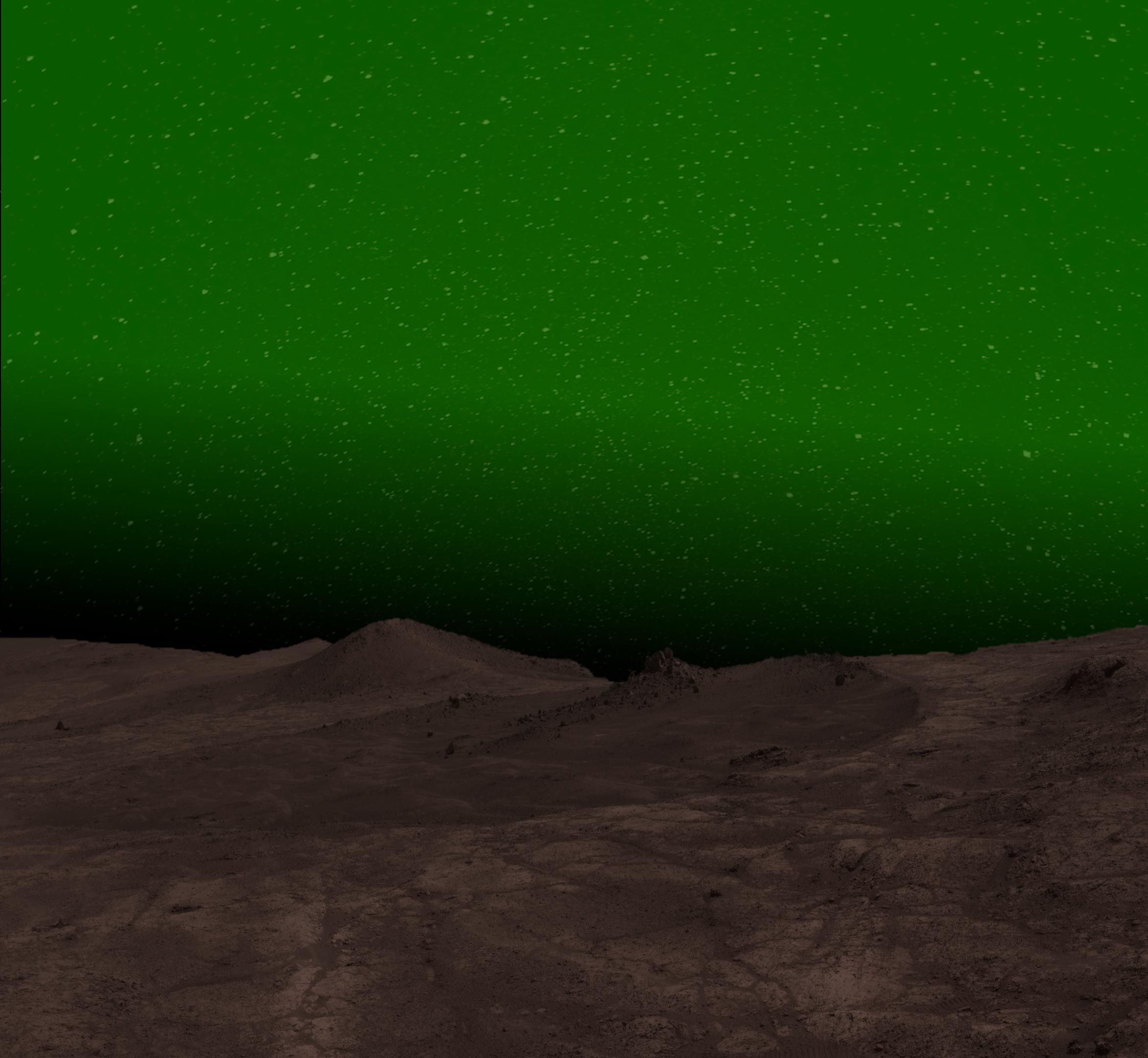
    Green Glow in Martian Night
    This image shows an artist’s impression of what nightglow might look like to an astronaut in the polar winter regions of Mars at night. The green glow occurs when oxygen atoms high up in the atmosphere combine to form oxygen molecules.
    This simulated view was created using a real but darkened image of the Martian surface from the panoramic camera of NASA’s Opportunity rover, and a synthetic nightglow corresponding to the real color of the oxygen emission. Credit: NASA/JPL-Caltech/Cornell Univ./Arizona State Univ.– E. W. Knutsen

    ESA’s ExoMars Trace Gas Orbiter has discovered a green nightglow in the Martian atmosphere, providing crucial data on atmospheric processes and potential illumination for future Martian missions. This phenomenon, distinct from auroras, marks a significant advancement in our understanding of Mars.

    When future astronauts explore Mars’s polar regions, they will see a green glow lighting up the night sky. For the first time, a visible nightglow has been detected in the Martian atmosphere by ESA’s ExoMars Trace Gas Orbiter (TGO) mission.

    Under clear skies, the glow could be bright enough for humans to see by and for rovers to navigate in the dark nights. Nightglow is also observed on Earth. On Mars, it was something expected, yet never observed in visible light until now.

    Nightglow on Mars

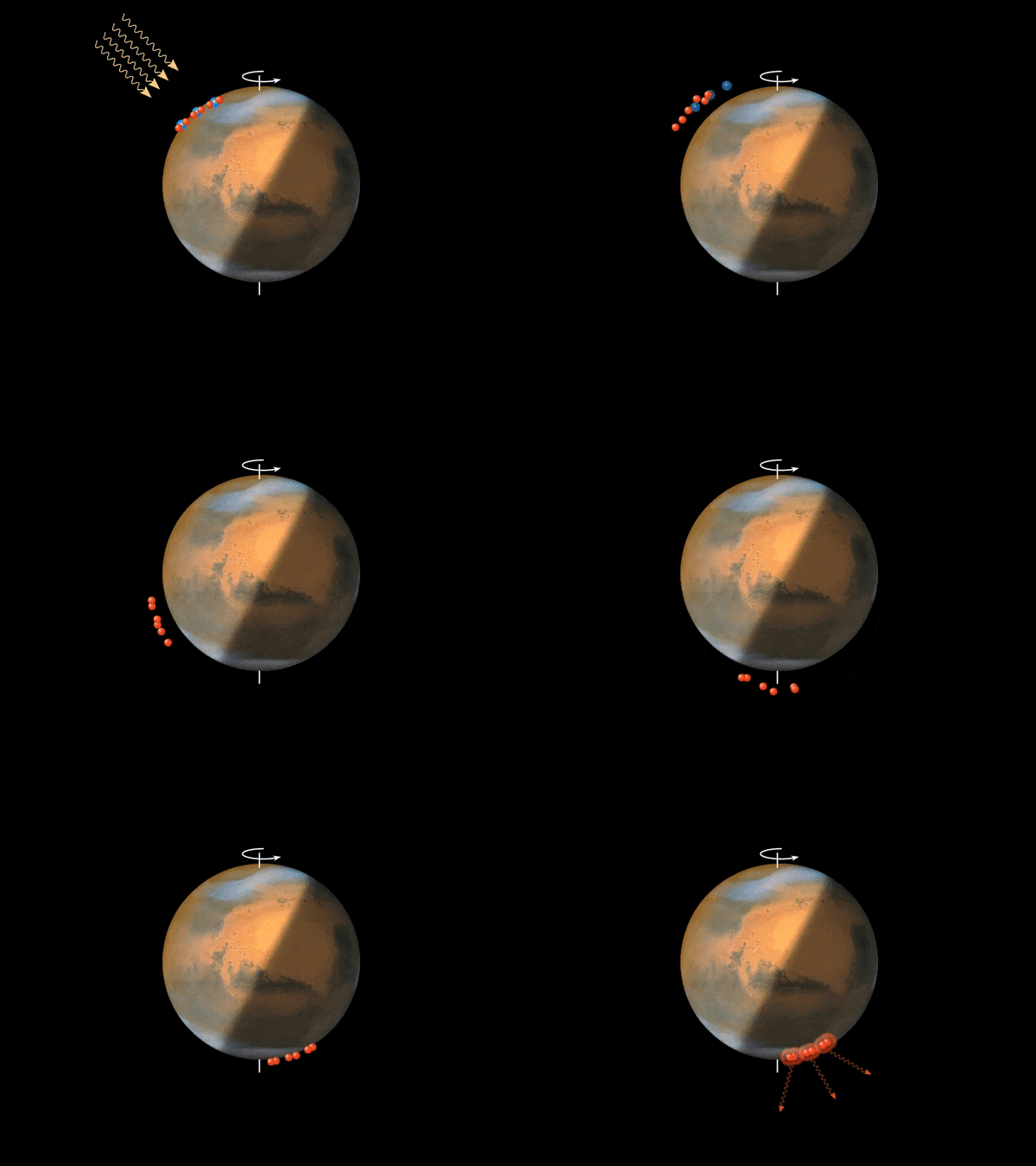
    The atmospheric nightglow occurs when two oxygen atoms combine to form an oxygen molecule, about 50 km (~30 miles) above the planetary surface.

    The oxygen atoms have been on a journey: they form on Mars’s dayside when sunlight gives energy to carbon dioxide molecules, making them split apart. When the oxygen atoms migrate to the night side and stop being excited by the Sun, they regroup and emit light at lower altitudes.
    Production of Oxygen Nightglow on Mars
    This animation depicts the process that is believed to account for the Martian nightglow. When exposed to solar ultraviolet radiation above an altitude of 70 km, carbon dioxide molecules – the main atmospheric constituent of Mars’ atmosphere – are split into carbon monoxide and oxygen atoms. Those oxygen atoms (depicted as red spheres) are transported by a gigantic Hadley cell, which features an ascending branch above the daytime summer pole and a descending branch over the winter pole, which is in the night hemisphere. The oxygen atoms recombine into molecular oxygen in the descending branch of the Hadley cell, at an altitude of 30-50 km, emitting infrared radiation. Credit: ESA

    “This emission is due to the recombination of oxygen atoms created in the summer atmosphere and transported by winds to high winter latitudes, at altitudes of 40 to 60 km in the Martian atmosphere,” explains Lauriane Soret, researcher from the Laboratory of Atmospheric and Planetary Physics of the University of Liège, in Belgium, and part of the team that published the discovery in Nature Astronomy.

    The illumination from the nightglow could be bright enough to light the way of the future see the glow as bright as moonlit clouds on Earth.

    “These observations are unexpected and interesting for future trips to the Red Planet,” says Jean-Claude Gérard, lead author of the new study and planetary scientist at the University of Liège.

    Airglow Observed From the International Space Station
    Airglow occurs in Earth’s atmospheres as sunlight interacts with atoms and molecules within the atmosphere. In this image, taken by astronauts aboard the International Space Station (ISS) in 2011, a green band of oxygen glow is visible over Earth’s curve. On the surface, portions of northern Africa are visible, with evening lights shining along the Nile River and its delta. Credit: NASA

    Follow the Green Glowing Road

    The international scientific team was intrigued by a previous discovery made using Mars Express, which observed the nightglow in infrared wavelengths a decade ago. The Trace Gas Orbiter followed up by detecting glowing green oxygen atoms high above the dayside of Mars in 2020 – the first time that this dayglow emission was seen around a planet other than Earth.

    These atoms also travel to the nightside and then recombine at lower altitude, resulting in the visible nightglow detected in the new research published today.
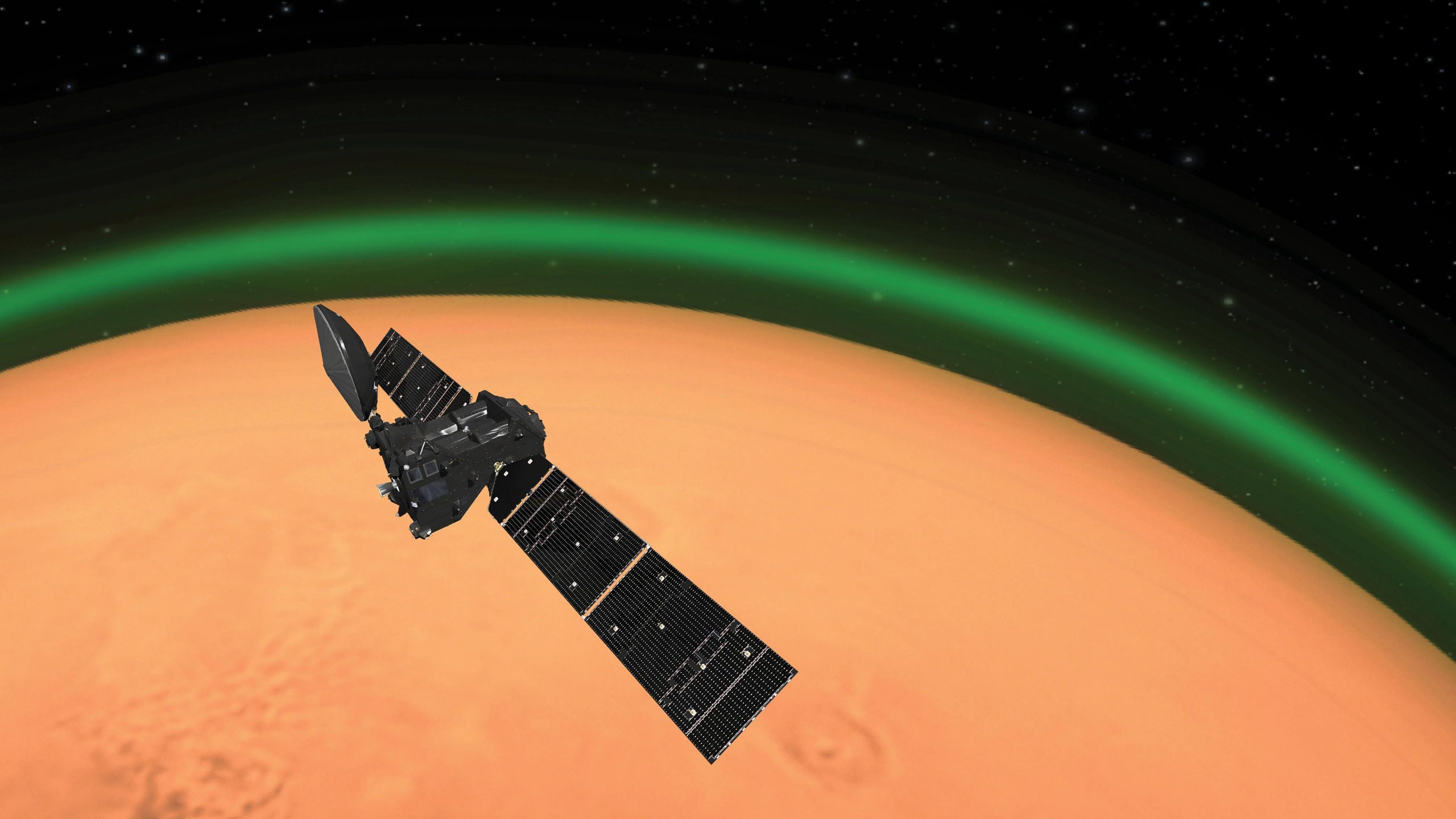
    ExoMars Trace Gas Orbiter Spots Daylight Green Oxygen at Mars
    Artist’s impression of ESA’s ExoMars Trace Gas Orbiter detecting the green glow of oxygen in the martian atmosphere. This emission, spotted on the dayside of Mars, is similar to the night glow seen around Earth’s atmosphere from space. Credit: ESA

    Orbiting the Red Planet at an altitude of 400 km, TGO was able to monitor the night side of Mars with the ultraviolet-visible channel of its NOMAD instrument. The instrument covers a spectral range from near ultraviolet to red light and was oriented towards the edge of the Red Planet to better observe the upper atmosphere.

    The NOMAD experiment is led by the Royal Belgian Institute for Space Aeronomy, working with teams from Spain (IAA‐CSIC), Italy (INAF‐IAPS), and the United Kingdom (Open University), among others.

    Scientific Value

    The nightglow serves as a tracer of atmospheric processes. It can provide a wealth of information about the composition and dynamics of a region of the atmosphere difficult to measure, as well as the oxygen density. It can also reveal how energy is deposited by both the Sun’s light and the solar wind – the stream of charged particles emanating from our star.
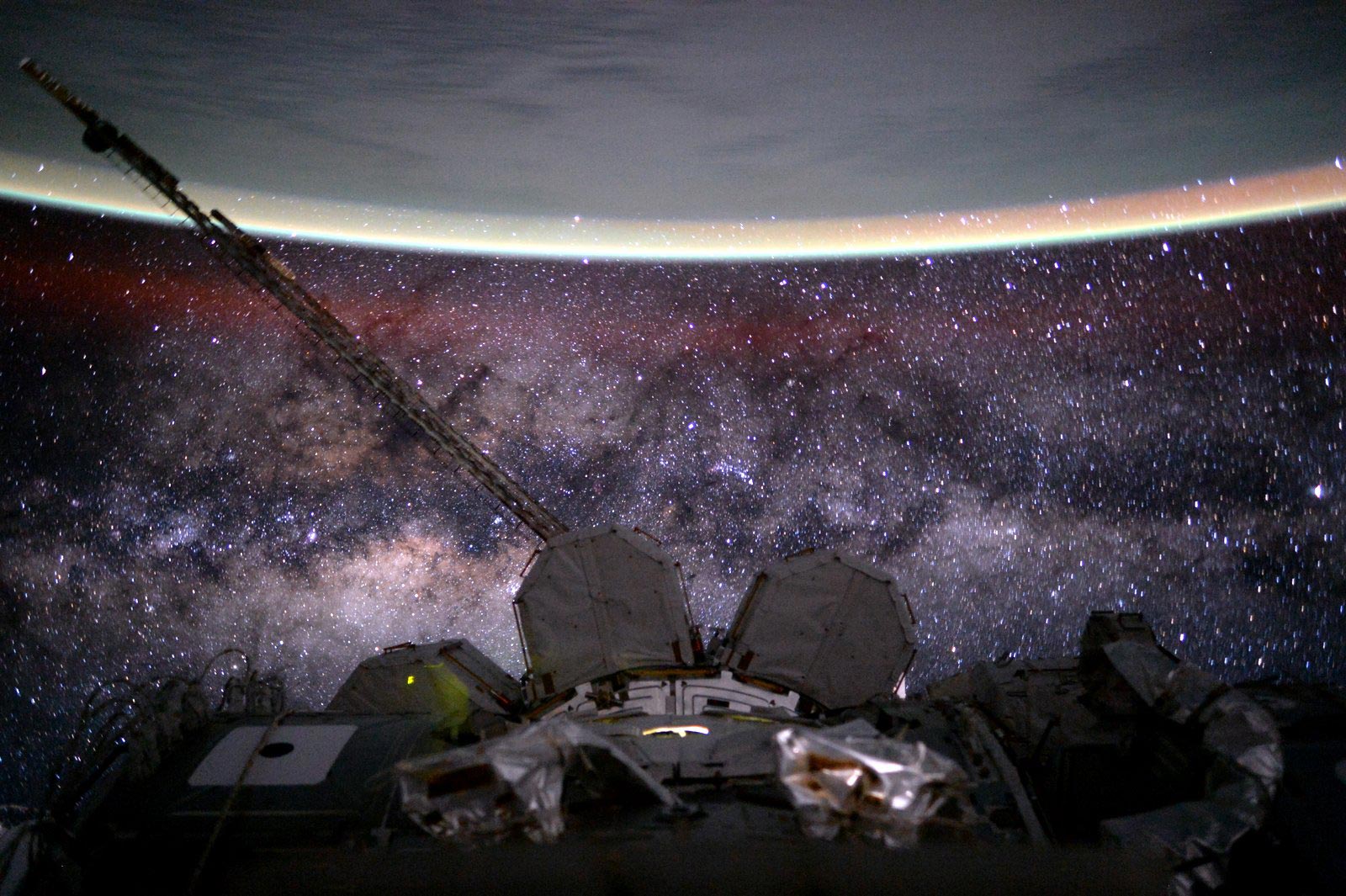
    Milky Way and Earth’s Airglow From Space Station
    Snapshot from space of the Milky Way and Earth posing together beyond the International Space Station. The Milky Way stretches below the curve of Earth’s limb in the scene that also records a faint green airglow. The galaxy’s central bulge appears with starfields cut by dark rifts of obscuring interstellar dust. The picture was taken by NASA astronaut Scott Kelly in 2015 during his one-year mission in space. Credit: NASA/Scott Kelly

    Understanding the properties of Mars’ atmosphere is not only scientifically interesting but it is also key for missions to the Red Planet’s surface. Atmospheric density, for example, directly affects the drag experienced by orbiting satellites and by the parachutes used to deliver probes to the Martian surface.

    Nightglow Versus Aurora

    Nightglow is also observed on Earth, but it is not to be confused with auroras. Auroras are just one way in which planetary atmospheres light up.

    Auroras are produced, on Mars as on Earth, when energetic electrons from the Sun hit the upper atmosphere. They vary across space and time, while nightglow is more homogeneous. Nightglow and auroras can both exhibit a wide range of colors depending on which atmospheric gases are most abundant at different altitudes.

    The green nightglow on our planet is quite faint, and so is best seen by looking from an ‘edge on’ perspective – as portrayed in many spectacular images taken by astronauts from the International Space Station.


    A timelapse video by European Space Agency astronaut Tim Peake taken during his six-month Principia mission on the International Space Station. The British astronaut commented on this timelapse: “International Space Station view of an ‘aurora rise’ – spot the two satellites at the end? Timelapse video made from images taken at one second intervals played back 25 times faster.” Credit: ESA/NASA

    Reference: “Observation of the Mars O2 visible nightglow by the NOMAD spectrometer onboard the Trace Gas Orbiter” by J.-C. Gérard, L. Soret, I. R. Thomas, B. Ristic, Y. Willame, C. Depiesse, A. C. Vandaele, F. Daerden, B. Hubert, J. P. Mason, M. R. Patel and M. A. López-Valverde, 9 November 2023, Nature Astronomy.
    DOI: 10.1038/s41550-023-02104-8

    Never miss a breakthrough: Join the SciTechDaily newsletter.
    Follow us on Google and Google News.

    Atmospheric Science European Space Agency ExoMars Mars Planets Popular
    Share. Facebook Twitter Pinterest LinkedIn Email Reddit

    Related Articles

    Webb Uncovers Unexpected Phenomena Above Jupiter’s Great Red Spot

    A Snaking Scar Across Mars: The Mystery of Aganippe Fossa

    Mars Express Discovers Mysterious Martian “Spiders”

    Mars Express Reveals Hidden Ice Reserves at Mars’s Equator

    NASA’s Perseverance Rover Captures 200-Foot-Wide Dust Devil Tearing Across Mars

    ExoMars Discovers Hidden Water in Mars’ Grand Canyon – The Largest Canyon in the Solar System

    A New Chemistry: ExoMars Orbiter Discovers New Gas and Traces Water Loss on Mars

    How Venus and Mars Can Teach Us About the Past and Future of Earth

    “Puzzling and Surprising” New Gas Signatures Discovered by ExoMars Orbiter in the Martian Atmosphere

    1 Comment

    1. Drifter Don on December 4, 2023 8:25 pm

      Where does the carbon from the CO2 go?

      Reply
    Leave A Reply Cancel Reply

    • Facebook
    • Twitter
    • Pinterest
    • YouTube

    Don't Miss a Discovery

    Subscribe for the Latest in Science & Tech!

    Trending News

    Bone-Strengthening Discovery Could Reverse Osteoporosis

    Scientists Uncover Hidden Trigger Behind Stem Cell Aging

    Scientists Find Way to Reverse Fatty Liver Disease Without Changing Diet

    Could Humans Regrow Limbs? New Study Reveals Promising Genetic Pathway

    Scientists Reveal Eating Fruits and Vegetables May Increase Your Risk of Lung Cancer

    Scientists Reverse Brain Aging With Simple Nasal Spray

    Scientists Uncover Potential Brain Risks of Popular Fish Oil Supplements

    Scientists Discover a Surprising Way To Make Bread Healthier and More Nutritious

    Follow SciTechDaily
    • Facebook
    • Twitter
    • YouTube
    • Pinterest
    • Newsletter
    • RSS
    SciTech News
    • Biology News
    • Chemistry News
    • Earth News
    • Health News
    • Physics News
    • Science News
    • Space News
    • Technology News
    Recent Posts
    • Europe’s Most Active Volcano Just Got Stranger – Here’s Why Scientists Are Rethinking It
    • Why Are Giant Ants Letting Tiny Ants Crawl All Over Them?
    • Revolutionary Technique Sends Healthy Mitochondria Exactly Where They’re Needed
    • This Student Recreated the Universe in a Bottle. What She Discovered Could Help Reveal How Life Started on Earth
    • Alzheimer’s Symptoms May Start Outside the Brain, Study Finds
    Copyright © 1998 - 2026 SciTechDaily. All Rights Reserved.
    • Science News
    • About
    • Contact
    • Editorial Board
    • Privacy Policy
    • Terms of Use

    Type above and press Enter to search. Press Esc to cancel.