
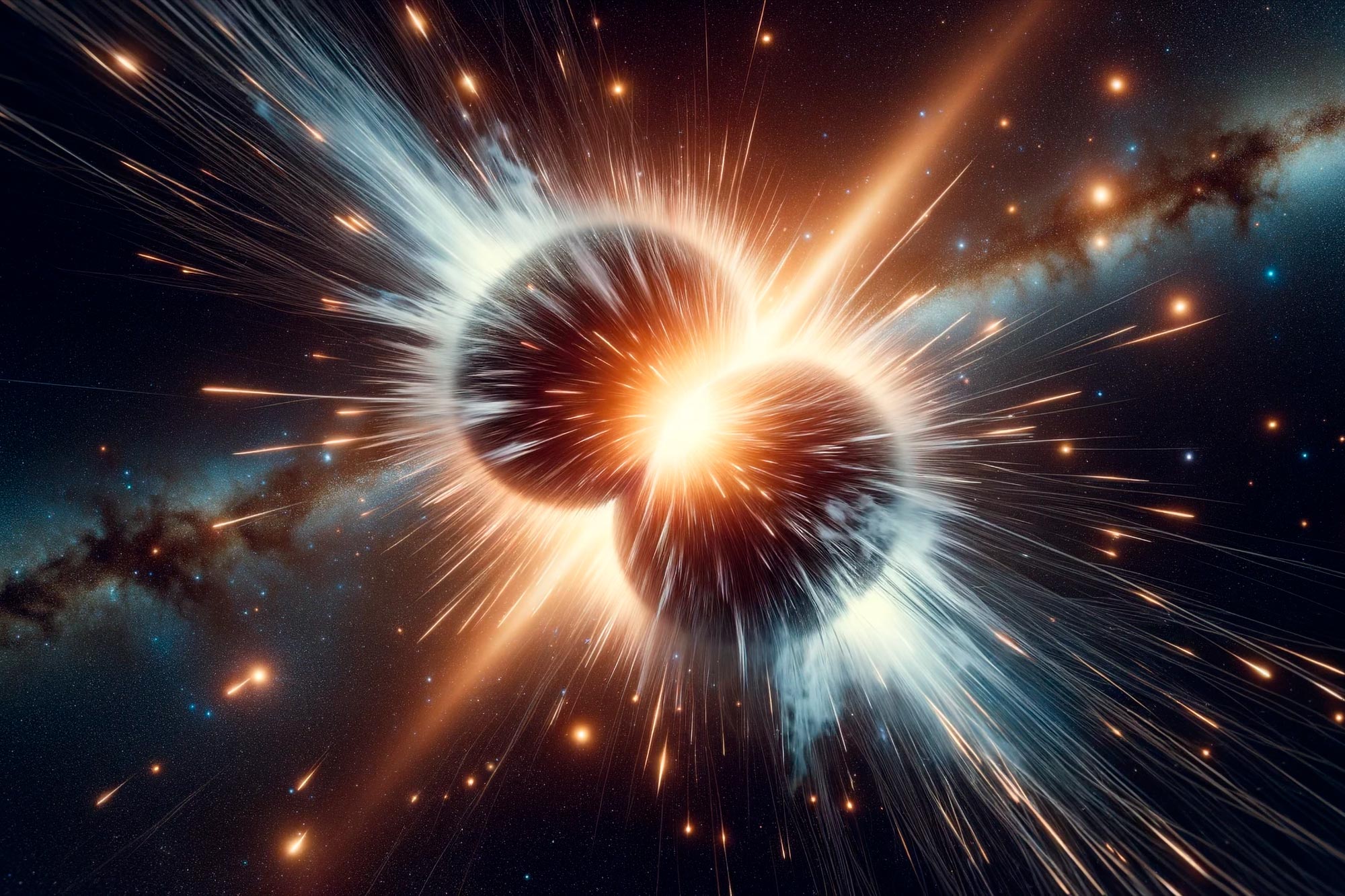
Using multiple observatories, astronomers directly detect tellurium in two merging neutron stars.
An extraordinary burst of high-energy light in the sky has pointed astronomers to a pair of metal-forging neutron stars 900 million light years from Earth.
In a study published recently in Nature, an international team of astronomers, including scientists at MIT, reports the detection of an extremely bright gamma-ray burst (GRB), which is the most powerful type of explosion known in the universe. This particular GRB is the second-brightest so far detected, and the astronomers subsequently traced the burst’s origin to two merging neutron stars. Neutron stars are the collapsed, ultradense cores of massive stars, and are thought to be where many of the universe’s heavy metals are forged.
Evidence of Heavy Metals in Space
The team found that as the stars circled each other and eventually merged, they gave off an enormous amount of energy in the form of the GRB. And, in a first, the astronomers directly detected signs of heavy metals in the stellar aftermath. Specifically, they picked up a clear signal of tellurium, a heavy, mildly toxic element that is rarer than platinum on Earth but thought to be abundant throughout the universe.
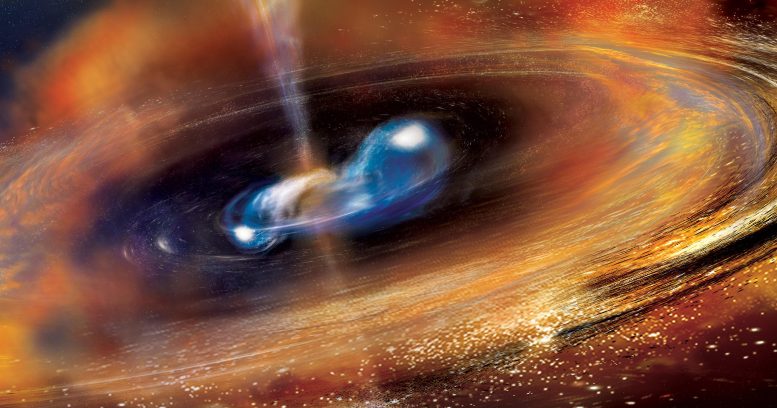
The astronomers estimate that the merger gave off enough tellurium to equal the mass of 300 Earths. And if tellurium is present, the merger must have churned up other closely related elements such as iodine, which is an essential mineral nutrient for much of life on Earth.
Global Astronomical Efforts
The discovery was made through the collective effort of astronomers around the world, using NASA’s James Webb Space Telescope (JWST) as well as other ground and space telescopes, including NASA’s TESS satellite (an MIT-led mission), and the Very Large Telescope (VLT) in Chile, which scientists at MIT used to contribute to the discovery.
“This discovery is a major step forward in our understanding of the formation sites of heavy elements in the universe, and demonstrates the power of combining observations in different wavelengths to reveal new insights into these extremely energetic explosions,” says study co-author Benjamin Schneider, a postdoc in MIT’s Kavli Institute for Astrophysics and Space Research.
Schneider is one of many researchers from multiple institutions around the world who contributed to the study, which was led by Andrew Levan of Radboud University in the Netherlands and the University of Warwick in the United Kingdom.
“Everything All at Once”
The initial burst was detected on March 7, 2023, by NASA’s Fermi Gamma-Ray Space Telescope, and was determined to be an exceptionally bright gamma-ray burst, which astronomers labeled GRB 230307A.
“It might be difficult to overstate how bright it was,” says Michael Fausnaugh, who was a research scientist at MIT at the time and is now an assistant professor at Texas Tech University. “In gamma-ray astronomy, you’re usually counting individual photons. But so many photons came in that the detector couldn’t distinguish individual ones. It was kind of like the dial hit the max.”
The ultrabright burst was also exceptionally long, lasting 200 seconds, whereas neutron star mergers typically result in short GRBs that flash for less than two seconds. The bright and long-lasting flare drew immediate interest around the world, as astronomers focused a host of other telescopes toward the burst. This time, the burst’s brightness worked to scientists’ advantage, as the gamma-ray flare was detected by satellites across the solar system. By triangulating these observations, astronomers could zero in on the burst’s location — in the southern sky, within the Mensa constellation.
At MIT, Schneider and Fausnaugh joined the multipronged search. Shortly after Fermi’s initial detection, Fausnaugh checked to see whether the burst showed up in data taken by the TESS satellite, which happened to be pointing toward the same section of the sky where GRB 230307A was initially detected. Fausnaugh went back through that portion of TESS data and spotted the burst, then traced its activity from beginning to end.
“We could see everything all at once,” Fausnaugh says. “We saw a really bright flash, followed by a little bump, or afterglow. That was a very unique light curve. Without TESS, it is almost impossible to observe the early optical flash that occurs at the same time as the gamma rays.”
Meanwhile, Schneider examined the burst with another, ground-based scope: the Very Large Telescope (VLT) in Chile. As a member of a large GRB-observing program running on this telescope, Schneider happened to be on shift soon after the Fermi’s initial observation and focused the telescope toward the burst.
VLT’s observations echoed TESS’ data and revealed an equally curious pattern: The GRB’s emissions appeared to transition quickly from blue to red wavelengths. This pattern is characteristic of a kilonova — a massive explosion that typically occurs when two neutron stars collide. The MIT group’s analyses, combined with other observations around the world, helped to determine that the GRB was likely the product of two merging neutron stars.
Tracing the Neutron Star Merger
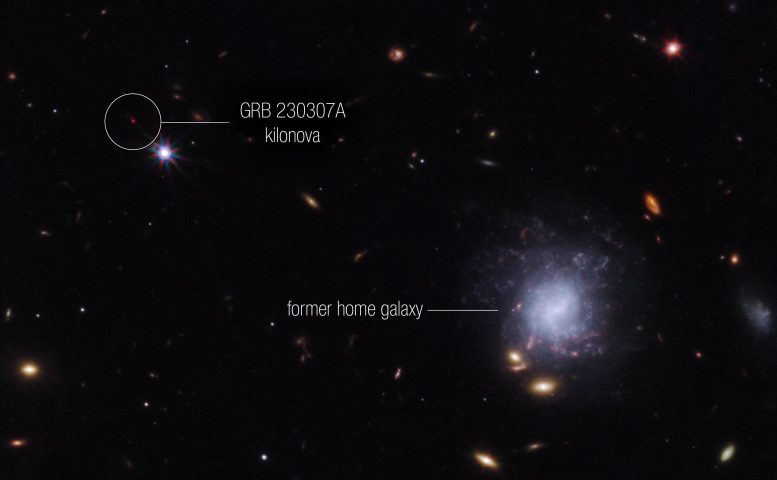
Where did the merger itself originate? For this, astronomers turned to the deep-field view of JWST, which can see further into space than any other telescope. Astronomers used JWST to observe GRB 230307A, hoping to pick out the host galaxy where the neutron stars originated. The telescope’s images revealed that, strangely, the GRB appeared to be unmoored from any host galaxy. But there did appear to be a nearby galaxy, some 120,000 light years away.
The telescope’s observations suggest that the neutron stars were kicked out of the nearby galaxy. They likely formed as a pair of massive stars in a binary system. Eventually, both stars collapsed into neutron stars, in powerful events that effectively “kicked” the pair out of their home galaxy, causing them to escape to a new location where they slowly circled in on each other and merged, several hundred million years later.
Amid the merger’s energetic emissions, JWST also detected a clear signal of tellurium. While most stars can churn up lighter elements up to iron, it’s thought that all other, heavier elements in the universe were forged in more extreme environments, such as a neutron star merger. JWST’s detection of tellurium further confirmed that the initial gamma-ray burst was produced by a neutron star merger.
“For JWST, it’s only the beginning, and it has already made a huge difference,” Schneider says. “In the coming years, more neutron star mergers will be detected. The combination of JWST with other powerful observatories will be crucial for shedding light on the nature of these extreme explosions.”
For more on this research, see:
- Life-Essential Elements Forged in Massive Space Explosion
- Webb’s First Glimpse Into Heavy Element Creation
Reference: “Heavy element production in a compact object merger observed by JWST” by Andrew Levan, Benjamin P. Gompertz, Om Sharan Salafia, Mattia Bulla, Eric Burns, Kenta Hotokezaka, Luca Izzo, Gavin P. Lamb, Daniele B. Malesani, Samantha R. Oates, Maria Edvige Ravasio, Alicia Rouco Escorial, Benjamin Schneider, Nikhil Sarin, Steve Schulze, Nial R. Tanvir, Kendall Ackley, Gemma Anderson, Gabriel B. Brammer, Lise Christensen, Vikram S. Dhillon, Phil A. Evans, Michael Fausnaugh, Wen-fai Fong, Andrew S. Fruchter, Chris Fryer, Johan P. U. Fynbo, Nicola Gaspari, Kasper E. Heintz, Jens Hjorth, Jamie A. Kennea, Mark R. Kennedy, Tanmoy Laskar, Giorgos Leloudas, Ilya Mandel, Antonio Martin-Carrillo, Brian D. Metzger, Matt Nicholl, Anya Nugent, Jesse T. Palmerio, Giovanna Pugliese, Jillian Rastinejad, Lauren Rhodes, Andrea Rossi, Andrea Saccardi, Stephen J. Smartt, Heloise F. Stevance, Aaron Tohuvavohu, Alexander van der Horst, Susanna D. Vergani, Darach Watson, Thomas Barclay, Kornpob Bhirombhakdi, Elmé Breedt, Alice A. Breeveld, Alexander J. Brown, Sergio Campana, Ashley A. Chrimes, Paolo D’Avanzo, Valerio D’Elia, Massimiliano De Pasquale, Martin J. Dyer, Duncan K. Galloway, James A. Garbutt, Matthew J. Green, Dieter H. Hartmann, Páll Jakobsson, Paul Kerry, Chryssa Kouveliotou, Danial Langeroodi, Emeric Le Floc’h, James K. Leung, Stuart P. Littlefair, James Munday, Paul O’Brien, Steven G. Parsons, Ingrid Pelisoli, David I. Sahman, Ruben Salvaterra, Boris Sbarufatti, Danny Steeghs, Gianpiero Tagliaferri, Christina C. Thöne, Antonio de Ugarte Postigo and David Alexander Kann, 25 October 2023, Nature.
DOI: 10.1038/s41586-023-06759-1
Never miss a breakthrough: Join the SciTechDaily newsletter.
Follow us on Google and Google News.