
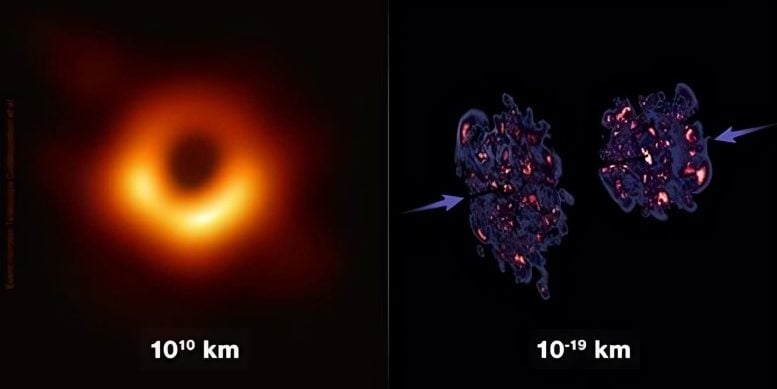
Physicists have demonstrated that black holes and the dense state of gluons, which are the “glue” particles responsible for holding nuclear matter together, have similar characteristics.
The Science
Physicists have uncovered a remarkable correspondence between dense gluon states, which are responsible for the strong nuclear force within atomic nuclei, and massive black holes in the universe. Dense gluon walls, referred to as color glass condensate (CGC), emerge from collisions between atomic nuclei and are incredibly small, measuring just 10-19 kilometers in size—less than a billionth of a kilometer. In stark contrast, black holes can span billions of kilometers.
This groundbreaking research reveals that both systems consist of densely arranged, self-interacting force carrier particles. In the case of CGC, these particles are gluons, while in black holes, they are gravitons. Both the organization of gluons within CGC and gravitons within black holes is optimized for the energy and size of each respective system.
The Impact
The high degree of order in CGC and black holes is driven by each system packing in the maximal amount of quantum “information” possible about the particles’ features. This includes their spatial distributions, velocities, and collective forces. Such limits on “information” content are universal. This means the research suggests that quantum information science could provide novel organizing principles for understanding these widely different systems.
The mathematical correspondence between these systems also means that studying each can improve our understanding of the other. Of particular interest are comparisons of gravitational shockwaves in black hole mergers with gluon shockwaves in nuclear collisions.
Summary
Scientists study the strong force in nuclear collisions. For example, at the Relativistic Heavy Ion Collider, a Department of Energy user facility, atomic nuclei accelerated close to the speed of light become dense walls of gluons known as color glass condensate (CGC). When the nuclei collide, CGC evolves to form a nearly perfect liquid of quarks and gluons, the fundamental building blocks that make up all visible matter.
Though the strong force operates at subatomic scales, this recent analysis by scientists at Ludwig Maximilian University of Munich, the Max Planck Institute for Physics, and Brookhaven National Laboratory shows that CGC shares features with black holes, enormous conglomerates of gravitons that exert gravitational force across the universe.
Both sets of self-interacting particles appear to organize themselves in a way that satisfies a universal limit on the amount of entropy, or disorder, that can exist in each system. This mathematical correspondence points to similarities between black hole formation, thermalization, and decay and what happens when walls of gluons collide in nuclear collisions at ultrarelativistic speeds—near the speed of light.
The limit on entropy that drives this correspondence is related to maximal information packing—a key feature of quantum information science (QIS). QIS may therefore further inform scientists’ understanding of gluons, gravitons, CGC, and black holes. This approach may also advance the design of quantum computers that use cold atoms to simulate and address questions about these complex systems.
Reference: “Classicalization and unitarization of wee partons in QCD and gravity: The CGC-black hole correspondence” by Gia Dvali and Raju Venugopalan, 29 March 2023, Physical Review D.
DOI: 10.1103/PhysRevD.105.056026
The study was fudned by the Department of Energy Office of Science, Nuclear Physics program, the Humboldt Foundation, and the German Research Foundation.
Never miss a breakthrough: Join the SciTechDaily newsletter.
Follow us on Google and Google News.
4 Comments
This is a lie. You cannot have “gravitons” in a true/successful theory unless you first PROVE GRAVITONS EXIST. If that had happened, that would be the headline. This is shoddy science reporting.
BACK ON EARTH.the winds vacuum helped me create 4 higgins RPM <…
Back to superior earths natural currents produced 4 Higgins blossoms rpm.using only Einstines relativity.
US pat.lonien 934870
Equal an opposite reactions of tides rivers wind/vacuums x 2 simontanisly.
automaticaly