
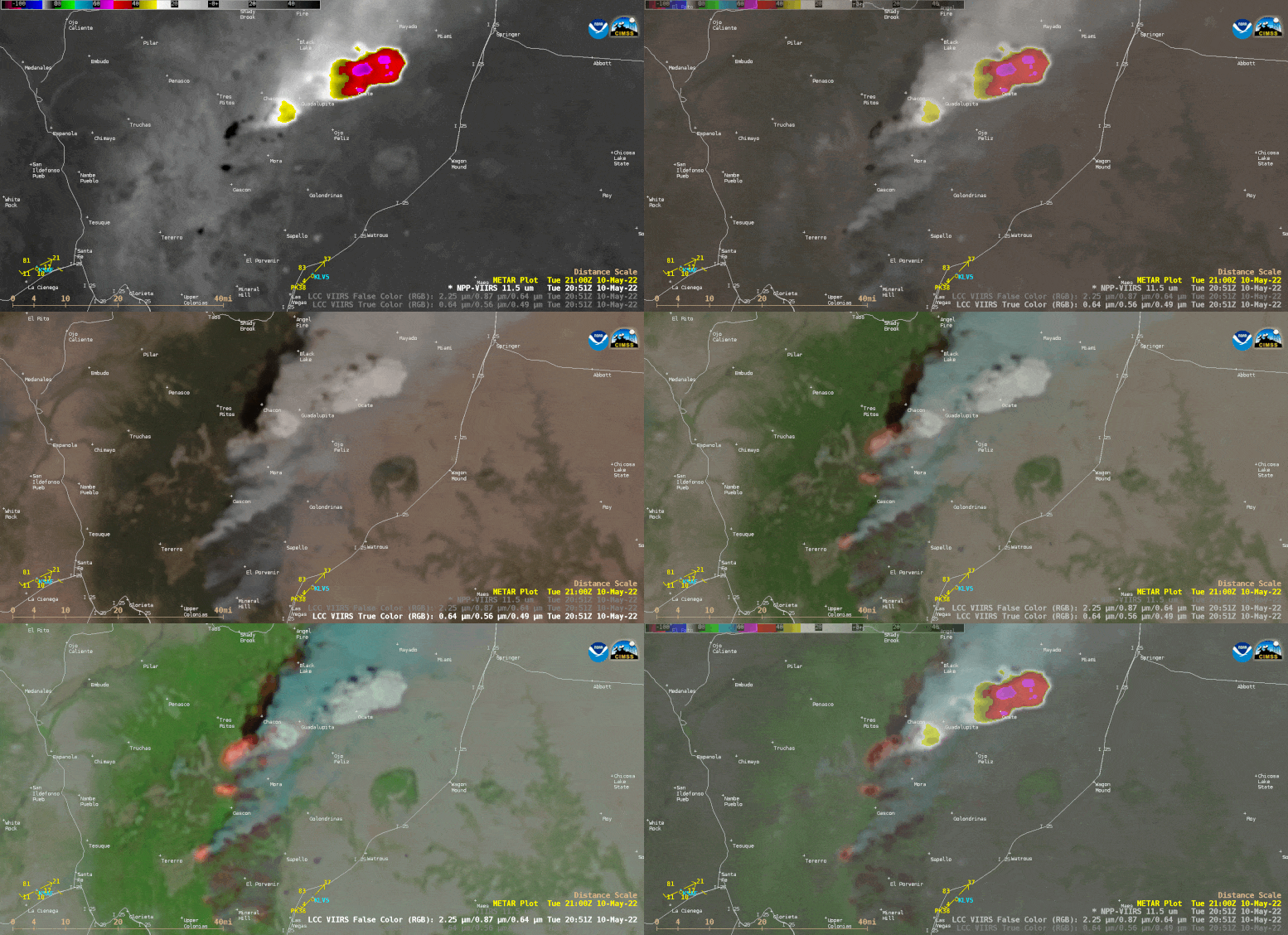
A massive, early season wildfire that continues to burn in northern New Mexico generated a pyrocumulonimbus cloud.
The Calf Canyon-Hermits Peak fire continued to rage across northern New Mexico in mid-May 2022, entering its second month. On May 13, it was the largest fire actively burning in the United States and the second largest in New Mexico’s history.
The burned area spanned more than 270,000 acres (1,100 square kilometers) east of Santa Fe and stretched 50 miles (80 kilometers) from its northern to southern perimeter in the Sangre de Cristo mountains. As of May 13, the fire was 29 percent contained, mostly on its southern perimeter, but continued to spread northeast. Hundreds of buildings and homes were destroyed, and thousands of people have been evacuated. Evacuation orders remained in effect in San Miguel, Moro, and Colfax counties, and have been expanded into the ski resort town of Angel Fire.
Periods of critical fire weather continued to challenge the 1,800 firefighters battling the blaze. Extremely low humidity and high winds helped spread the fire through dry grass, brush, and trees. Periodic gusts reaching 65 miles (105 kilometers) per hour prevented aerial firefighting efforts, including water drops and the dispersal of flame retardant.
The cumulonimbus flammagenitus cloud (CbFg), also known as the pyrocumulonimbus cloud, is a type of cumulonimbus cloud that forms above a source of heat, such as a wildfire or volcanic eruption, and may sometimes even extinguish the fire that created it. It is the most extreme manifestation of a flammagenitus cloud.
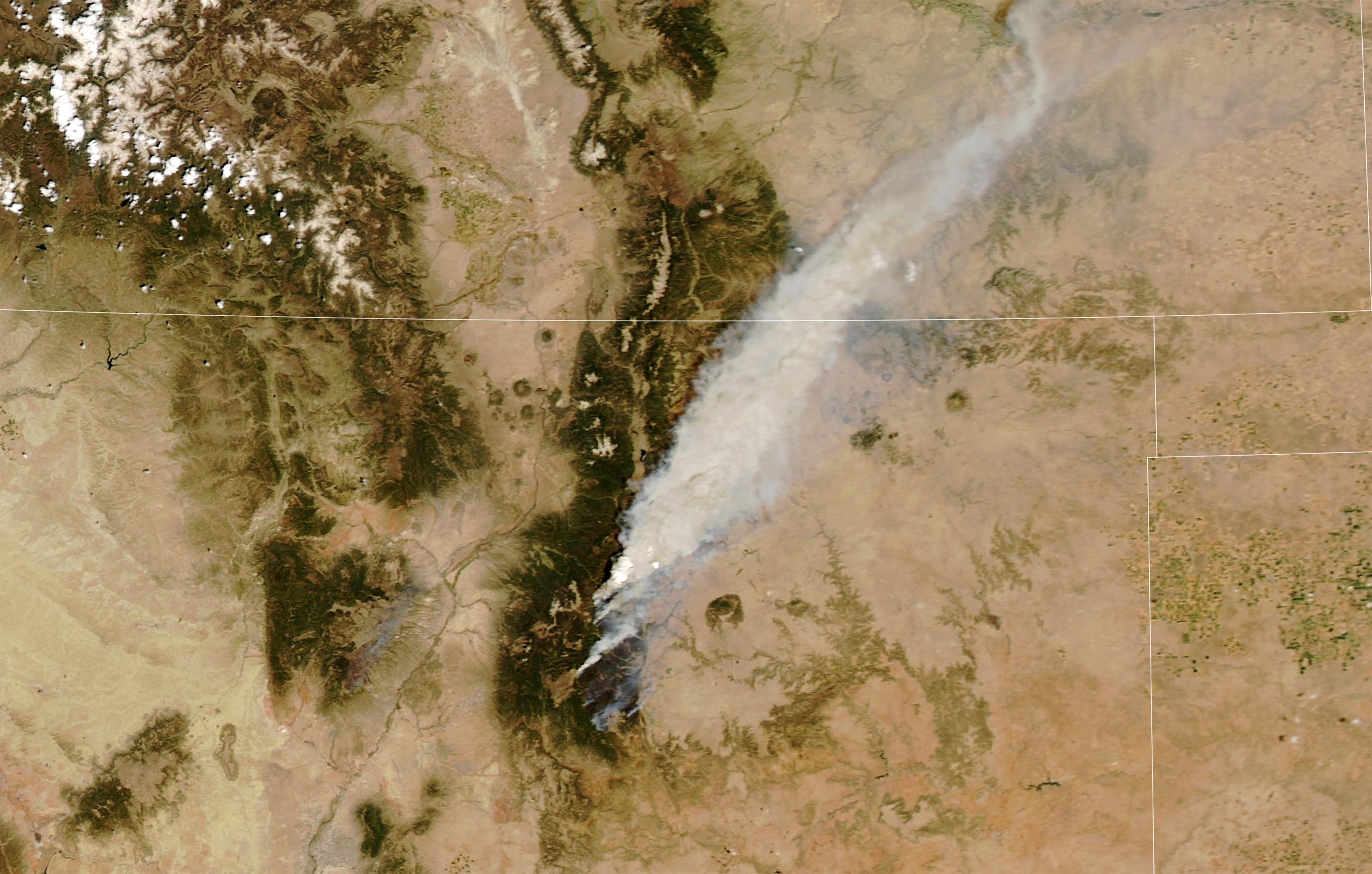
On May 10, 2022, the northern part of the fire produced a pyrocumulonimbus cloud (pyroCb). These vertical plumes, generated by the heat from a wildfire, can loft smoke and particulates high into the stratosphere. The pyroCb can be seen in the above natural-color image, which was acquired by the Moderate Resolution Imaging Spectroradiometer (MODIS) on NASA’s Aqua satellite on May 10.
Researchers at the Cooperative Institute for Meteorological Satellite Studies measured a cloud-top temperature of -75°F (-59°C). This indicated that the cloud had reached the tropopause, the boundary between the troposphere and the stratosphere at an altitude of about 7.5 miles (12 kilometers).
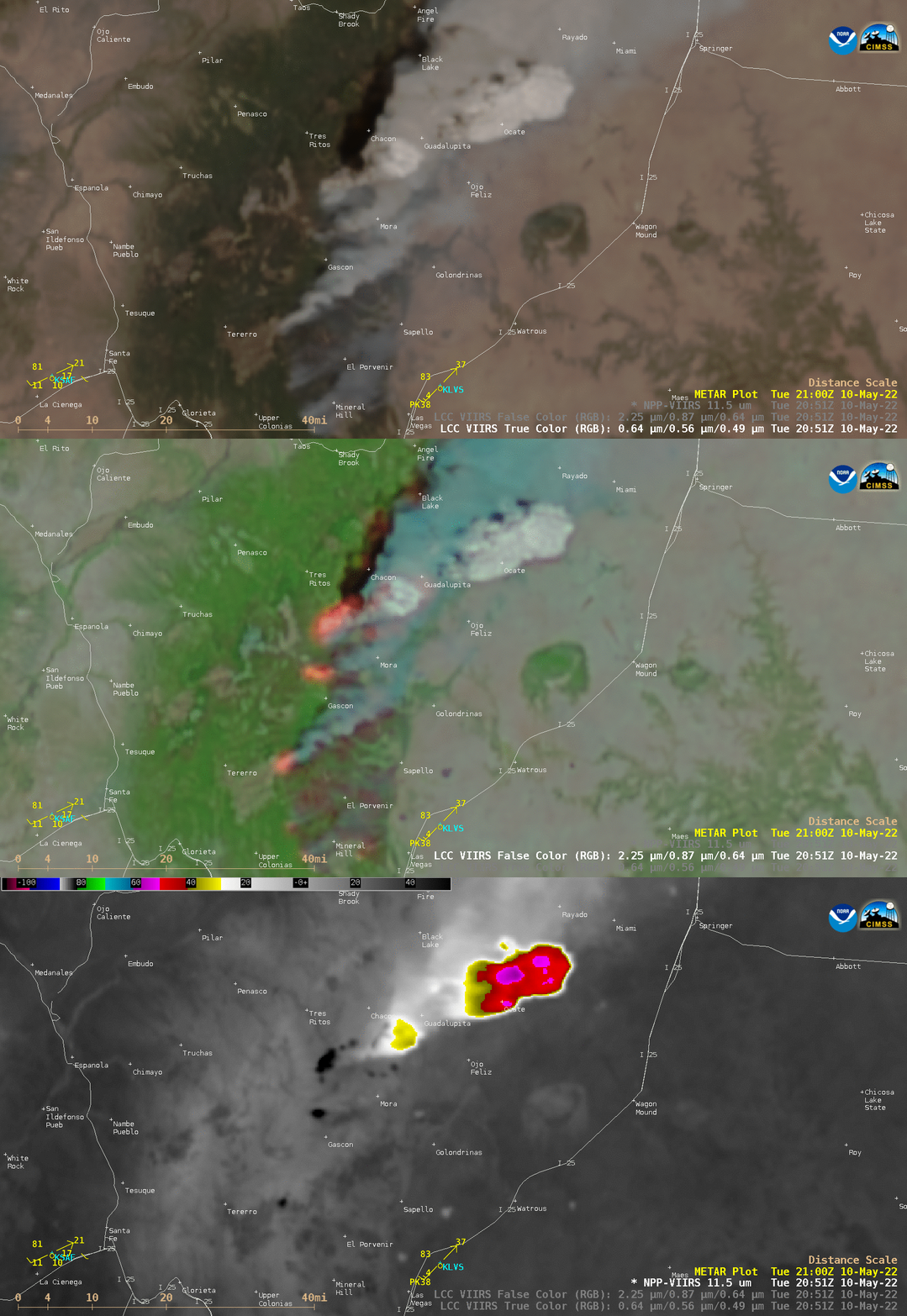
“This is considered to be a small pyroCb,” said Mike Fromm, a meteorologist with the U.S. Naval Research Laboratory. “The significance is that it is still early in the fire season, so any indication of such a blowup tells us to be on high alert for more and bigger pyroCb events.”
The Calf Canyon-Hermits Peak fire complex formed when two smaller fires merged on April 22-23. The Hermits Peak fire had started as a prescribed burn in part of the Santa Fe National Forest on April 6, but erratic, gusty winds blew it out of control. The cause of the Calf Canyon fire, which started on April 19, is still being investigated.
Several other large fires also continued to burn across New Mexico in mid-May. The Cerro Pelado Fire burning southwest of Los Alamos National Laboratory has surpassed 45,000 acres (182 square kilometers) and is 19 percent contained. The Cooks Peak Fire has burned 60,000 acres (243 square kilometers) north of Las Vegas, New Mexico, and was 97 percent contained on May 13. Smoke from the fires has drifted north into Colorado and northeast across Kansas and the Midwest.
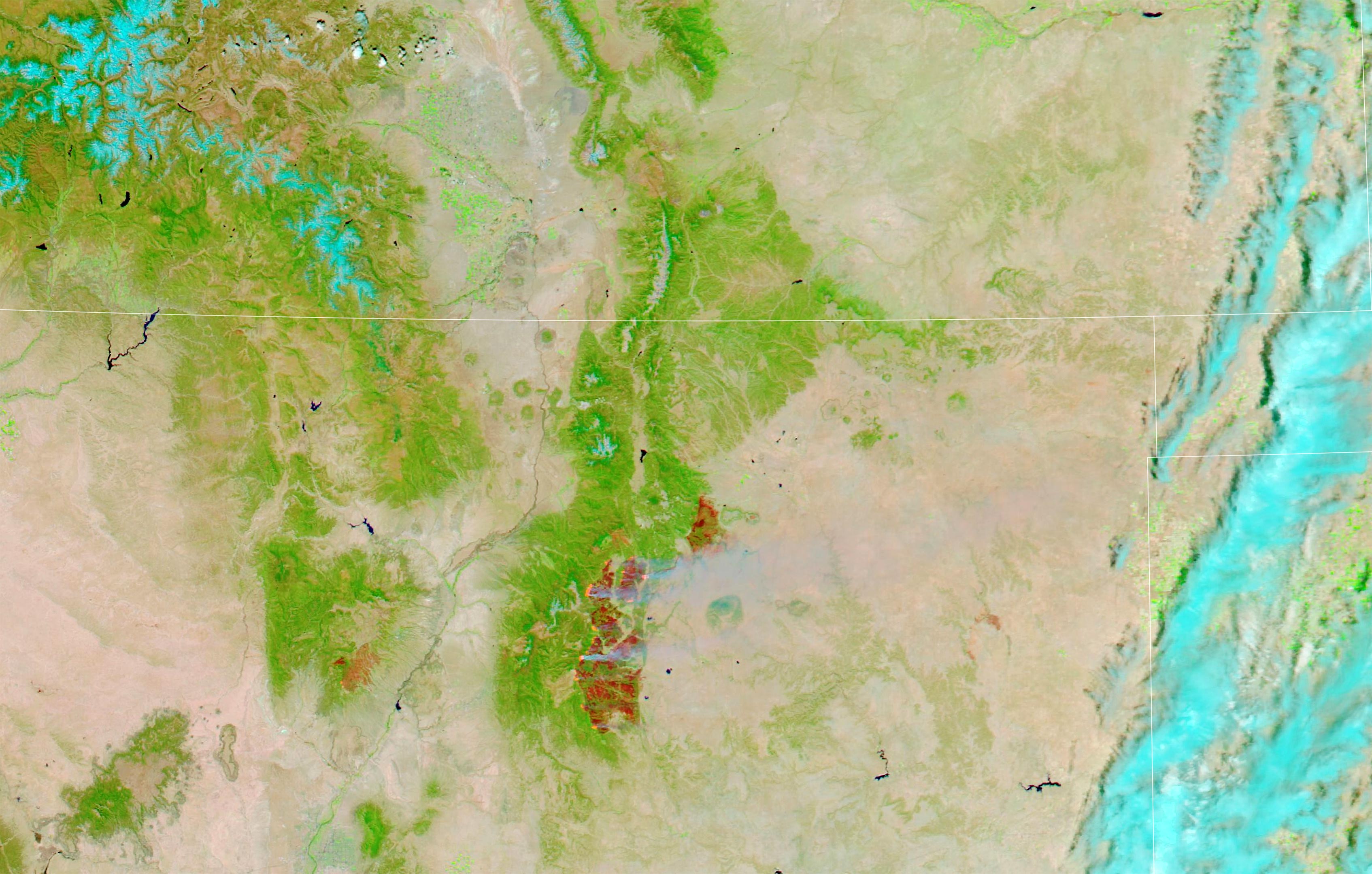
This false-color image was acquired on May 12, 2022, by MODIS-Aqua. The use of shortwave infrared and visible light (bands 7-2-1) shows the burn scars (in red) from three major fires burning in northern New Mexico. The largest scar, in the center of the image, is from the Calf Canyon-Hermits Peak fire. To the west of Santa Fe is the Cerro Pelado burn scar. The scar to the northeast is from the Cooks Peak fire.
Most of the state continues to experience extreme to exceptional drought in the midst of the Southwest megadrought. New Mexico has had 244 fires so far this year, burning more than 360,000 acres (1,460 square kilometers), according to the National Interagency Fire Center. That is roughly three times as much acreage as was burned in 2021, when 672 fires burned about 124,000 acres (500 square kilometers).
NASA Earth Observatory image by Lauren Dauphin, using MODIS data from NASA EOSDIS LANCE and GIBS/Worldview.
Never miss a breakthrough: Join the SciTechDaily newsletter.
Follow us on Google and Google News.
2 Comments
“Let wildfires keep burning because they are “natural”!” attitude is the real problem (including “prescribed-burns”)!!
(National parks management people also have the same attitude? Or private forest owners?)
Burning biomass alone by itself is massive waste, let alone burning massive numbers of valuable/rare/endangered trees/plants & not to mention massive numbers of animals keep burning to death! Not to mention a lot of property loss/damage!
The real solutions are full/proper forest management (like forest thinning & creating a grid of easy access roads in all forest areas)!
Let private companies harvest a lot of wood/biomass for any usage & for producing biodiesel/biofuel!
Use automated patrol drones to quickly detect any wildfires very early!!
This fire was a “controlled burn” set by federal agents during the windy season in bone dry conditions. Any 10 year old could have told you this was a bad idea.