

They combined optical tweezers with metasurfaces to trap more than 1,000 atoms, with the potential to capture hundreds of thousands more.
Quantum computers will only surpass classical machines if they can operate with far more quantum bits, known as qubits. Today’s most advanced systems contain roughly 1,000 qubits, but Columbia University physicists Sebastian Will and Nanfang Yu are working toward a much larger scale.
“We are laying critical groundwork to enable quantum computers with more than 100,000 qubits,” Will said. In a new paper published in Nature, Will and Yu combine two powerful technologies—optical tweezers and metasurfaces—to dramatically scale the size of neutral-atom arrays.
A route past the qubit bottleneck
Neutral atom arrays have emerged as one of the leading approaches for building quantum hardware. In a key demonstration led by graduate students Aaron Holman and Yuan Xu from the Will and Yu research groups, the team successfully trapped 1,000 strontium atoms. Their results also show that the same technique can be extended to systems containing well over 100,000 atoms.
Atoms are well suited to serve as qubits because they naturally support the quantum behaviors required for computation, including superposition and entanglement. Just as importantly, every atom of a given type is identical. This removes the need to individually tune and synchronize qubits, a growing challenge for fabricated systems as their size increases.
“Atoms are nature’s own qubits; perfectly identical and massively abundant. The bottleneck has always been finding a way to control them at scale,” said Holman.

From optical tweezers to flat optics
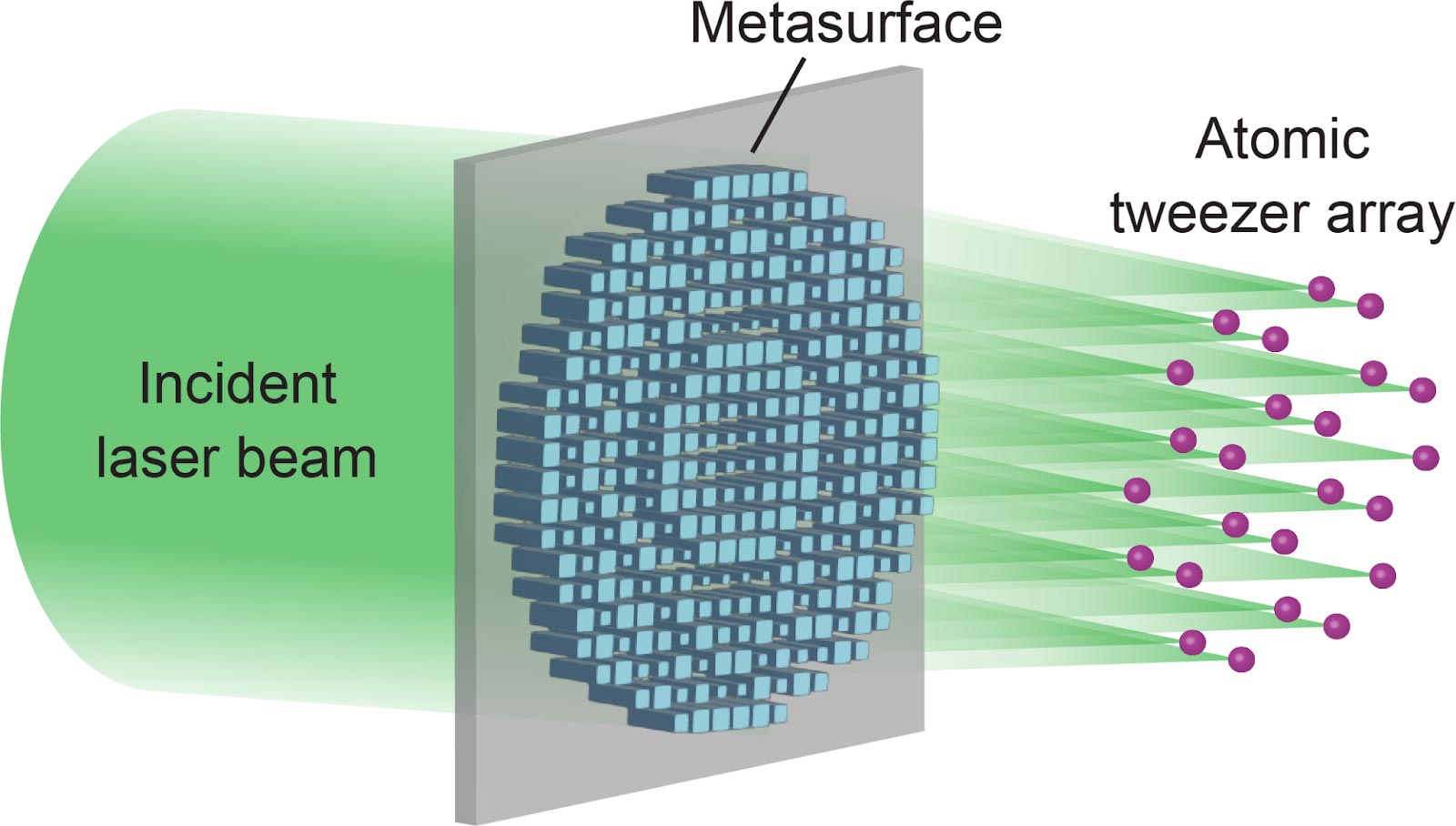
For the past decade, researchers have relied on optical tweezer arrays to trap individual atoms. An optical tweezer is a tightly focused laser beam that holds a single atom at its focal point.
Large arrays are formed by generating many such beams, typically using spatial light modulators (SLMs) or acousto optic deflectors (AODs). Using these tools, a team at Caltech recently created arrays containing 6,100 trapped atoms and showed that they could function as qubits.
“Their report is an amazing achievement,” Will said. “With our metasurface tweezer array approach, we hope to scale neutral atom arrays even further, perhaps even beyond 100,000 atoms.”
This scaling comes from a fundamentally new approach to generating optical tweezer arrays: metasurfaces. Metasurfaces are flat optical devices comprising a two-dimensional array of nanometer-sized “pixels.” When a single beam of light passes through a metasurface, it is shaped by the pixels into a unique pattern.
In the current work, the pixels are much smaller than the wavelength of the light they are manipulating: less than 200 nm, compared to the 520-nm light used for the tweezers. That means they can directly generate a tweezer array; SLM and AOD approaches require additional equipment that is bulky, expensive, and limits the ultimate size of the array.
“The metasurfaces used in this work can be considered a superposition of tens of thousands of flat lenses over the same plane and differing in their focal spot location,” said Yu, “so that upon the incidence of a laser beam, one metasurface can simultaneously produce tens of thousands of focal spots.”
Built for power and precision
The metasurfaces, made from silicon nitride and titanium dioxide, can also tolerate extremely powerful lasers with optical intensities of more than 2000 W/mm2—that’s about a million times more intense than sunlight as it reaches Earth. “The high-power handling capability of metasurfaces coupled with the scalability of cleanroom nanofabrication of ever larger and more precise devices makes our platform uniquely capable of realizing massively scalable optical tweezer arrays,” said Xu.

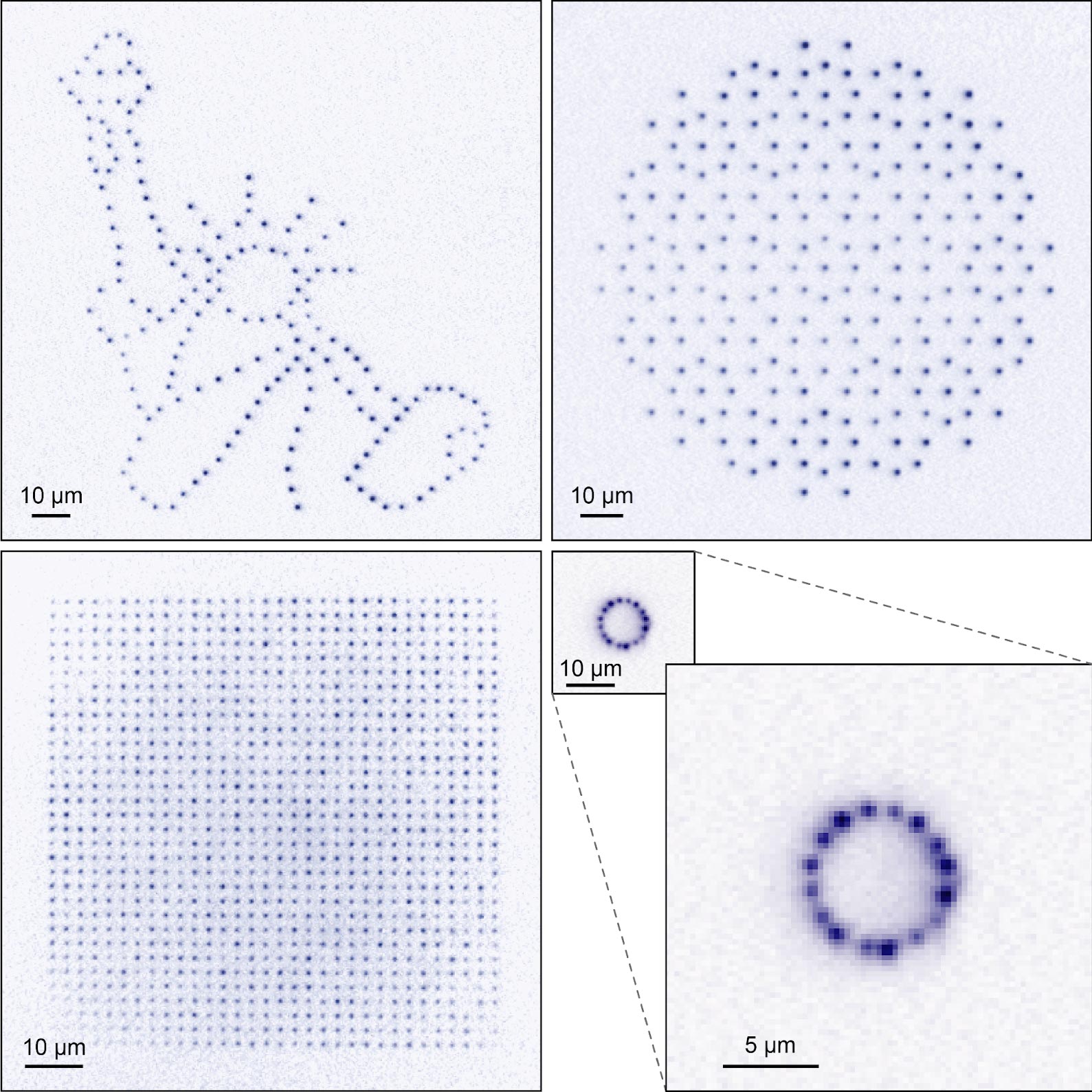
For the paper, the team demonstrated the versatility of the metasurface optical tweezer platform by trapping atoms into a number of highly uniform 2D arrays. The patterns include a square lattice with 1024 sites; quasicrystal and Statue of Liberty patterns with hundreds of sites; and a circle made up of atoms spaced just under 1.5 microns apart.
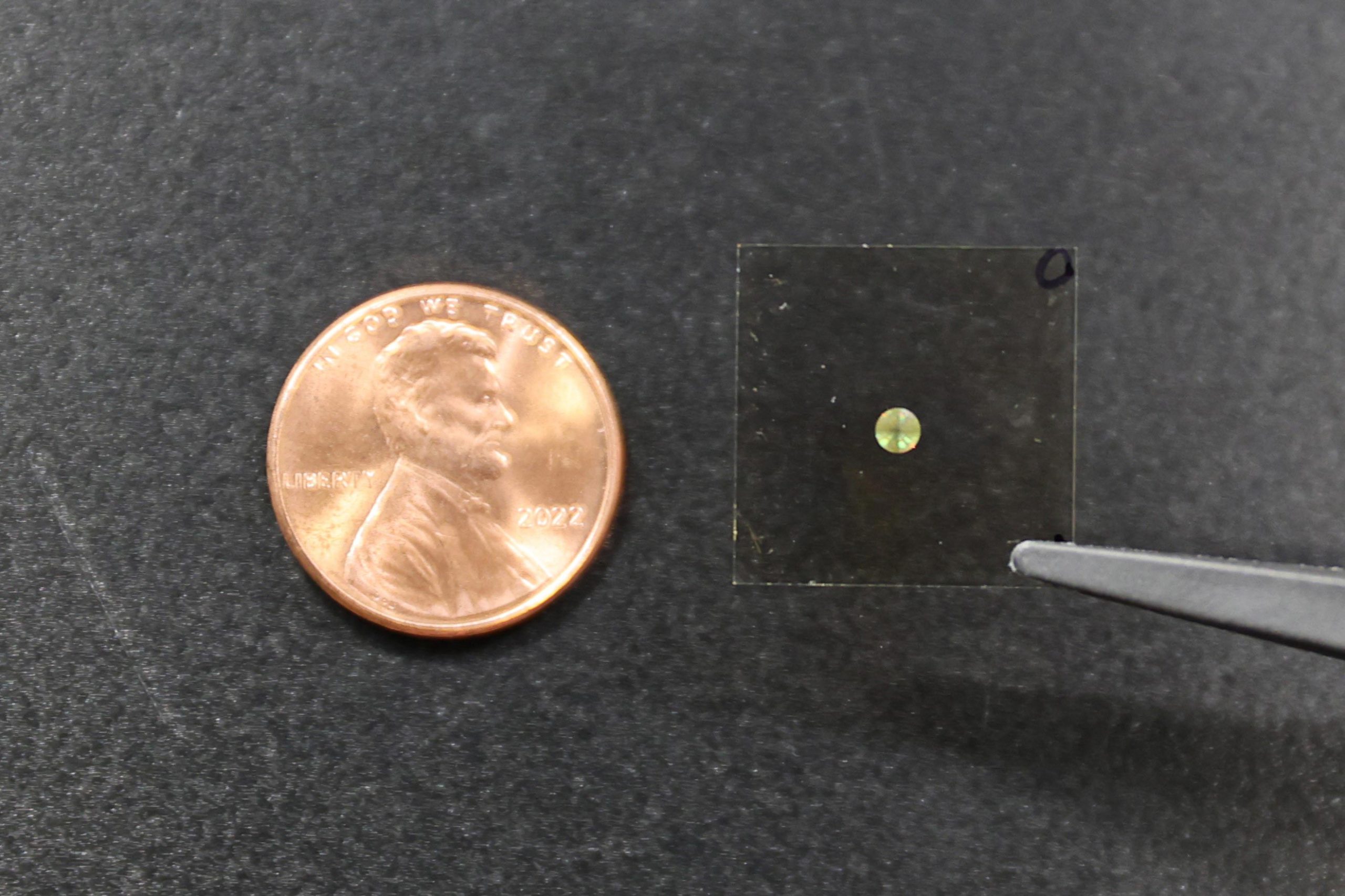
The team also created a 3.5-mm diameter metasurface containing more than 100 million pixels that generates a 600 x 600 array: that’s 360,000 optical tweezers in total, which is two orders of magnitude beyond the capabilities of current technologies.
What massive atom arrays enable next
Will and Yu see a realistic path to scalability for neutral-atom arrays, which may not only benefit quantum computers but also other neutral-atom quantum technologies, like quantum simulators, which help scientists model complex quantum many-body phenomena, and precise optical atomic clocks that could be deployed outside of laboratories.
What’s next? The team is ready to take on more atoms. To do so, they just need a bigger laser. “To trap a hundred thousand atoms, we’ll need a much more powerful laser than we currently have,” said Will. “But, it’s in a realistic range.”
Reference: “Trapping of single atoms in metasurface optical tweezer arrays” by Aaron Holman, Yuan Xu, Ximo Sun, Jiahao Wu, Mingxuan Wang, Zezheng Zhu, Bojeong Seo, Nanfang Yu and Sebastian Will, 14 January 2026, Nature.
DOI: 10.1038/s41586-025-09961-5
Never miss a breakthrough: Join the SciTechDaily newsletter.
Follow us on Google and Google News.
5 Comments
Awesome article!!! Amazing tech.
Ignoring pseudoscience will only make so-called science more hypocritical and contemptible. Please ask researchers to think deeply: How do you understand particles? How do you understand atoms and lasers?
Chinese chip?
Didnt understand nothing 🙁
To trap a hundred thousand atoms, we’ll need a much more powerful laser than we currently have.
VERY GOOD.
Please ask researchers to think deeply:
1. Why can light manipulate atoms?
2. How do you understand atoms and lasers?