
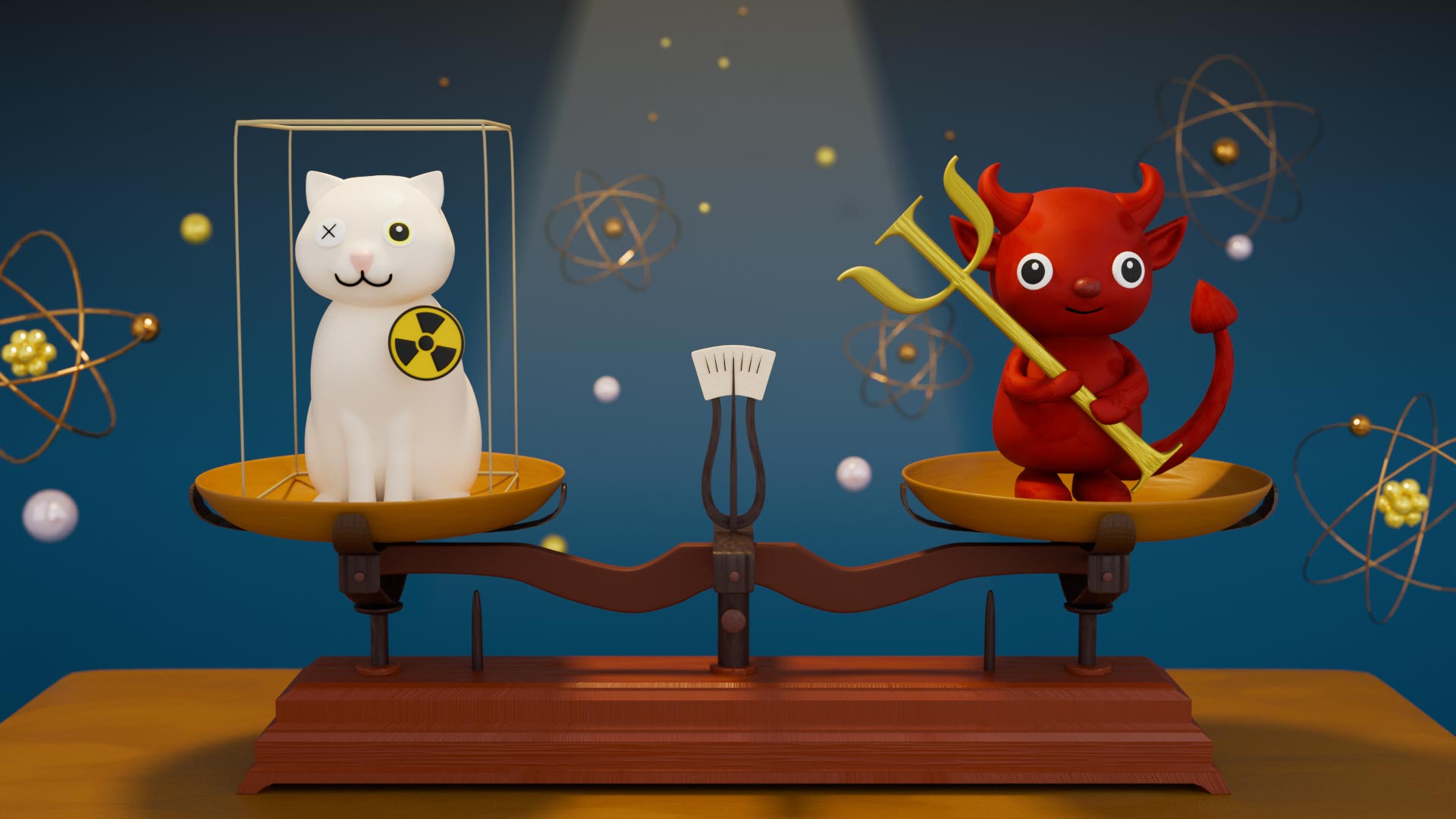
For over a century, the Maxwell’s Demon paradox has haunted physics. This thought experiment suggests that a tiny, energy-free “demon” could defy the second law of thermodynamics. Researchers put this to the test in a quantum setting, revealing that quantum mechanics allows surprising loopholes—though ultimately, thermodynamic balance always wins.
Researchers from Nagoya University in Japan and the Slovak Academy of Sciences have made a significant discovery about the relationship between quantum theory and thermodynamics. Their study, published in npj Quantum Information, reveals that while quantum theory does not strictly forbid violations of the second law of thermodynamics, quantum processes can still operate without actually breaking the law. This finding demonstrates that quantum mechanics and thermodynamics, despite being logically independent, can coexist in a complementary way.
Their research provides new insights into the thermodynamic limits of quantum technologies, including quantum computing and nanoscale engines. It also contributes to the ongoing study of the second law of thermodynamics—one of the most fundamental and intriguing principles in physics. This law states that entropy, a measure of disorder in a system, never decreases on its own. It also establishes that a cyclic engine cannot generate mechanical work solely by extracting heat from a single thermal reservoir and reinforces the idea of time’s one-way direction.
Maxwell’s Demon: A Thought Experiment That Won’t Die
Despite its foundational role, the second law remains one of the most debated and misunderstood principles in science. Central to this debate is the paradox of “Maxwell’s Demon,” a thought experiment proposed by physicist James Clerk Maxwell in 1867.
Maxwell envisioned a hypothetical being—the demon—capable of sorting fast and slow molecules within a gas at thermal equilibrium without expending energy. By separating these molecules into distinct regions, the demon could create a temperature difference. As the system returns to equilibrium, mechanical work is extracted, seemingly defying the second law of thermodynamics.
The paradox has intrigued physicists for over a century, raising questions about the law’s universality and whether it depends on the observer’s knowledge and capabilities. Solutions to the paradox have largely centered on treating the demon as a physical system subject to thermodynamic laws. A proposed solution is erasing the demon’s memory, which would require an expenditure of mechanical work, effectively offsetting the violation of the second law.
The Demonic Engine: Testing the Limits of Thermodynamics
To explore this phenomenon further, the researchers developed a mathematical model for a “demonic engine,” a system powered by Maxwell’s demon. Their approach is rooted in the theory of quantum instruments, a framework introduced in the 1970s and 1980s to describe the most general forms of quantum measurement.
The model involves three steps: the demon measures a target system, then extracts work from it by coupling it to a thermal environment, and finally erases its memory by interacting with the same environment.
Unexpected Results: Can the Second Law Be Broken?
Using this framework, the team derived precise equations for the work expended by the demon and the work it extracts, expressed in terms of quantum information measures such as von Neumann entropy and Groenewold-Ozawa information gain. When comparing these equations, they got a surprising result.
“Our results showed that under certain conditions permitted by quantum theory, even after accounting for all costs, the work extracted can exceed the work expended, seemingly violating the second law of thermodynamics,” explained Shintaro Minagawa, a lead researcher on the project. “This revelation was as exciting as it was unexpected, challenging the assumption that quantum theory is inherently ‘demon-proof.’ There are hidden corners in the framework where Maxwell’s Demon could still work its magic.”
Quantum Theory’s Hidden Loopholes—But No Real Violations
Despite these loopholes, the researchers emphasize that they don’t pose a threat to the second law. “Our work demonstrates that, despite these theoretical vulnerabilities, it is possible to design any quantum process so that it complies with the second law,” said Hamed Mohammady. “In other words, quantum theory could potentially break the second law of thermodynamics, but it doesn’t actually have to. This establishes a remarkable harmony between quantum mechanics and thermodynamics: they remain independent but never fundamentally at odds.”
This discovery also suggests that the second law does not impose strict limitations on quantum measurements. Any process permitted by quantum theory can be implemented without violating thermodynamic principles. By refining our understanding of this interplay, the researchers aim to unlock new possibilities for quantum technologies while upholding the timeless principles of thermodynamics.
Quantum Technologies and the Future of Thermodynamics
“One thing we show in this paper is that quantum theory is really logically independent of the second law of thermodynamics. That is, it can violate the law simply because it does not ‘know’ about it at all,” Francesco Buscemi explained. “And yet—and this is just as remarkable—any quantum process can be realized without violating the second law of thermodynamics. This can be done by adding more systems until the thermodynamic balance is restored.”
he implications of this study extend beyond theoretical physics. Illuminating the thermodynamic limits of quantum systems provides a foundation for innovations in quantum computing and nanoscale engines. As we explore the quantum realm, this research serves as a reminder of the delicate balance between the fundamental laws of nature and the potential for groundbreaking technological advancements.
Reference: “Universal validity of the second law of information thermodynamics” by Shintaro Minagawa, M. Hamed Mohammady, Kenta Sakai, Kohtaro Kato and Francesco Buscemi, 7 February 2025, npj Quantum Information.
DOI: 10.1038/s41534-024-00922-w
Never miss a breakthrough: Join the SciTechDaily newsletter.
Follow us on Google and Google News.
13 Comments
For over a century, the Maxwell’s Demon paradox has haunted physics. This thought experiment suggests that a tiny, energy-free “demon” could defy the second law of thermodynamics. Researchers put this to the test in a quantum setting, revealing that quantum mechanics allows surprising loopholes—though ultimately, thermodynamic balance always wins.
Ask the researchers:
1. Why are there so many paradoxes in physics?
2. How do you understand ‘The Blind and the Elephant’? Is it just a fable?
Scientific research guided by correct theories can enable researchers to think more.
According to the Topological Vortex Theory (TVT), spins create everything, spins shape the world. There are substantial distinctions between Topological Vortex Theory (TVT) and traditional physical theories. Grounded in the inviscid and absolutely incompressible spaces, TVT introduces the concept of topological phase transitions and employs topological principles to elucidate the formation and evolution of matter in the universe, as well as the impact of interactions between topological vortices and anti-vortices on spacetime dynamics and thermodynamics.
Within TVT, low-dimensional spacetime matter serves as the foundation for high-dimensional spacetime matter, and the hierarchical structure of matter and its interaction mechanisms challenge conventional macroscopic and microscopic interpretations. The conflict between Quantum Physics and Classical Physics can be attributed to their differing focuses: Quantum Physics emphasizes low-dimensional spacetime matter, whereas Classical Physics centers on high-dimensional spacetime matter.
Subatomic particles in the quantum world often defy the familiar rules of the physical world. The fact repeatedly suggests that the familiar rules of the physical world are pseudoscience. In the familiar rules of the physical world, two sets of cobalt-60 can form the mirror image of each other by rotating in opposite directions, and should receive the Nobel Prize for physics.
Please witness the grand performance of some so-called peer review publications (including PRL, PNAS, Nature, Science, etc.). https://scitechdaily.com/microscope-spacecrafts-most-precise-test-of-key-component-of-the-theory-of-general-relativity/#comment-854286. Some so-called academic publications (including PRL, PNAS, Nature, Science, etc.) are addicted to their own small circles and have deviated from science for a long time.
As the background of various material interactions and movements, space exhibits isotropic physical characteristics. It may form various forms of spacetime vortices through topological phase transitions. Hence, vortex phenomena are ubiquitous in cosmic space, from vortices of quantum particles and living cells to tornados and black holes. Stars and radioactive elements are one of the most active topological nodes in spacetime. Utilizing them is more valuable and meaningful than simulating them. Small or micro power topology intelligent batteries may be the direction of future energy research and development for human society.
Under the topological vortex architecture, science and pseudoscience are clear at a glance. Topological Vortex Theory (TVT) can play a crucial role in elucidating the foundations of physics, establishing its principles, and combating pseudoscience. Therefore, TVT has been strongly opposed and boycotted by traditional so-called peer review publications (such as PRL, PNAS, Nature, Science, etc.).
These so-called peer review publications (including PRL, PNAS, Nature, Science, etc.) mislead the direction of science and are known for their various absurdities and wonders. They collude together, reference each other, and use so-called Impact Factor (IF) or the Nobel Prize to deceive people around.
Ask the so-called peer review publications (including PRL, PNAS, Nature, Science, etc.):
1. What are your criteria for distinguishing science from pseudoscience?
2. Is your Impact Factor (IF) the standard for distinguishing science from pseudoscience?
3. Is the Nobel Prize the standard for distinguishing science from pseudoscience?
4. What is the most important aspect of academic publications?
5. Is the most important aspect of academic publications being flashy and impractical articles?
Pseudo academic publications (including PRL, PNAS, Nature, Science, etc.) are neither inclusivity nor openness, nor transparency and fairness, and have already had a serious negative impact on the progress of science and technology. Some so-called peer review publications (including PRL, PNAS, Nature, Science, etc.) are addicted to their own small circle and no longer know what science is. They hardly know what is dirty and ugly.
Publications that mislead the public under the guise of scholarship are more reprehensible than ordinary publications. The field of physics faces an ongoing challenge in maintaining scientific rigor and integrity in the face of pervasive pseudoscientific claims. Fighting against rampant pseudoscience, physics still has a long way to go.
While my comments may be lengthy, they are necessary to combat the proliferation of rampant pseudoscience and to promote the advancement of science and technology, and also is all I can do.
Appreciate the SciTechDaily for its inclusivity, openness, transparency, and fairness. If the researchers are truly interested in science, please read: The Application of Inviscid and Absolutely Incompressible Spaces in Engineering Simulation (https://scitechdaily.com/microscope-spacecrafts-most-precise-test-of-key-component-of-the-theory-of-general-relativity/#comment-870077).
Just by the questions you asked and claims you made, I’m inclined to believe that I have ascertained the likelihood of your claims being true as less than low to middling. You ask why so many paradoxes? Do you understand what they are? They aren’t real, just thought exercises to determine if you can poke a hole in the idea. It’s looking to see if you can find an exception to a proposed (or established) theory. They are good things, not hindrances as you imply.
Ask yourself, what does your theory do better? What does it predict? Where is the math describing your idea? If you don’t have good answers to that, then your allegations of pseudoscience are preposterous.
@Jay
VERY GOOD!
You are ruly outstanding talents cultivated by physics today and so-called peer review publications (including PRL, PNAS, Nature, Science, etc.). Topology is not mathematics, it is imagination. Two sets of cobalt-60 can form the mirror image of each other by rotating in opposite directions, which is ruly science and should be awarded the Nobel Prize in Physics. The so-called peer review publications (including PRL, PNAS, Nature, Science, etc.) have played an indispensable role in popularizing the absurdities that two sets of cobalt-60 can form the mirror image of each other by rotating in opposite directions. They will be proud and honored to have a good student like you.
We must have a correct understanding that two sets of cobalt-60 can form the mirror image of each other by rotating in opposite directions, which misleads the theory of physics today.
I have not read the entirety of your comment, but spins are “naturally” obtained from relativistic quantum mechanics, from solving the Dirac equation. Therefore it is highly unlekly that spins create everything.
VERY GOOD!
The universe is not algebra, formulas, or fractions. The universe is the superposition, deflection, and entanglement of geometric shapes, is the interaction and balance of countless spacetime vortices and their fractal structures, and is the synchronous effect based on topological phase transitions in space. Vortex phenomena are ubiquitous in cosmic space, from vortices of quantum particles and living cells to tornados and black holes.
If the you are truly interested in science, please read: The Application of Inviscid and Absolutely Incompressible Spaces in Engineering Simulation (https://scitechdaily.com/microscope-spacecrafts-most-precise-test-of-key-component-of-the-theory-of-general-relativity/#comment-870077).
I’m starting to think you don’t want to be understood…
If you disagree with me, what’s so “VERY GOOD!” about it?
Also, what exactly is your problem with peer review? It exists to combat the spread of misinformation (intentonal or unintentional); people can make mistakes or be dishonest. So, what’s the problem with the concept of peer review? Do you think taking everything anybody sais as fact would be better?
You are correct.
Peer review can reduce be mistakes or be dishonest.
However, some so-called peer review publications (including PRL, PNAS, Nature, Science, etc.) are addicted to their own small circle and no longer know what science is. They stubbornly believe that two sets of cobalt-60 can form the mirror image of each other by rotating in opposite directions and should receive the Nobel Prize for physics. They mislead the direction of science and are known for their various absurdities and wonders, and hardly know what is dirty and ugly.
Like Trump, your inability to come up with any real world evidence for your claims, coupled with your insults directed at working scientists and journals, marks you out as someone divorced from reality.
You are truly an outstanding student of some so-called peer review publications (including PRL, PNAS, Nature, Science, etc.). Please continue to believe that two sets of cobalt-60 can form the mirror image of each other by rotating in opposite directions to mislead physics, which is one of the highest academic achievements in physics today and deserves the Nobel Prize for Physics.
VERY GOOD!!!
Not being as someone divorced from realistic interests and continuing to cling to the current situation of rampant greed is the best choice for research workers.
I can’t help but feel that your “spin / vortex / topology” interpretation of reality would create far more (and more obvious) incidents of uncontrolled chaos that would have potentially prevented the rise of any system as complex as human-kind.
Starting with something basic and well understood in the classical model, the generation of a single Xray photon. Try to explain this in terms of your model.
In tha case that your models. “fundamental underpinnings” are structured too differently, just do your best and we will attempt to follow along.
VERY GOOD!!!
You realize the “fundamental underpinnings” are structured too differently, indicating that you have recognized that scientific research is limited by nature.
What if you take a solar panel hook it to a laser then you magnify it wouldn’t you bend the entropy closed state or what ever call it Mcleans law or rule
Magnify a solar laser