
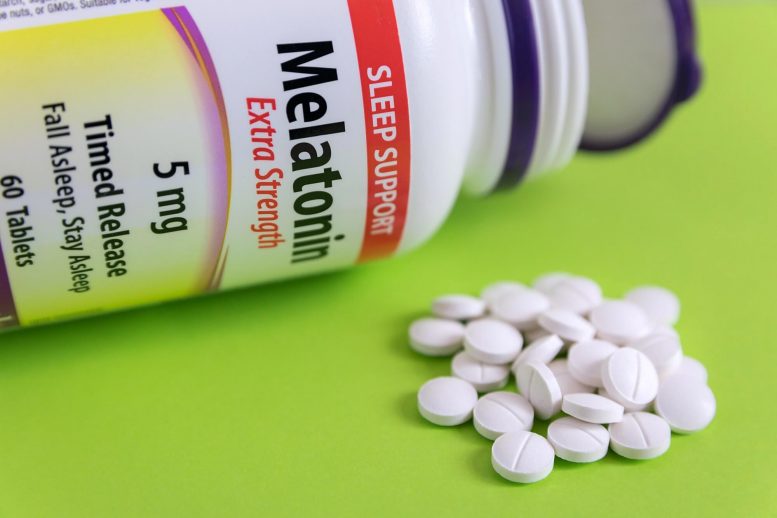
Medical sleep treatment may reduce self-harm in young people with anxiety and depression, an observational study from Karolinska Institutet in Sweden suggests. The risk of self-harm increased in the months preceding melatonin prescription and decreased thereafter, especially in girls. The study is published in The Journal of Child Psychology and Psychiatry.
Melatonin is a hormone that controls the sleep-wake cycle and is the most commonly prescribed drug for sleep disturbances in children and adolescents in Sweden. Melatonin use has dramatically increased in recent years, and it is available over the counter in Sweden since 2020.
“Given the established link between sleep problems, depression, and self-harm, we wanted to explore whether medical sleep treatment is associated with a lower rate of intentional self-harm in young people,” says Dr. Sarah Bergen, docent at the Department of Medical Epidemiology and Biostatistics, Karolinska Institutet, who led the study.
Psychiatric Disorders Were Common
The study identified over 25,500 children and teenagers between the ages of 6 and 18 who were prescribed melatonin in Sweden. Over 87 percent had at least one psychiatric disorder, mainly attention-deficit hyperactivity disorder (ADHD), anxiety disorders, depression, or autism spectrum disorder. Self-harm was about five times more common in girls than in boys.
The researchers estimated the risks of self-harm in the same individual while on or off medication by comparing the risk in the last unmedicated month with the twelve months after melatonin treatment was initiated. By doing so, they were able to take into account background factors that may affect associations, such as genetics, sleep disorder severity, or psychiatric disorders.
The risk of self-harm increased shortly before melatonin was prescribed and decreased by about half in the months following the initiation of treatment. Risk reduction was particularly evident among adolescent girls with depression and/or anxiety disorders.
Youth Mental Health Crisis
“There is currently a youth mental health crisis, and the risk of self-harm and suicide is high,” says Sarah Bergen. “Our findings support the hypothesis that sleep interventions may reduce self-harm in this population, especially in girls.”
As it was an observational study, it cannot establish a causal relationship between melatonin and reduced self-harm rates. To check whether the use of other medications might have affected the findings, analyses were also carried out which excluded antidepressant users. The results were similar.
“This suggests that melatonin might be responsible for the reduced self-harm rates, but we cannot rule out that the use of other psychiatric medications or psychotherapy may have influenced the findings,” says Dr Marica Leone, first author of the study and former PhD student in Sarah Bergen’s research group.
Reference: “Melatonin use and the risk of self-harm and unintentional injuries in youths with and without psychiatric disorders” by Marica Leone, Ralf Kuja-Halkola, Tyra Lagerberg, Johan Bjureberg, Agnieszka Butwicka, Zheng Chang, Henrik Larsson, Brian M. D’Onofrio, Amy Leval and Sarah E. Bergen, 23 March 2023, Journal of Child Psychology and Psychiatry.
DOI: 10.1111/jcpp.13785
The research was mainly financed by the European Union’s Horizon 2020 research and innovation program. Co-authors Marica Leone and Amy Leval are employees of Johnson & Johnson. Co-author Henrik Larsson has received grants from Shire Pharmaceuticals, personal and speaker fees from Medice, Shire/Takeda Pharmaceuticals and Evolan Pharma AB, and sponsorship for a conference on ADHD from Shire/Takeda Pharmaceuticals and Evolan Pharma AB, all outside the submitted work.
Never miss a breakthrough: Join the SciTechDaily newsletter.
Follow us on Google and Google News.
1 Comment
Try limiting decide time, gender confusion teachers, pornographic library material, and activities that will increase endorphins, plus a healthy dose of readin’, math, ‘arithmetic…. & prayer!
INSTEAD of a medication that will cause sleep disorders/reliance as they get older… Try THAT science: proven!