
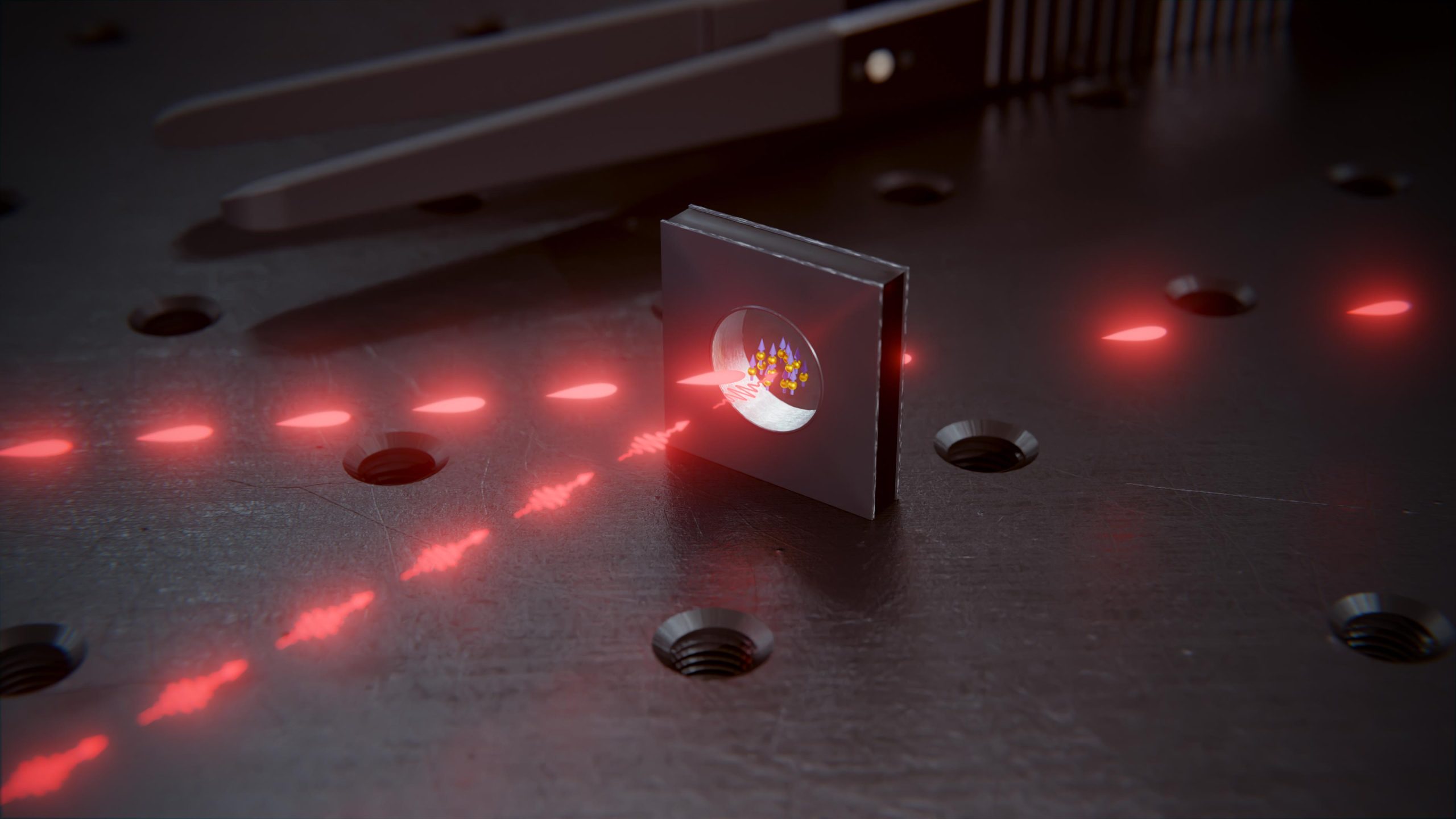
Researchers at the University of Basel have built a quantum memory element based on atoms in a tiny glass cell. In the future, such quantum memories could be mass-produced on a wafer.
It is hard to imagine our lives without networks such as the internet or mobile phone networks. In the future, similar networks are planned for quantum technologies that will enable the tap-proof transmission of messages using quantum cryptography and make it possible to connect quantum computers to each other.
Like their conventional counterparts, such quantum networks require memory elements in which information can be temporarily stored and routed as needed. A team of researchers at the University of Basel led by Professor Philipp Treutlein has now developed such a memory element, which can be micro-fabricated and is, therefore, suitable for mass production. Their results were recently published in the scientific journal Physical Review Letters.
Photon storage in glass cells
Light particles are particularly suited to transmitting quantum information. Photons can be used to send quantum information through fiber optic cables, to satellites or into a quantum memory element. There, the quantum mechanical state of the photons has to be stored as precisely as possible and, after a certain time, converted back into photons.
Two years ago, the Basel researchers demonstrated this works well using rubidium atoms in a glass cell. “However, that glass cell was handmade and several centimeters in size,” says postdoc Dr. Roberto Mottola: “To be suitable for everyday use, such cells need to be smaller and amenable to being produced in large numbers.”
That is precisely what Treutlein and his collaborators have now achieved. To use a much smaller cell measuring only a few millimeters, which they obtained from the mass production of atomic clocks, they needed to develop a few tricks. In order to have a sufficient number of rubidium atoms for quantum storage despite the small size of the cell, they had to heat up the cell to 100 degrees centigrade to increase the vapor pressure.
Moreover, they exposed the atoms to a magnetic field of 1 tesla, more than ten thousand times stronger than Earth’s magnetic field. This shifted the atomic energy levels in a way that facilitated the quantum storage of photons using an additional laser beam. This method allowed the researchers to store photons for around 100 nanoseconds. Free photons would have traveled 30 meters in that time.
A thousand quantum memories on a single wafer
“In this way, we have built, for the first time, a miniature quantum memory for photons of which around 1000 copies can be produced in parallel on a single wafer”, says Treutlein. In the current experiment, storage was demonstrated using strongly attenuated laser pulses, but in the near future, Treutlein, in collaboration with the CSEM in Neuchatel, also wants to store single photons in the miniature cells. Moreover, the format of the glass cells still needs to be optimized, such as to store the photons for as long as possible while preserving their quantum states.
Reference: “Optical Memory in a Microfabricated Rubidium Vapor Cell” by Roberto Mottola, Gianni Buser and Philipp Treutlein, 26 December 2023, Physical Review Letters.
DOI: 10.1103/PhysRevLett.131.260801
Never miss a breakthrough: Join the SciTechDaily newsletter.
Follow us on Google and Google News.
2 Comments
Their results were recently published in the scientific journal Physical Review Letters (PRL). The author has been fooled by the pseudoscientific theory of the Physics Review Letters (PRL).I hope the author can recognize Physics Review Letters (PRL) pseudoscientific nature. Physical Review Letters (PRL) firmly believe that two objects (such as two sets of cobalt-60) of high-dimensional spacetime rotating in opposite directions can be transformed into two objects that mirror each other. The Physics Review Letters (PRL) have created the most hypocritical, dirtiest, and ugliest era in the history of physics.
In the era of rampant pseudoscience, I hope that more scientific workers can bravely participate in the struggle against pseudoscience.