
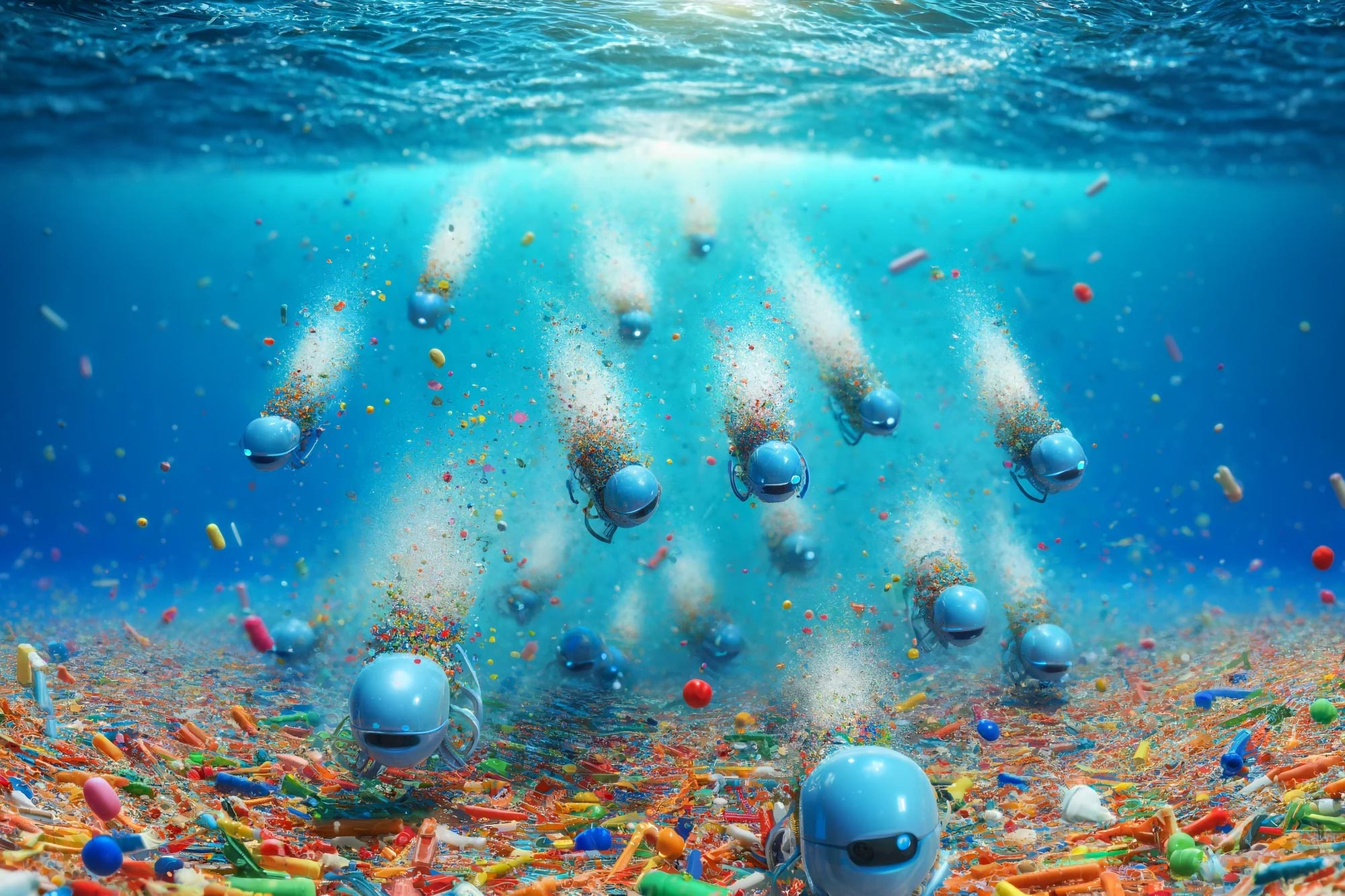
Researchers have developed microrobots capable of removing microplastics and bacteria from water, addressing the dual threat of pollution and disease spread in aquatic environments.
When old food packaging, discarded children’s toys, and other mismanaged plastic waste break down into microplastics, they become even harder to clean up from oceans and waterways. These tiny bits of plastic also attract bacteria, including those that cause disease. In a study in ACS Nano, researchers describe swarms of microscale robots (microrobots) that captured bits of plastic and bacteria from water. Afterward, the bots were decontaminated and reused. Watch a video of them swarming:
Reporting in ACS Nano, researchers made tiny magnetic beads that swarm through contaminated water picking up contaminants like microplastics and bacteria.
The size of microplastics, which measure 5 millimeters or less, adds another dimension to the plastic pollution problem because animals can eat them, potentially being harmed or passing the particles into the food chain that ends with humans. So far, the health effects for people are not fully understood.
However, microplastics themselves aren’t the only concern. These pieces attract bacteria, including pathogens, which can also be ingested. To remove microbes and plastic from water simultaneously, Martin Pumera and colleagues turned to microscale robotic systems, comprised of many small components that work collaboratively, mimicking natural swarms, like schools of fish.

To construct the bots, the team linked strands of a positively charged polymer to magnetic microparticles, which only move when exposed to a magnetic field. The polymer strands, which radiate from the surface of the beads, attract both plastics and microbes. And the finished products — the individual robots — measured 2.8 micrometers in diameter.
When exposed to a rotating magnetic field, the robots swarmed together. By adjusting the number of robots that self-organized into flat clusters, the researchers found that they could alter the swarm’s movement and speed.
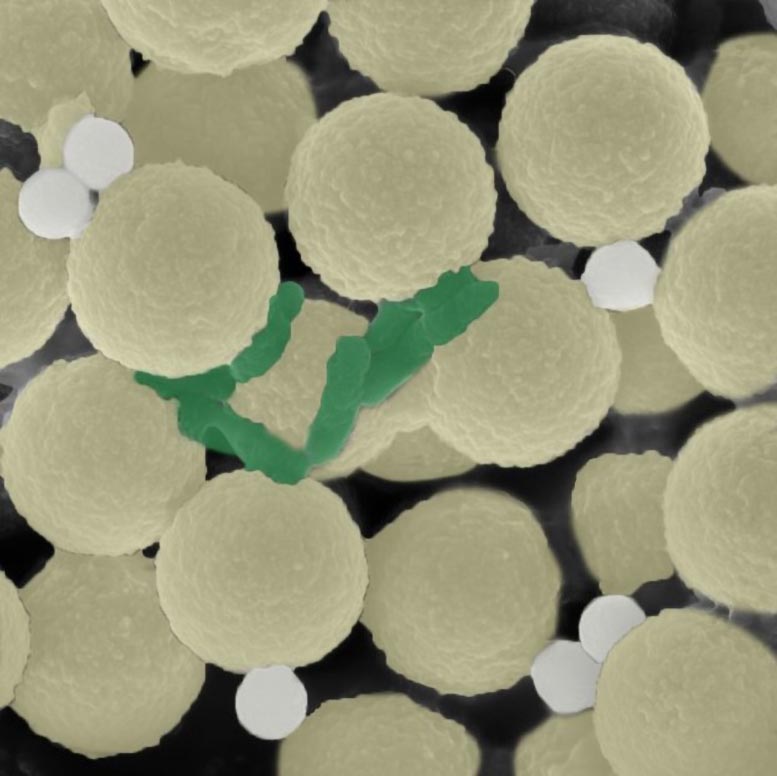
In lab experiments, the team replicated microplastics and bacteria in the environment by adding fluorescent polystyrene beads (1 micrometer-wide) and actively swimming Pseudomonas aeruginosa bacteria, which can cause pneumonia and other infections, to a water tank.
Next, the researchers added microrobots to the tank and exposed them to a rotating magnetic field for 30 minutes, switching it on and off every 10 seconds. A robot concentration of 7.5 milligrams per milliliter, the densest of four concentrations tested, captured approximately 80% of the bacteria. Meanwhile, at this same concentration, the number of free plastic beads also gradually dropped, as they were drawn to the microrobots.
Afterward, the researchers collected the robots with a permanent magnet and used ultrasound to detach the bacteria clinging to them. They then exposed the removed microbes to ultraviolet radiation, completing the disinfection. When reused, the decontaminated robots still picked up plastic and microbes, albeit smaller amounts of both. This microrobotic system provides a promising approach for ridding water of plastic and bacteria, the researchers note.
Reference: “Magnetic Microrobot Swarms with Polymeric Hands Catching Bacteria and Microplastics in Water” by Martina Ussia, Mario Urso, Cagatay M. Oral, Xia Peng and Martin Pumera, 8 May 2024, ACS Nano.
DOI: 10.1021/acsnano.4c02115
The authors acknowledge funding from the European Regional Development Fund/Europeal Social Fund project TECHSCALE, the REFRESH program of the European Union and CzechNanoLab.
Never miss a breakthrough: Join the SciTechDaily newsletter.
Follow us on Google and Google News.
7 Comments
Cars, toasters, mobile phones, etc. aren’t robots… I don’t understand why these particles are called robots, call it what it is! A polymeric-magnetic bead! It not just this article but also the research publication that is hype.
After the microbots have removed the microplastic – who’s gonna remove the microbots?
It should be a any screen vibration protocol with a less than 2 micron screen pan system maybe 2,5 microns even maybe 2.8 microns
Leaving with other techniques the picked up plastic above —usuuallynin a control nest array of other meshes —and further means. Esides gibration yo filter away
Seem like this could wowill be switched up to better efficiencies
So what happens when these things are swallowed by aquatic animals
The fish will eat
Thecfish will eat
This is just plain stupid. They’ll get eaten by animals, if they stop working they’ll become a part of the littering and it’s just plain stupid.