

Close Menu
    Facebook X (Twitter) Instagram
    SciTechDaily
    • Biology
    • Chemistry
    • Earth
    • Health
    • Physics
    • Science
    • Space
    • Technology
    Facebook X (Twitter) Pinterest YouTube RSS
    SciTechDaily
    Home»Science»Mid-Cretaceous Amber Unlocks the Secret to Caddisfly Swarming and Its Disappearance 50 Million Years Ago
    Science

    Mid-Cretaceous Amber Unlocks the Secret to Caddisfly Swarming and Its Disappearance 50 Million Years Ago

    By Science China PressOctober 16, 20241 Comment3 Mins Read
    Facebook Twitter Pinterest Telegram LinkedIn WhatsApp Email Reddit
    Share
    Facebook Twitter LinkedIn Pinterest Telegram Email Reddit
    Ecological Reconstruction of Copulariella ramus
    Ecological reconstruction of Copulariella ramus. Credit: Wang, Engel, Zhang, Shih et Ren 2024. Painted by Ms. Xiaoran Zuo.

    Caddisfly swarming behavior, identified from mid-Cretaceous amber, may have diminished in response to the rise of echolocating bats.

    A new study reveals that swarming behavior in caddisflies likely began in the Triassic but was frequently lost around 50–53 million years ago due to predation from echolocating bats, which the insects could not detect.

    The research was led by Professor Dong Ren and Dr. Jiajia Wang (College of Life Sciences, Capital Normal University). The obvious aggregations, a large gathering of adult caddisflies, were found in six small mid-Cretaceous Kachin amber pieces.

    The Mid-Cretaceous swarming of Trichoptera is identified according to the results of Principal Component Analysis based on the morphological traits of wing shape, as well as other morphological evidence such as the presence of sexual dimorphism and the extended phalli of males.

    Evolutionary Origins of Swarming

    Results of a phylogenetic reconstruction of both molecular and morphological data as well as ancestral-trait reconstructions and tip-dating analyses indicate that swarming was likely present in the Triassic as a feature of the trichopteran groundplan.
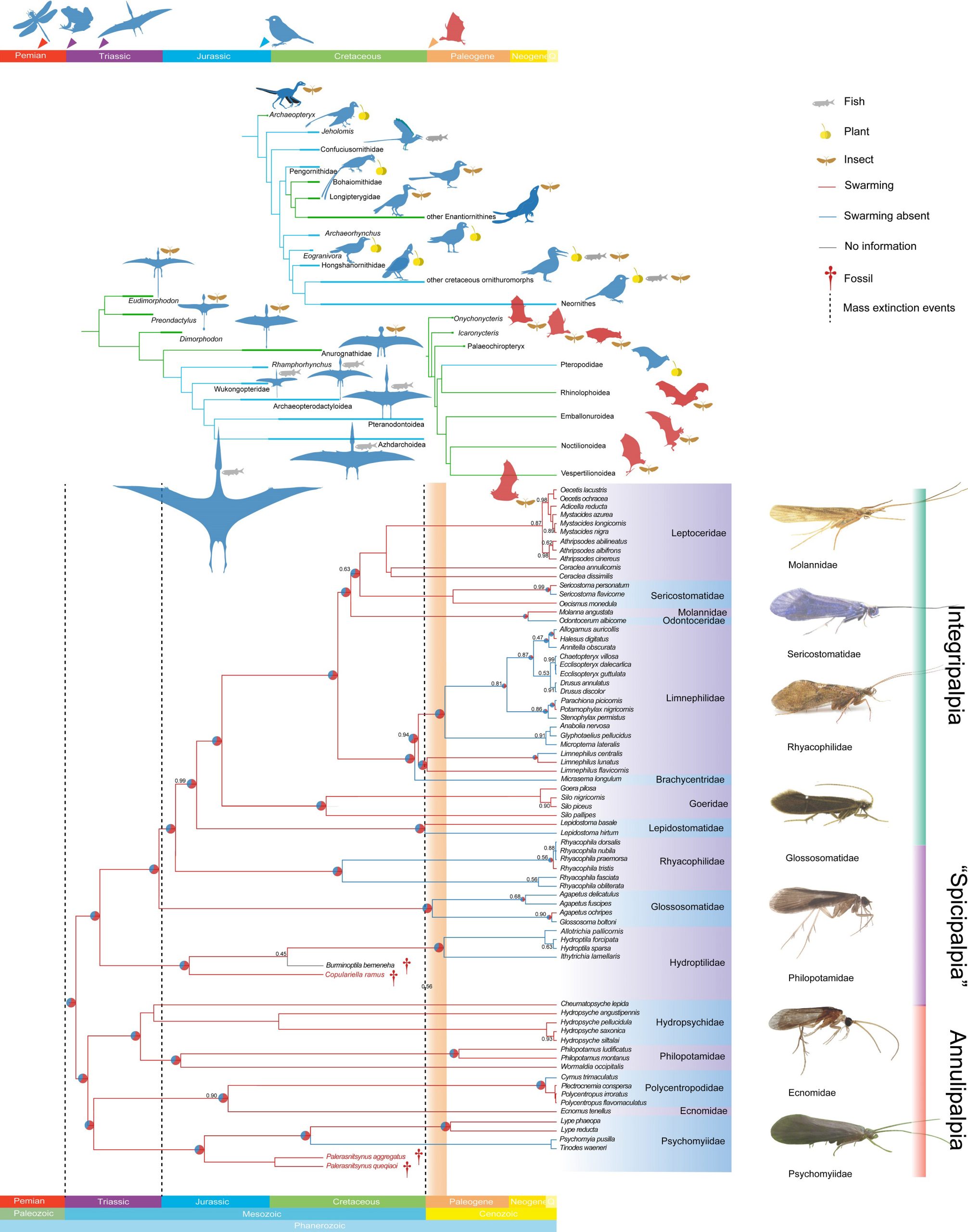
    Phylogenetic Analysis and Ancestral Reconstruction of Swarming Behavior for Trichoptera and Their Main Predators
    The ancestral reconstruction of swarming behavior based on morphological and molecular data using a Bayesian total-evidenced dating method with a molecular backbone constraint. The data source of trichopteran species comes from GenBank and NCBI. Credit: Jiajia Wang

    In order to reconstruct patterns of swarming during trichopteran evolution, the team took a Bayesian Evolutionary Analysis Sampling Tree based on 30 morphological characters and six molecular sequences. In this analysis, they selected 79 trichopteran species from 15 families, which include the major superfamilies and swarming groups. Swarming behavior was reconstructed as a synapomorphy of Trichoptera based on the ancestral trait reconstruction.

    Loss of Swarming Behavior

    The researchers also found that many trichopteran families lost swarming behavior about 50–53 million years ago. This episode of time is critical as it was coeval with the rise of echolocating bats. Tympanic organs and other sound-detecting organs of similar attunement have not been present in extant or fossil Trichoptera, so the caddisflies cannot detect bat ultrasound.

    This phenomenon shows that the presence of echolocating bats resulted in significant pressure on swarming Trichoptera, and it was possible that this was a contributing factor to the repeated loss of swarming behavior by various trichopterans during the Eocene, representing a strategic response to bat predation. Although birds and pterosaurs were the major small-flying predators from the Mesozoic, they seemingly had little impact on swarming because most Mesozoic flying insectivorous predators were also diurnal while the swarming began mainly after dusk and peaked before midnight.

    This study shows a correlation between the rise of nocturnal bat predators from the Paleocene or Early Eocene and the repeated loss of swarming from various clades of caddisflies, revealing the potential impact of bat predation on reshaping the behavioral landscape of Trichoptera during the Cenozoic. Trichoptera diversity appeared to have fallen behind that of their sister group, the Lepidoptera, during the Cenozoic, and this might have partly been a result of novel predator pressures such as those imposed by the rise of bats.

    Reference: “Swarming caddisflies in the mid-cretaceous” by Jiajia Wang, Michael S Engel, Weiting Zhang, Chungkun Shih, Rui Qiu and Dong Ren, 28 June 2024, National Science Review.
    DOI: 10.1093/nsr/nwae227

    Never miss a breakthrough: Join the SciTechDaily newsletter.
    Follow us on Google and Google News.

    Evolutionary Biology Paleontology Science China Press
    Share. Facebook Twitter Pinterest LinkedIn Email Reddit

    Related Articles

    “Utterly Bizarre” – Scientists Discover Another New Species of Dinosaur on Isle of Wight

    Three-Eyed “Fossil Monster” – 520 Million-Year-Old Fossil Reveals Amazing Detail of Early Animal Evolution

    500-Million-Year-Old Fossil Reveals Astonishing Secrets of a Strange Group of Marine Invertebrates

    The Ancient Dietary Secrets of Elephants: A Tale of Evolution and Adaptation

    Bizarre: Scientists Discover New Species of Mosasaur With Strange “Screwdriver Teeth”

    Dino Discoveries: Troodon’s Surprising Nesting Habits Revealed

    Controversial Prehistoric Egg Identified To Be the Last of the “Demon Ducks of Doom”

    World’s First: Dinosaur Discovered Sitting on Nest of Eggs With Fossilized Babies

    Turtles Share a Recent Common Ancestor with Birds and Crocodiles

    1 Comment

    1. Samuel Bess on October 17, 2024 10:58 am

      50 million years ago? Impossible.
      Based on fake unifitmiarian ancient age, this is a lie.

      Reply
    Leave A Reply Cancel Reply

    • Facebook
    • Twitter
    • Pinterest
    • YouTube

    Don't Miss a Discovery

    Subscribe for the Latest in Science & Tech!

    Trending News

    Artificial Sweeteners May Harm Future Generations, Study Suggests

    Splashdown! NASA Artemis II Returns From Record-Breaking Moon Mission

    What If Consciousness Exists Beyond Your Brain

    Scientists Finally Crack the 100-Million-Year Evolutionary Mystery of Squid and Cuttlefish

    Beyond “Safe Levels”: Study Challenges What We Know About Pesticides and Cancer

    Researchers Have Found a Dietary Compound That Increases Longevity

    Scientists Baffled by Bizarre “Living Fossil” From 275 Million Years Ago

    Your IQ at 23 Could Predict Your Wealth at 27, Study Finds

    Follow SciTechDaily
    • Facebook
    • Twitter
    • YouTube
    • Pinterest
    • Newsletter
    • RSS
    SciTech News
    • Biology News
    • Chemistry News
    • Earth News
    • Health News
    • Physics News
    • Science News
    • Space News
    • Technology News
    Recent Posts
    • What if Dark Matter Has Two Forms? Bold New Hypothesis Could Explain a Cosmic Mystery
    • Researchers Expose Hidden Chemistry of “Ore-Forming” Elements in Biology
    • Geologists Reveal the Americas Collided Earlier Than We Thought
    • 20x Difference: Study Reveals True Source of Airborne Microplastics
    • Scientists Uncover Hidden Force Powering Yellowstone’s Supervolcano
    Copyright © 1998 - 2026 SciTechDaily. All Rights Reserved.
    • Science News
    • About
    • Contact
    • Editorial Board
    • Privacy Policy
    • Terms of Use

    Type above and press Enter to search. Press Esc to cancel.