
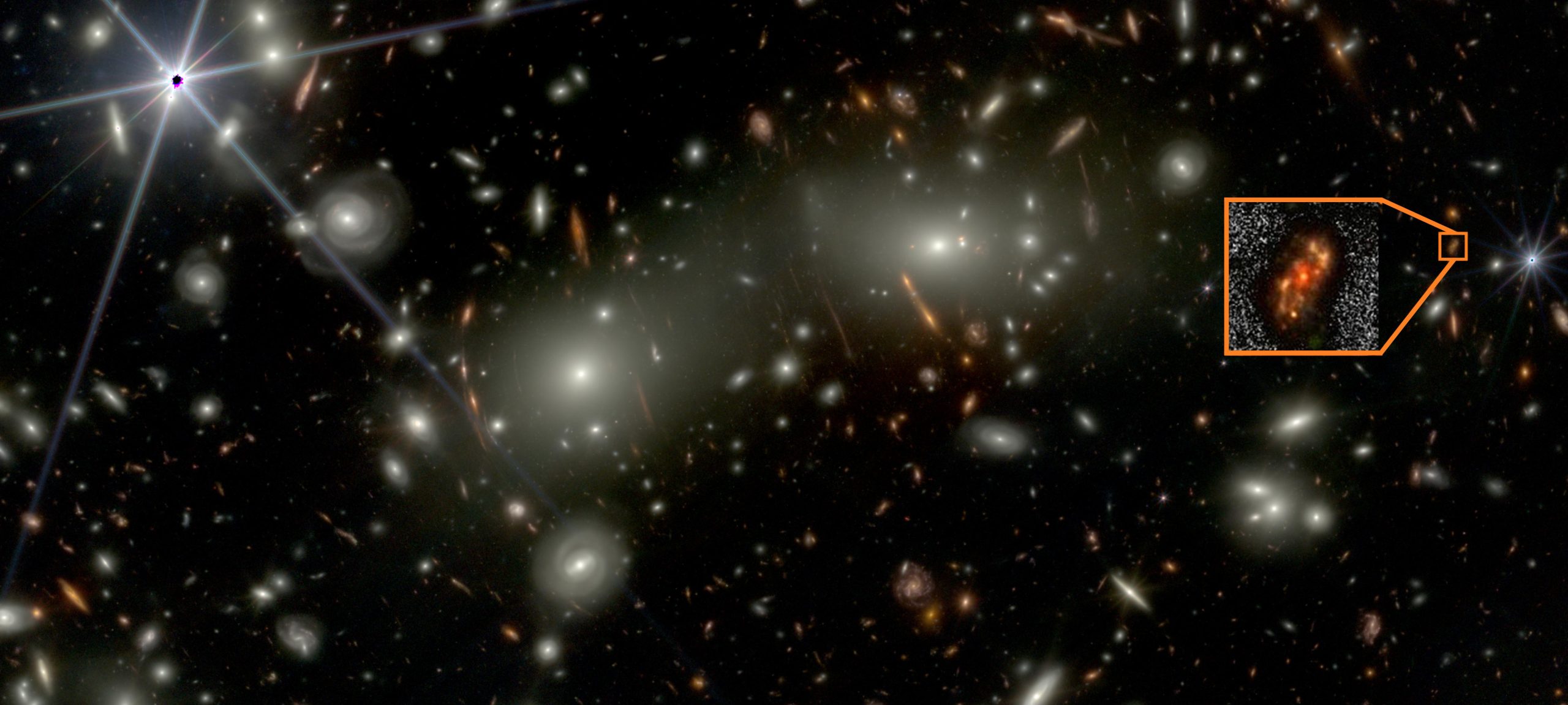
A distant spiral galaxy called Alaknanda has been found at a time when such orderly systems were thought impossible.
With clear spiral arms and intense star formation, it resembles a young version of the Milky Way. JWST data and gravitational lensing allowed astronomers to analyze it with surprising clarity. Its existence hints that galaxies in the early Universe formed and matured far faster than expected.
A Milky Way Look-Alike Detected Near the Beginning of Time
NASA’s James Webb Space Telescope (JWST) has the sensitivity to pick up extremely faint light from the early Universe, and that capability has led to an unexpected find. With JWST’s deep imaging, researchers Rashi Jain and Yogesh Wadadekar identified a galaxy that looks strikingly similar to the Milky Way. What makes this remarkable is its age. This galaxy existed when the Universe was only about 1.5 billion years old, which is roughly one tenth of its current age. The astronomers named it Alaknanda, inspired by a Himalayan river that forms one of the twin headstreams of the Ganga alongside the Mandakini, which is also the Hindi name for the Milky Way.
The work was carried out at the National Centre for Radio Astrophysics of the Tata Institute of Fundamental Research (NCRA-TIFR) in Pune, India, and the findings appear in the European journal Astronomy & Astrophysics.
A Galaxy Too Organized for Its Era
Classic spiral galaxies like the Milky Way have two well-defined, symmetrical arms (known as a ‘grand-design’ spiral), and astronomers have long believed that such structure takes billions of years to develop. The standard expectation was that galaxies in the early Universe should look messy and irregular, still assembling their stars and gas rather than forming the distinctive spirals seen nearby today. Creating a grand-design spiral requires several steps: gas must stream in from the surrounding environment (called ‘gas accretion’), settle into a rotating disk, and then slow-moving disturbances (called ‘density waves’) can reshape the disk into spiral arms. The system also needs to avoid major collisions that could destroy this delicate arrangement.
Alaknanda contradicts these assumptions. It already displays two prominent spiral arms that sweep around a bright, rounded central region (the galaxy’s ‘bulge’), stretching across about 30,000 light-years. Even more surprising is its level of star formation, which adds the mass of about 60 Suns each year. That rate is approximately 20 times faster than what the Milky Way produces today. And about half of Alaknanda’s stars may have formed in only 200 million years, which is extremely rapid on cosmic timescales.
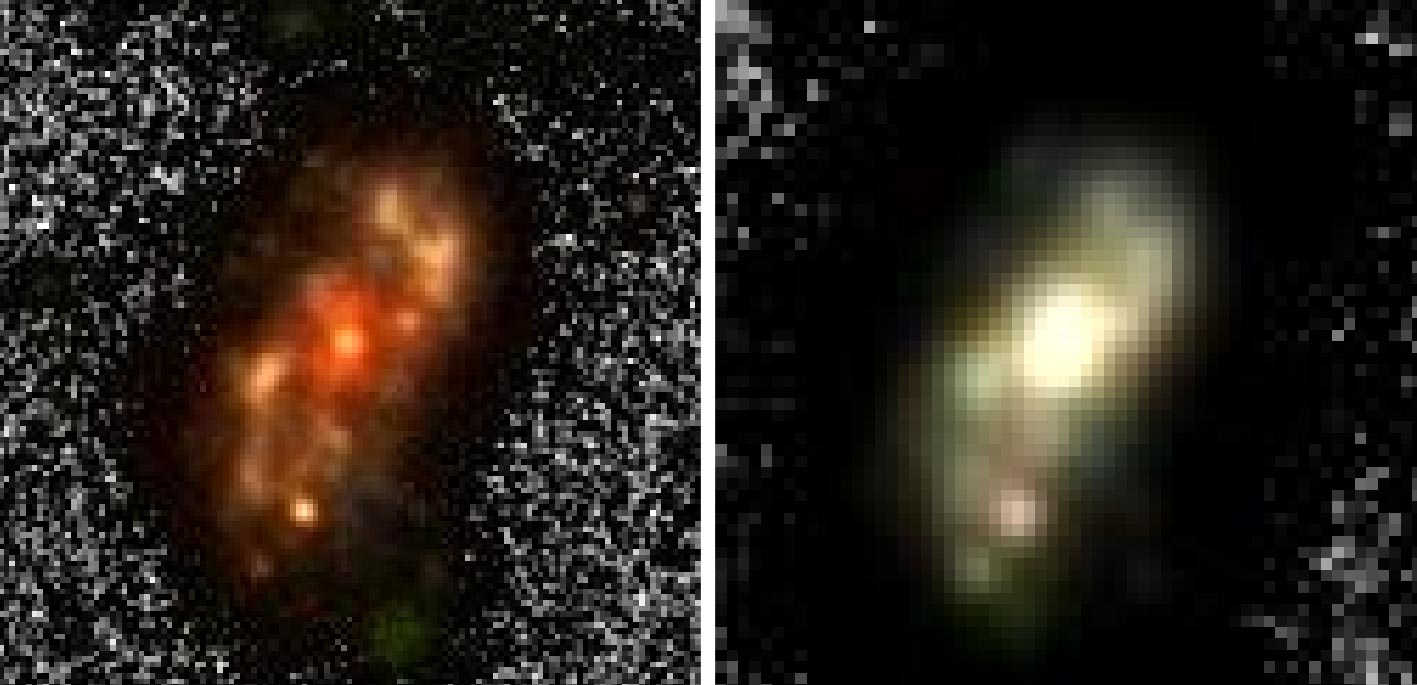
“Alaknanda has the structural maturity we associate with galaxies that are billions of years older,” explains Rashi Jain, the study’s lead author. “Finding such a well-organised spiral disk at this epoch tells us that the physical processes driving galaxy formation—gas accretion, disk settling, and possibly the development of spiral density waves—can operate far more efficiently than current models predict. It’s forcing us to rethink our theoretical framework.”
Gravitational Lensing Reveals Hidden Detail
Alaknanda lies in the direction of a huge galaxy cluster called Abell 2744, also known as Pandora’s Cluster. The cluster’s intense gravity bends and magnifies the light from galaxies behind it, acting like a natural zoom lens. This gravitational lensing effect made Alaknanda appear about twice as bright, giving JWST an unusually sharp look at its structure.
To study the galaxy more thoroughly, Jain and Wadadekar examined JWST images taken through up to 21 different filters, each capturing a different range of wavelengths. These observations, which are part of JWST’s UNCOVER and MegaScience surveys, allowed the team to measure the galaxy’s distance, dust levels, total stellar content, and the history of its star formation with impressive accuracy.
A Faster and More Advanced Early Universe
This discovery adds to a growing number of JWST results suggesting that the early Universe was much more evolved than scientists once believed. Several disk-shaped galaxies have been found at similar distances, but Alaknanda is one of the clearest examples of a classic “grand-design” spiral (a galaxy with two prominent, symmetric arms) appearing so early in cosmic history.
“Alaknanda reveals that the early Universe was capable of far more rapid galaxy assembly than we anticipated,” says Yogesh Wadadekar, the study’s co-author. “Somehow, this galaxy managed to pull together ten billion solar masses of stars and organise them into a beautiful spiral disk in just a few hundred million years. That’s extraordinarily fast by cosmic standards, and it compels astronomers to rethink how galaxies form.”
Researchers are now turning to the question of how Alaknanda developed its spiral arms. One idea is that smooth inflows of cold gas allowed density waves to naturally sculpt the disk into a spiral. Another possibility is that a close pass by a smaller companion galaxy set off the spiral pattern, although such tidally induced spirals usually disappear quickly. JWST’s spectroscopic tools or observations from the Atacama Large Millimeter Array (ALMA) in Chile may help determine whether the galaxy’s disk rotates in an orderly fashion (dynamically “cold”) or shows signs of turbulence (dynamically “hot”), which will provide clues about its formation process.
Why This Matters for Understanding Cosmic History
This finding is much more than a spectacular image from the distant past. It pushes astronomers to revisit the timeline of cosmic evolution, including how stars, galaxies, and even planets like Earth emerged. If galaxies could organize themselves so quickly, the early Universe must have been far more active and productive than earlier theories suggested, possibly allowing the conditions for planet formation to arise sooner than expected.
As JWST continues exploring deeper into the cosmos, more early spirals like Alaknanda are likely to appear, each offering new evidence of how fast the young Universe built its first complex structures.
The existence of Alaknanda shows that the early cosmos had the ability to create stable, disk-dominated galaxies much earlier than previously believed, and it remains the furthest known example of a grand-design spiral discovered so far.
Reference: “A grand-design spiral galaxy 1.5 billion years after the Big Bang with JWST” by Rashi Jain and Yogesh Wadadekar, 10 November 2025, Astronomy & Astrophysics.
DOI: 10.1051/0004-6361/202451689
Never miss a breakthrough: Join the SciTechDaily newsletter.
Follow us on Google and Google News.
4 Comments
People weren’t even around then to find something that happened right after the big
bang. People didn’t come around until many
billion years later. So no one could have seen this milky way twin. Also I wanna see a video of the big bang, I don’t believe that happened either. And no fake videos of it either. The microwave back radiation isn’t really there either, they didn’t have microwave ovens back then around the tine of the big bang.
But JWST was not fooled.
B Memo 2512090310_Source 1. Reinterpretation []
Source 1.
https://scitechdaily.com/milky-way-twin-found-shockingly-soon-after-the-big-bang/
1.
Milky Way Twin Shockingly Discovered Soon After the Big Bang
1-1.
_A distant spiral galaxy named Alaknanda was discovered at a time when such an ordered system was thought impossible.
With its distinct spiral arms and intense star formation, it resembles a young Milky Way.
_JWST data and gravitational lensing allowed astronomers to analyze this galaxy with surprising clarity, suggesting that galaxies in the early Universe formed and matured much more quickly than previously thought.
>_Something Similar to the Milky Way Discovered at the Beginning of Time
1-1.
NASA’s James Webb Space Telescope (JWST) has discovered a galaxy in the early Universe that bears a striking resemblance to our own Milky Way.
What makes this galaxy even more remarkable is its age. It existed when the universe was only about 1.5 billion years old, roughly one-tenth of its current age.
1-1. A Galaxy Unusually Organized for Its Age
Classical spiral galaxies like our own Milky Way have two distinct, symmetrical arms (called “grand-design” spirals), and astronomers have long believed that this structure takes billions of years to form.
The general expectation was that galaxies in the early Universe would appear messy and irregular, constantly accumulating stars and gas, rather than forming the distinctive spirals we see around us today.
Forming a grand-design spiral requires several steps: gas flows in from the surrounding environment (called “gas accretion”), settles into a rotating disk, and slow-moving disturbances (called “density waves”) transform the disk into spiral arms. Furthermore, the system must avoid a major collision that could destroy this delicate arrangement.
1-2.
_Alaknanda refutes this assumption. Alaknanda already has two distinct spiral arms surrounding a bright, round central region (the galaxy’s “bulge”), spanning about 30,000 light-years.
_Even more surprising is Alaknanda’s rate of star formation, adding about 60 suns’ worth of mass each year. This rate is about 20 times faster than our own galaxy is currently producing mass. And about half of Alaknanda’s stars likely formed in just 200 million years—an incredibly fast rate on cosmic timescales.
2.
_”Alaknanda has a structural maturity associated with galaxies that are billions of years older,” explains Rashi Jain, lead author of the study.
“The discovery of such a well-organized spiral disk at this time suggests that the physical processes driving galaxy formation—gas accretion, disk subsidence, and perhaps the generation of spiral density waves—may operate much more efficiently than current models predict. This forces us to rethink our theoretical framework.”
2-1. Gravitational Lensing Reveals Hidden Details
2-2. A Faster, More Advanced Early Universe
This discovery adds to a growing trend of JWST results suggesting that the early universe was much more evolved than scientists once believed.
Although several disk-shaped galaxies have been discovered at similar distances, Alaknanda is one of the clearest examples of a classic “grand spiral” galaxy (a galaxy with two distinct, symmetrical arms) that appeared early in cosmic history.
2-3.
“Alaknanda shows that the early universe could have formed galaxies at a much faster rate than we expected,” says study co-author Yogesh Wadadekar.
_>”Somehow, this galaxy gathered 10 billion times the mass of the Sun and formed a beautiful spiral disk in just a few hundred million years.]
_This is incredibly fast by cosmic standards, and it forces astronomers to rethink the process of galaxy formation.”
ㅡ[_>This remarkable ability of the early universe is explained in my msbase4. theory.
; It appears to have spiraled out of existence, but its past has left a reddish trace in our early universe. Hehe. 0250]
3-1.
_Researchers are now questioning how the Alaknanda galaxy developed its spiral arms.
_One hypothesis is that the smooth inflow of cool gas allowed density waves to naturally sculpt the disk into a spiral shape.
_>Another possibility is that the flyby of a smaller companion galaxy triggered the spiral pattern, but these tidal-induced spirals usually fade quickly.
ㅡ[2512090227
There is growing evidence that the early universe, as observed by James Webb, unfolded very rapidly.
The Big Bang event, which occurred in subatomic form and allowed the mass production of 5% ordinary matter within the nucleus, with only a few protons, neutrons, and electrons, is due to the decay of the Big Bang explosive force (nk2/qpeoms) of the msbase4.nk2(16) nucleus.
; Here’s an example of how small and powerful nk2 is: msbase4.galaxy.mode. 0233]
3. Why this is important for understanding cosmic history
_This discovery is more than just a spectacular image of the distant past. Astronomers must reexamine the chronology of cosmic evolution, including how stars, galaxies, and even planets like Earth formed.
If galaxies could be organized so quickly, the early universe must have been much more active and productive than previous theories suggested, and planetary conditions likely formed earlier than expected.
-[The early universe is msbase4.galaxy.power.version. The instantaneous creators of n’sc created this situation. Oh, my. All arrangements occurred in an instant and then moved on. The early universe was enormous, but there was a limit to its initial value, ms4, exemple1.bsae.size.4.
exemple1.msbase4.galaxy
01100716
15090802
14061203
04110713
This msbase4. galaxy instantaneously created 672 Newton’s Cradle beads, then spiraled into powers of 672 at infinite speed.
And power.energy.qqcell vanished like the last bead in Newton’s cradle.
And somewhere, like the first bead (00) instanton, another Newton’s pendulum string msbase4.672 power. Up version will hit. 0245,59]
[
<Researchers are now questioning how the Alaknanda galaxy developed its spiral arms.
<<Another possibility is that a close pass of a smaller companion galaxy triggered the spiral pattern, but these tidally induced spirals usually fade quickly. ]
]
3-1.
As JWST continues to explore deeper into space, more early spiral galaxies like Alaknanda are likely to emerge, each providing new evidence of how quickly the young universe built its first complex structures.
_The existence of Alaknanda demonstrates that the early universe was capable of creating stable, disk-dominated galaxies much earlier than previously believed, and it remains the most distant example of a grand design spiral discovered to date.
Much less shocking when you discard the idea of some “Big Bang”.