
Close Menu
    Facebook X (Twitter) Instagram
    SciTechDaily
    • Biology
    • Chemistry
    • Earth
    • Health
    • Physics
    • Science
    • Space
    • Technology
    Facebook X (Twitter) Pinterest YouTube RSS
    SciTechDaily
    Home»Space»Mira Supercomputer Will Run Simulation of Our Universe
    Space

    Mira Supercomputer Will Run Simulation of Our Universe

    By SciTechDailySeptember 27, 2012No Comments2 Mins Read
    Facebook Twitter Pinterest Telegram LinkedIn WhatsApp Email Reddit
    Share
    Facebook Twitter LinkedIn Pinterest Telegram Email Reddit
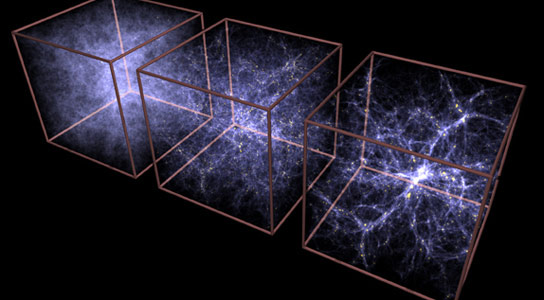
    dark-energy-simulation
    Scientists plan to use supercomputers to simulate the early universe from just after the Big Bang, covering about 12 billion years.

    The advent of the Mira supercomputer, along with more powerful Sequoia and K supercomputers, marks the first time that computers have enough computational power to simulate trillions of particles on the move, running a simulation of the Universe.

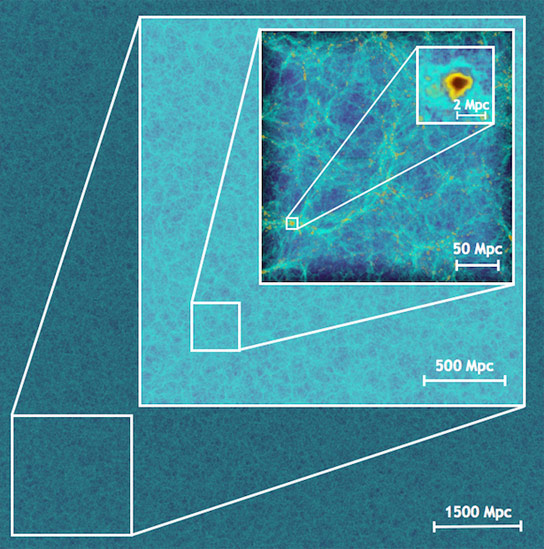
    Mira can process quadrillions of operations every second, which is rare in the machine world. It will track trillions of particles as they move, expand and react to each other. The simulation will use the known laws of physics and will try to give researchers a deeper understanding of how the cosmos came to be.
    mira-simulation

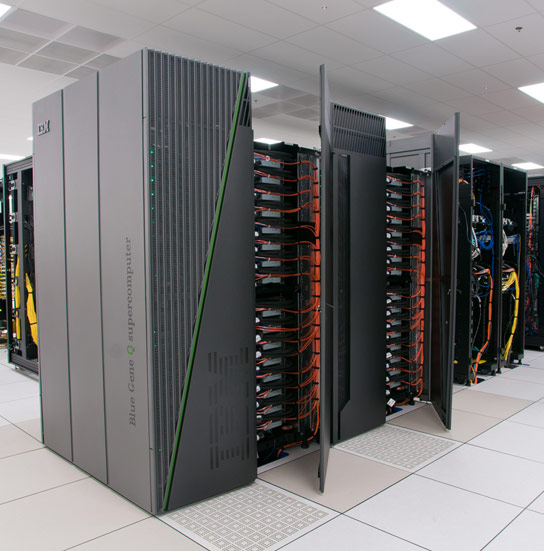
    Mira was built along IBM’s BlueGene technology and it is powered by 768,000 cores spread across 48 blade racks. It has 8 petaflops of processing power, and at its peak performance, Mira will be able to perform 10 quadrillion floating point operations per second, using up a petabyte of RAM.
    processors-mira

    Just like previous simulations, including the Bolshoi simulation, researchers at the Argonne National Laboratory are interested in learning about star formation and how entire galaxies expand, clump together and form filament structures as well as other cosmic superstructures. The scientists plan on creating a computer simulation of the early universe starting just after the Big Bang, simulating a period of roughly 12 billion years.

    The first nascent galaxies flew apart from each other, while others merged and fell into enormous clusters and filaments to form the deeper structure of the Universe. The simulation might also give indications about dark energy, which is supposed to make up the majority of the matter in the known Universe.

    Never miss a breakthrough: Join the SciTechDaily newsletter.
    Follow us on Google and Google News.

    Cosmology Dark Energy Popular Simulation Supercomputer
    Share. Facebook Twitter Pinterest LinkedIn Email Reddit

    Related Articles

    Earth Could Be in a Massive Cosmic Bubble That’s Warping the Universe, Astrophysicists Reveal

    Is Dark Energy Changing? Mysterious New Data Challenges Einstein’s Cosmological Constant

    Supercomputers Are Simulating the Universe to Unlock Its Darkest Secrets

    Is the Universe Changing? Breakthrough Data Suggests Dark Energy Is Evolving

    Universe’s Expansion Defies Explanation: New Data Shatters Cosmological Models

    Rewriting Cosmic History: DESI’s New Map Challenges Traditional Dark Energy Views

    Is the Universe Defying Einstein? New Discoveries Challenge Relativity

    Reimagining the Drake Equation: Scientists Uncover New Clues About Alien Life

    Rewriting Cosmic Calculations: New AI Unlocks the Universe’s Settings

    Leave A Reply Cancel Reply

    • Facebook
    • Twitter
    • Pinterest
    • YouTube

    Don't Miss a Discovery

    Subscribe for the Latest in Science & Tech!

    Trending News

    Beyond Pain Relief: Scientists Discover a Protein That Could Stop Osteoarthritis in Its Tracks

    Scientists Discover Why Alcohol Prevents the Liver From Healing, Even After You Quit

    Scientists Stunned As Volcano Removes Methane From the Air

    Scientists Discover Signs Africa May Be Splitting Apart Beneath Zambia

    Common Blood Pressure Drug Supercharges Cancer Treatment in Surprising New Study

    540-Million-Year-Old Fossils Reveal a Huge Surprise About Early Life on Earth

    Scientists Reverse Stroke Damage Using Stem Cells in Breakthrough Study

    Eating One Egg a Day Could Cut Alzheimer’s Risk by 27%

    Follow SciTechDaily
    • Facebook
    • Twitter
    • YouTube
    • Pinterest
    • Newsletter
    • RSS
    SciTech News
    • Biology News
    • Chemistry News
    • Earth News
    • Health News
    • Physics News
    • Science News
    • Space News
    • Technology News
    Recent Posts
    • Scientists Discover Surprising Effect of Ultra-Processed Foods Inside Thigh Muscles
    • Common Cleaning Chemical Could Triple Your Risk of a Dangerous Liver Disease
    • New Brain “Bypass” Technology Could Transform Treatment for Neurological Disorders
    • Physicists Observe Strange Quantum Rotation Effect That Defies Intuition
    • Europe Was Never a Giant Dark Forest, New 20-Million-Year Study Reveals
    Copyright © 1998 - 2026 SciTechDaily. All Rights Reserved.
    • Science News
    • About
    • Contact
    • Editorial Board
    • Privacy Policy
    • Terms of Use

    Type above and press Enter to search. Press Esc to cancel.