
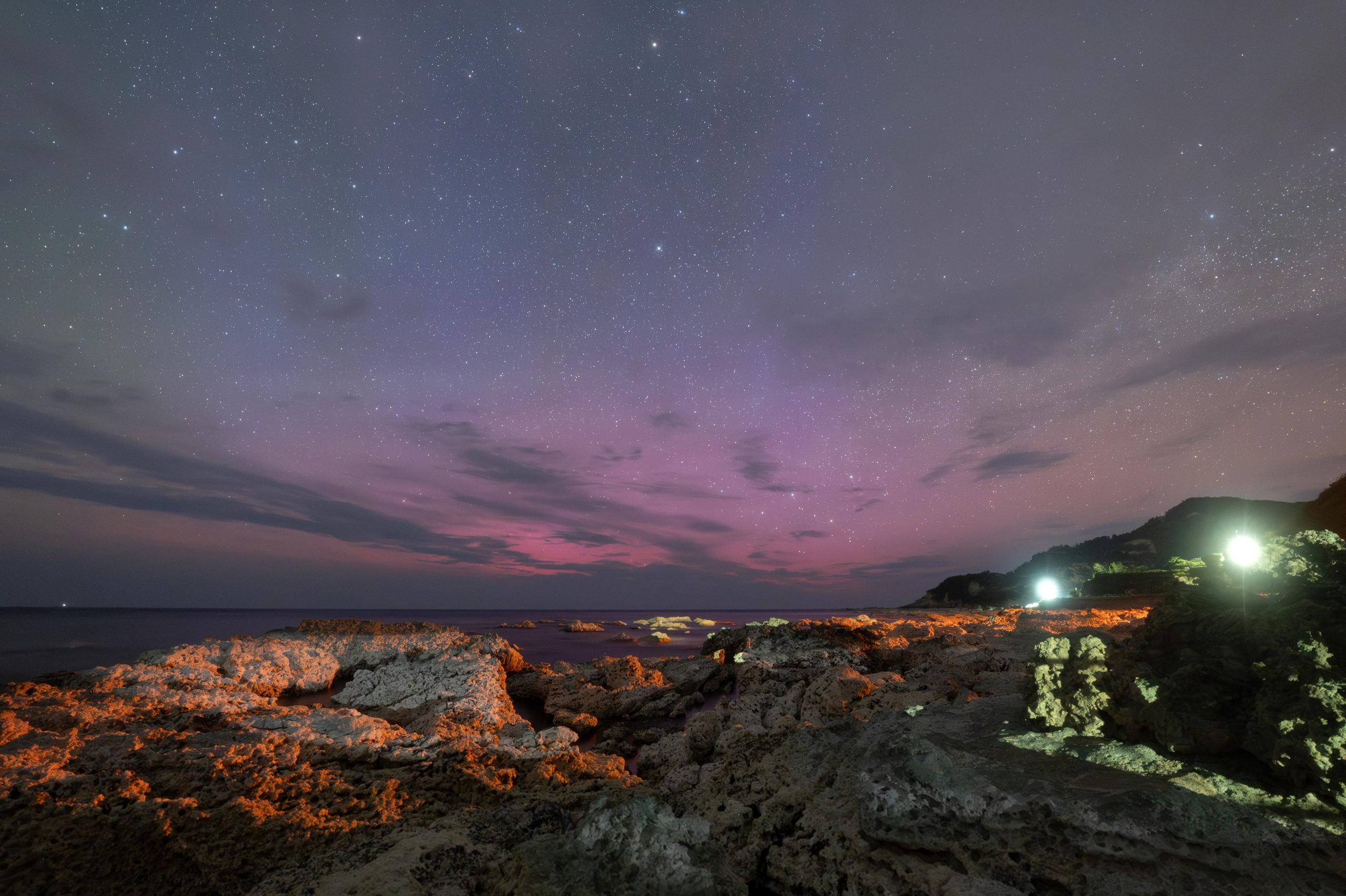
Japan recently witnessed unusual auroral activity with the appearance of salmon pink and blue-dominant auroras, resulting from a significant magnetic storm.
Researchers utilized public and scientific data to analyze these phenomena, discovering new structural details and potential formation mechanisms, challenging existing theories about auroral genesis.
Spectacular Auroras Light Up Japan
Brilliant auroras lit up the skies over Japan’s Honshu and Hokkaido islands on May 11, 2024, driven by a powerful magnetic storm. Typically, low-latitude auroras appear red due to oxygen atom emissions, but this event was unique. A salmon pink aurora persisted throughout the night, and just before midnight, a striking, unusually tall blue-dominant aurora emerged.
The spectacle was captured in smartphone videos and amateur photographs, allowing scientists to merge public contributions with their own data for detailed analysis.
In a new study, researchers used the videos and images of the blue-dominant aurora to map its extent, validating their findings with spectrophotometer measurements. The research, published on December 5 in Earth, Planets and Space, was led by Sota Nanjo, a postdoctoral researcher at the Swedish Institute of Space Physics, and Professor Kazuo Shiokawa from the Institute for Space-Earth Environmental Research (ISEE) at Nagoya University, Japan.

Unveiling the Mystery of Blue Auroras
Nanjo and Shiokawa’s investigation provided the first visualization of the spatial structure of blue-dominant auroras during a storm. The researchers found that the auroras had longitudinal structures that were aligned with magnetic field lines, the first time they had been identified in a low-latitude, blue-dominant aurora. They also found that the aurora spanned about 1200 km in longitude, consisted of three separated structures, and ranged in altitude from 400-900 km.
Nanjo and Shiokawa’s findings may change our understanding of blue auroras. The ring current, a donut-shaped region of charged particles encircling Earth, is believed to be the source of energetic neutral atoms (ENAs) that produce low-latitude auroras, including the red aurora. According to this model, the storm likely energized the ENAs, creating a colorful display of light.
Challenging Established Models
However, the group’s discoveries cannot easily be explained by this mechanism. As Shiokawa explains: “In this study, a structure of several hundred kilometers was found in the blue-dominant aurora in the longitudinal direction, which is difficult to interpret by ENA activity only. In addition, ENAs are unlikely to create auroral structures aligned with magnetic field lines, as observed in this study.”
Another possibility was that the aurora was due to the resonant scattering of nitrogen molecular ions caused by sunlight irradiation. However, the group’s research suggests that a different process occurred, as sunlight only reached down to 700 km, not the 400 km observed by the researchers.
Unidentified Processes at High Altitudes
Instead, their results may indicate the intriguing possibility of an unidentified process. “Our findings suggest that nitrogen molecular ions may have accelerated upward by some mechanism and were responsible for the formation of the blue-dominant aurora,” Shiokawa said.
“To date, it is not well understood how nitrogen molecular ions with large molecular weight can exist at such high altitudes,” he continued. “Such ions are not easily able to exist for long periods of time due to their heavy mass and short dissociative-recombination time intervals; however, they are observed at high altitudes. The process is shrouded in mystery.”
Implications for Future Research
Overall, repeated observations of blue-dominant auroras, such as the one observed in Japan, may provide clues to understand the principle behind how nitrogen can be found at these altitudes. As the process of nitrogen molecular ion outflow into the magnetosphere is important in everything from understanding geomagnetic storms and the radiation environment in space, these findings could help us understand the processes that take place hundreds of kilometers above us.
Reference: “Spatial structures of blue low-latitude aurora observed from Japan during the extreme geomagnetic storm of May 2024” by Sota Nanjo, and Kazuo Shiokawa, 5 December 2024, Earth, Planets and Space.
DOI: 10.1186/s40623-024-02090-9
Never miss a breakthrough: Join the SciTechDaily newsletter.
Follow us on Google and Google News.