
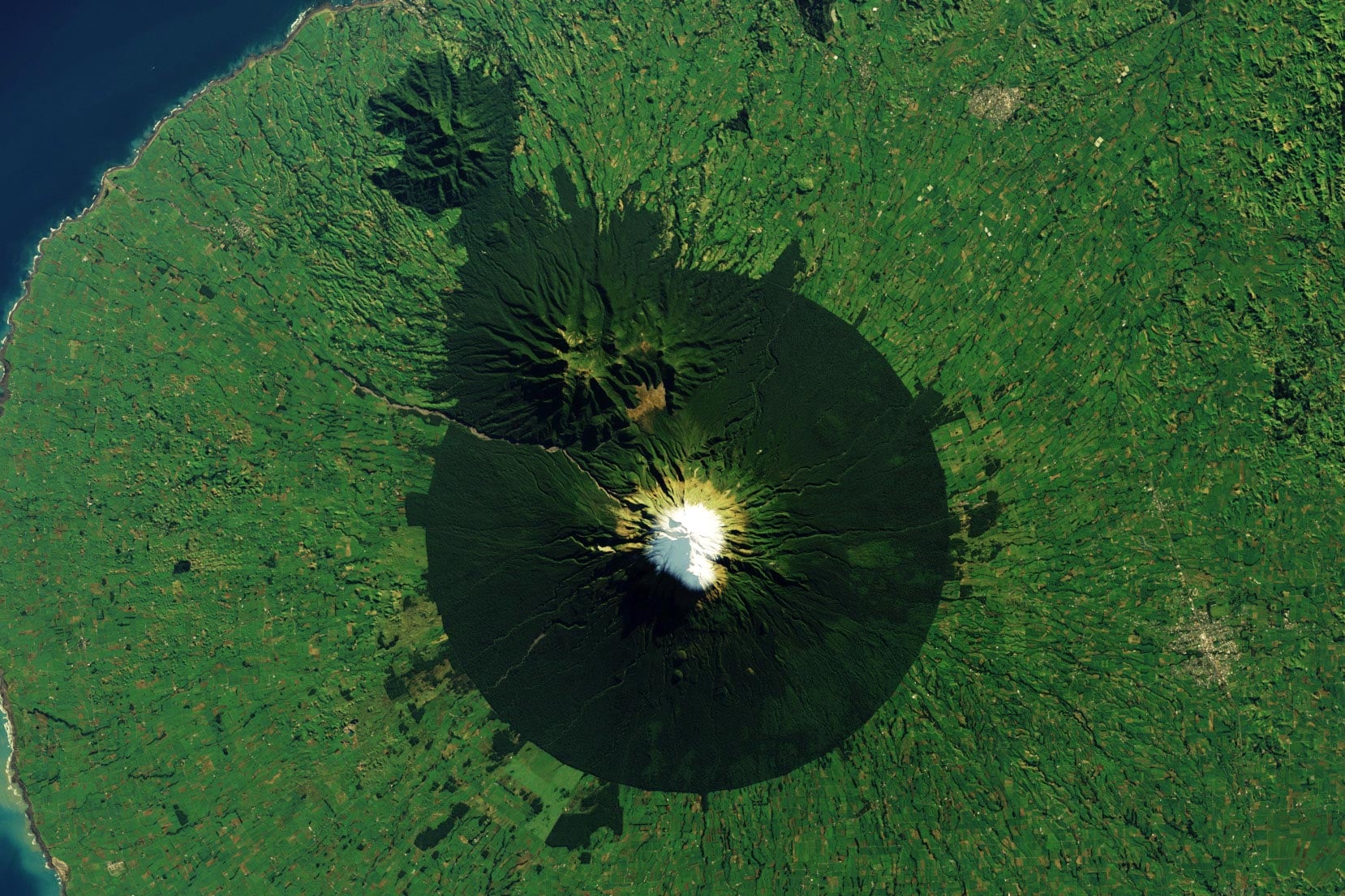
The precise geometry of the protected area encompassing an iconic New Zealand volcano, Mount Taranaki, is unmistakable from space, highlighting its status as New Zealand’s second national park.
This conical, often snow-capped volcano not only captivates with its natural beauty but also serves as a critical area for scientific research due to its unstable geological history and ongoing volcanic threats. In 2017, Mount Taranaki was granted the same legal rights as a person, emphasizing its profound cultural significance to the Indigenous Māori people.
Mount Taranaki
On New Zealand’s North Island, a conical snow-capped volcano ringed by dark green forest rises above dairy pasture. The often-snowcapped peak of Mount Taranaki (dubbed Mount Egmont by Captain Cook) is the centerpiece of Egmont National Park. A circular piece of land—with a 9.6-kilometer (6-mile) radius from the volcano’s summit—was first formally protected as a forest reserve in 1881. With some subsequent additions, it became New Zealand’s second national park in 1900.
Satellite Observations and Geology
Landsat 8’s OLI (Operational Land Imager) captured this image of Mount Taranaki in June 2023. Two older and extinct volcanoes, Kaitake and Pouakai, lie to the northwest of its peak. At 2,518 meters (8,261 feet) tall, Taranaki is the second-highest peak on New Zealand’s North Island after Ruapehu.
At the widest part of the ring around the mountain, forests of rimu and kāmahi, tall evergreen trees native to New Zealand, dominate. Stands of kāmahi have also found a niche at higher elevations in what’s known as the “Goblin Forest.” Here, they grow gnarled and twisted around trees that have been destroyed in volcanic eruptions. Moving higher, forests give way to progressively smaller bands of subalpine and alpine habitat.
Geological Instability and Hazards
Despite its neat appearance from above, the volcano has a history of dramatic change. By one count, the mountain’s edifice has collapsed and rebuilt 16 times, with each cycle sending large debris avalanches down its flanks. Steep slopes, loose sediments, high rainfall rates, and buried faults all contribute to its tendency to collapse. Avalanche deposits have accumulated to form the peninsula on which the mountain sits, and debris has even been found to extend up to 8 kilometers (5 miles) offshore.
Mount Taranaki’s last volcanic eruption was over 200 years ago, and scientists give it a 30 to 50 percent chance of erupting in the next 50 years. Hazards such as mudflows, or lahars, are still present and have occurred occasionally in the past several decades. A present-day eruption could have serious and costly consequences, researchers say, as the region is home to more than 110,000 people and economic activities such as farming, manufacturing, and energy production.

Cultural Significance and Legal Protection
Despite its inherent threats, the towering, symmetrical cone has become iconic in New Zealand culture. It has served not only as an inspiration for artwork but also as a symbol depicted on product labels, postage stamps, and even the country’s currency.
In 2017, the mountain attained a new level of protection when it was granted the same legal rights as a person, according to news reports. The status is an acknowledgment of the Indigenous Māori people’s relationship to the mountain and means that harming the mountain has the same legal implications as harming the tribe.
NASA Earth Observatory image by Wanmei Liang, using Landsat data from the U.S. Geological Survey.
Never miss a breakthrough: Join the SciTechDaily newsletter.
Follow us on Google and Google News.
3 Comments
“Mount Taranaki was granted the same legal rights as a person, …”
A right is something that an individual can exercise, such as self defense, voting, traveling, speaking publicly, and most importantly, sue in court for damages from another individual or group. Minors do not have legal standing and are not allowed generally to represent themselves, and mentally impaired people, who are not capable of representing themselves, are provided protections by society, and represented by an individual (parent) or group(s) (conservation NGOs, government agencies) to insure that legal protections are observed. Basically, an inanimate object that is not sentient is not capable of even understanding what rights are, let alone defend itself, can logically only have protections offered by those capable of suing in court. There is a spectrum of actions from ‘inalienable rights’ to ‘legal privileges’ that have important differences. Careless use of words only leads to legal problems later on. Maybe New Zealand courts are different from others, but I’m surprised that someone didn’t challenge the law as being absurd.
It’s not Mount Taranaki anymore. Has a Maori name that most wouldn’t remember, I don’t know what’s it called anymore. Maori own it.
Taranaki Maunga. Not exactly difficult, especially as Maunga (mountain) appears in dozens of New Zealand place names.