
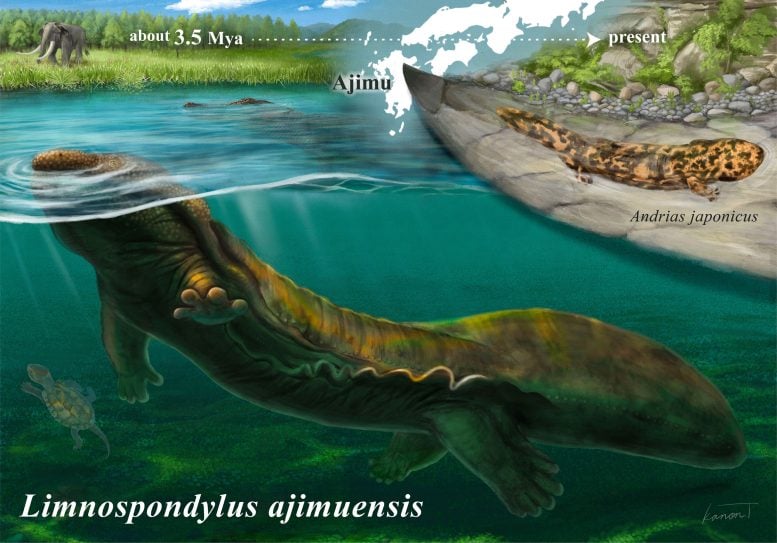
Three bones unearthed in Japan have revealed a lost giant salamander species that prowled ancient wetlands 3.5 million years ago.
Three isolated bones discovered in Japan nearly 30 years ago have turned out to belong to a giant salamander unlike any scientists had previously identified.
The animal, now named Limnospondylus ajimuensis, lived about 3.5 million years ago in the lakes and wetlands of what is now northern Kyushu. It may have grown to roughly 1.1 meters (3.6 feet) long, making it comparable in size to some of the largest amphibians alive today. Researchers estimate that it could have reached that length at around 18 years old.
Its remains were found between 1995 and 1997 in the Ajimu region of Oita Prefecture. The three fossilized vertebrae came from the Tsubusugawa Formation, a layer of ancient lake sediments that has also preserved elephants, crocodiles, and other animals no longer found in Japan.
Together, those fossils reveal a very different Kyushu. The region was warmer and wetter than it is today, with extensive freshwater lakes, marshes, and surrounding habitats capable of supporting large amphibians and reptiles.
A New Genus Emerges From Old Fossils
The salamander bones were first described in 2001 and tentatively assigned to Andrias, the genus that includes the Japanese and Chinese giant salamanders. At the time, researchers did not have enough skeletal material or detailed anatomical studies to classify them more precisely.
A Kyoto University team has now reexamined the fossils using a much broader collection of modern and extinct giant salamander specimens.
The researchers determined that the bones represented an anterior trunk vertebra, a mid-trunk vertebra, and a sacro-caudal vertebra. Because they differ in size and were recovered from separate locations, the fossils are thought to have come from different individuals rather than a single skeleton.
The decisive evidence came from the mid-trunk vertebra. It contained a distinctive combination of anatomical features not seen in any known member of the giant salamander family, Cryptobranchidae. Those differences were substantial enough to justify creating both a new species and an entirely new genus.
Filling a Gap in Salamander Evolution
“Ajimu contains the only site in the world where fossils of the giant salamander family and extant genera have both been found,” says first author Masahiro Noda. “I’m delighted that this study has highlighted Japan as a crucial region for understanding its evolutionary history.”
The name Limnospondylus combines the Greek words “limne,” meaning lake, and “spondylos,” meaning vertebra. The species name ajimuensis refers to the region where the fossils were discovered.
The finding helps fill a major gap in the history of giant salamanders, an ancient amphibian lineage that has survived for roughly 60 million years. Although members of the family once lived across much of the Northern Hemisphere, their fossil record in Asia contains a gap of more than 20 million years between previously known ancient species and their living relatives.
Only five extinct and living genera in the family had previously been described. The addition of Limnospondylus suggests that giant salamanders were once more diverse in Asia and occupied a wider range of freshwater environments than their few surviving descendants do today.
Extinction, Survival, and Conservation
It may also force scientists to reconsider fossils already stored in museum collections. Many fragmentary giant salamander remains have traditionally been assigned to Andrias because researchers lacked enough evidence to distinguish them. Some of those specimens could represent additional genera or species that have remained hidden under an overly broad classification.
Limnospondylus ajimuensis appears to have been adapted to lakes and wetlands rather than the flowing rivers favored by many giant salamanders today. Its disappearance may have followed global cooling near the end of the Pliocene, when changing temperatures transformed freshwater habitats across the region.
Yet one branch of the family endured. Andrias japonicus, the Japanese giant salamander, still inhabits rivers in the Ajimu region and elsewhere in Japan, creating a rare link between the area’s prehistoric ecosystem and its modern wildlife.
“Recently, Japan’s native giant salamanders have faced challenges such as hybridization with foreign species and habitat destruction,” says Noda. “This research has given me a renewed appreciation for the importance of preserving extant species for the future.”
Reference: “A new genus of giant salamander (Urodela, Cryptobranchidae) from the Pliocene of Japan” by Masahiro Noda, Masafumi Matsui and Kanto Nishikawa, 3 June 2026, PeerJ.
DOI: 10.7717/peerj.21362
This study was supported by the Japan Science and Technology Agency, the Environmental Restoration and Conservation Agency, and Fukada Geological Institute.
Never miss a breakthrough: Join the SciTechDaily newsletter.
Follow us on Google and Google News.