
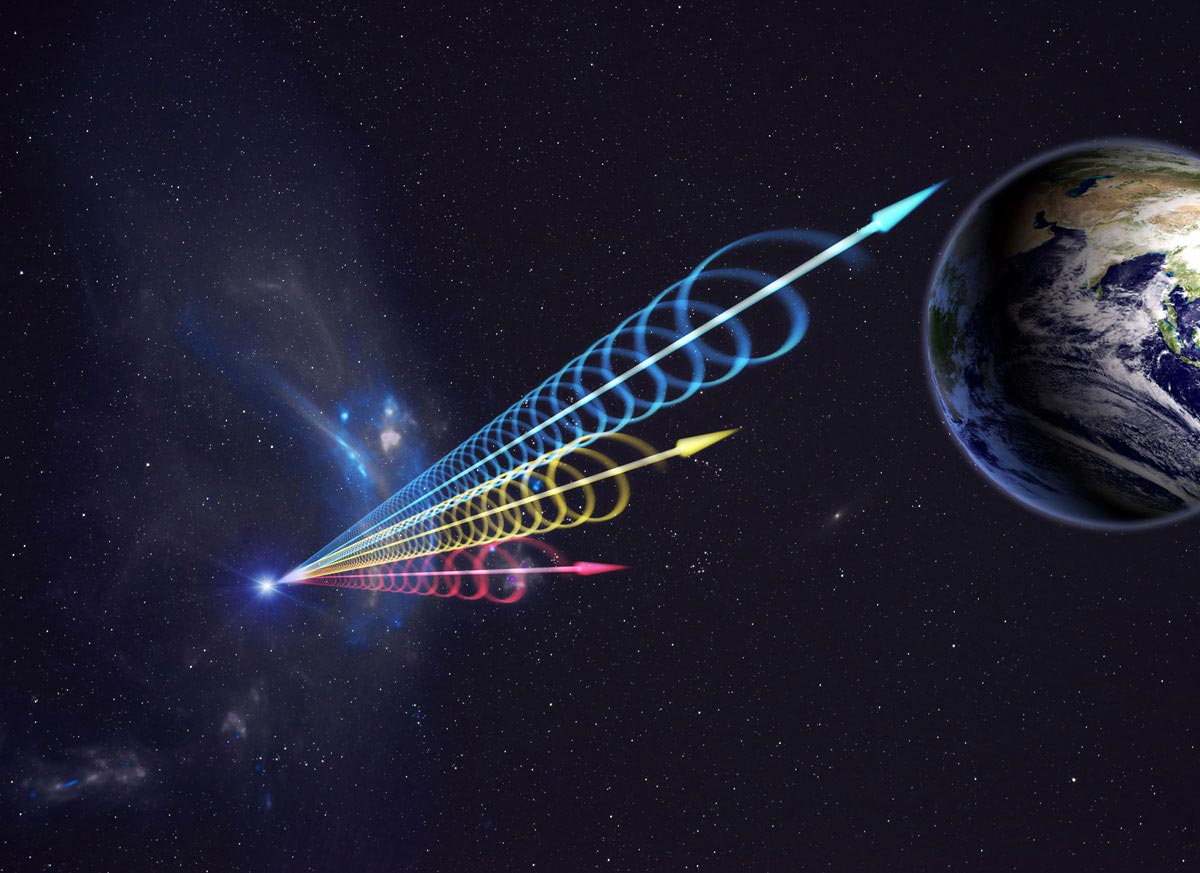
Astronomers have pinpointed an FRB outside a dead galaxy for the first time, challenging existing models that link FRBs to star-forming regions.
Using the CHIME/FRB Outriggers, they suspect the burst came from a globular cluster of ancient stars. This discovery forces a rethink of FRB origins and sets the stage for more revelations as technology improves.
Unraveling the Mystery of Fast Radio Bursts
Astronomers studying the origins of enigmatic fast radio bursts (FRBs) have made a major discovery that could reshape our understanding of these powerful cosmic signals. Researchers with the Canadian Hydrogen Intensity Mapping Experiment Fast Radio Burst (CHIME/FRB) collaboration have pinpointed the location of a repeating FRB, designated FRB 20240209A, outside a “dead” galaxy — one that no longer forms new stars. This is the first time an FRB has been found so far from its host galaxy, making it a unique and puzzling case.
“This is not only the first FRB to be found outside a dead galaxy, but, compared to all other FRBs, it’s also the farthest from the galaxy it’s associated with. The FRB’s location is surprising and raises questions about how such energetic events can occur in regions where no new stars are forming,” said Vishwangi Shah, PhD student in the Department of Physics and the Trottier Space Institute, and the corresponding author of a recent study published in the journal Astrophysical Journal Letters.
Pinpointing the Cosmic Origins of FRBs
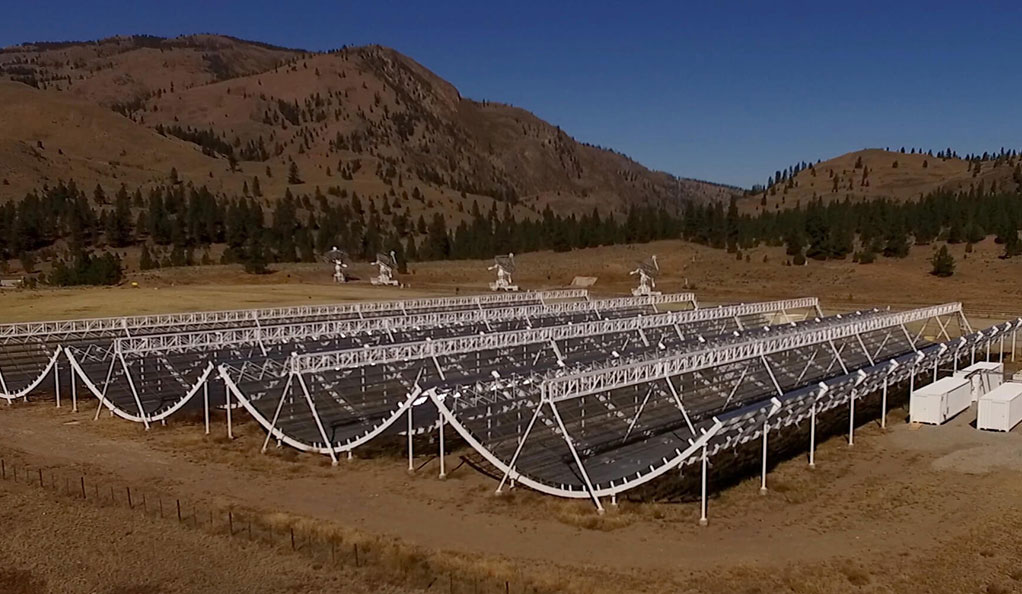
FRBs are intense, millisecond-long flashes of radio energy emanating from galaxies millions of light years away. While most are isolated events, some repeat sporadically, making them key targets for efforts to pinpoint their exact location on the sky. Using one of the newly operational CHIME/FRB Outrigger telescopes, which enhance the capabilities of the main CHIME telescope located in Penticton, B.C., astronomers have placed FRB 20240209A in a region of space associated with a “dead” galaxy, one that is no longer forming stars.
Challenging Existing Theories on FRB Formation
“This result challenges existing theories that tie FRB origins to phenomena in star-forming galaxies,” said Shah. “The source could be in a globular cluster, a dense region of old, dead stars outside the galaxy. If confirmed, it would make FRB 20240209A only the second FRB linked to a globular cluster.” She added that the other FRB originating in a globular cluster was associated with a live galaxy.
The discovery underscores that FRBs occur in diverse environments and pushes scientists to reconsider established models.
“This work provides vital clues for theorists. Any model explaining FRBs must account for their presence in these extreme and unexpected environments,” she said.
A New Era in FRB Exploration
This breakthrough marks the first pinpointing of an FRB on the sky using a CHIME/FRB Outrigger, in this case, the one located in Princeton, B.C. With the location of many more FRBs expected to be pinpointed soon, astronomers are poised to uncover even more information about these enigmatic cosmic bursts.
“This is proof that the Outriggers are set to revolutionize our understanding of FRBs,” said Shah. “We’re at the forefront of solving one of astronomy’s biggest mysteries.”
“This discovery challenges our previous understanding of FRBS, and highlights the significant role that their environments play in unraveling their origins,” said Tarraneh Eftekhari, co-author and NASA Einstein Fellow at Northwestern’s Center for Interdisciplinary Exploration and Research in Astrophysics (CIERA).
Explore Further:
- Mysterious Space Signal Traced Across the Universe to an Ancient Dead Galaxy
- This Mysterious Radio Burst Came From Nowhere and It’s Baffling Experts
“A Repeating Fast Radio Burst Source in the Outskirts of a Quiescent Galaxy” by Vishwangi Shah, Kaitlyn Shin, Calvin Leung, Wen-fai Fong, Tarraneh Eftekhari, Mandana Amiri, Bridget C. Andersen, Shion Andrew, Mohit Bhardwaj, Charanjot Brar, Tomas Cassanelli, Shami Chatterjee, Alice Curtin, Matt Dobbs, Yuxin Dong, Fengqiu Adam Dong, Emmanuel Fonseca, B. M. Gaensler, Mark Halpern, Jason W. T. Hessels, Adaeze L. Ibik, Naman Jain, Ronniy C. Joseph, Jane Kaczmarek, Lordrick A. Kahinga, Victoria M. Kaspi, Bikash Kharel, Tom Landecker, Adam E. Lanman, Mattias Lazda, Robert Main, Lluis Mas-Ribas, Kiyoshi W. Masui, Ryan Mckinven, Juan Mena-Parra, Bradley W. Meyers, Daniele Michilli, Kenzie Nimmo, Ayush Pandhi, Swarali Shivraj Patil, Aaron B. Pearlman, Ziggy Pleunis, J. Xavier Prochaska, Masoud Rafiei-Ravandi, Mawson Sammons, Ketan R. Sand, Paul Scholz, Kendrick Smith and Ingrid Stairs, 21 January 2025, The Astrophysical Journal Letters.
DOI: 10.3847/2041-8213/ad9ddc
The Gordon & Betty Moore Foundation funded the construction of the Outriggers. The Canada Foundation for Innovation and provinces of Quebec, Ontario and British Columbia funded the construction of CHIME. The Trottier Space Institute is funded by a gift from the Trottier Family Foundation.
Never miss a breakthrough: Join the SciTechDaily newsletter.
Follow us on Google and Google News.
2 Comments
NOTE 2502141427 Source 1. Comprehensive analysis _【
_[3]It is nonsense to place the origin of the FRB only as the general msbase.galaxy.
3-1)The presence in extreme and unexpected environments should be considered.
1-1.)It has pinpointed the location of a repeating FRB, named FRB 20240209A, outside a “dead” galaxy that no longer forms a new star. This is the first time an FRB has been found so far away from a host galaxy, a unique and perplexing case.
The powerful energy comes from qms.dark_energy. The globular cluster is msbase.value.sp.r
spin.n ≡ FRB. Hmm.
3-1.4)
“This work provides important clues to theorists. Any model that describes FRBs must consider their presence in these extreme and unexpected environments.
This is proof that it will revolutionize our understanding of FRBs. We are at the forefront of solving one of the biggest mysteries of astronomy. Huh.
2-1.)FRBs are intense millisecond-long flashes of radio energy from galaxies millions of light years away. Most are isolated events, but some are repeated sporadically, making them the main targets of efforts to locate them in the sky.
≈≈=≈==≈≈
1.
Mystery Signals Unpleas Astronomers by Revealing Dead Galaxy
McGill University February 13, 2025
A newly discovered FRB outside of a dead galaxy reverses the theory of its origin. Scientists suggest it may have originated from an old cluster, and the FRB proves that it can occur in unexpected environments. (Artistic impression of high-speed radio bursts (FRB) reaching Earth.) Source: Jingchuan Yu, Beijing Astronomical Observatory
Astronomers found FRBs outside dead galaxies for the first time, challenging existing models linking FRBs to star-forming regions.
Using the CHIME/FRB outrigger, they suspect that the outburst may have come from a globular cluster of ancient stars. This discovery forces a rethink of the origins of FRBs and sets the stage for more revelations as technology advances.
1-1.)
Solving the Mystery of a Fast Wireless Explosion
Astronomers studying the origin of enigmatic fast radio bursts (FRBs) have made an important discovery that could alter our understanding of these powerful cosmic signals. Researchers at the Canadian Hydrogen Intensity Mapping Experiment The CHIME/FRB Collaboration have pinpointed the location of a repeating FRB, named FRB 20240209A, outside a “dead” galaxy that no longer forms a new star. This is the first time an FRB has been found so far away from a host galaxy, a unique and perplexing case.
2.
Not only is this the first FRB discovered outside of a dead galaxy, but it is also the farthest away from the galaxy involved, compared to all other FRBs. The FRB’s location is striking, and raises questions about how such a powerful event can occur in a region where no new star is formed.
2-1.) to pinpoint the cosmic origin of the FRB
FRBs are intense millisecond-long flashes of radio energy from galaxies millions of light years away. Most are isolated events, but some are repeated sporadically, making them the primary target of efforts to locate them in the sky.
Using one of the newly launched CHIME/FRB Outrigger telescopes in Pentickton, BC, which improves the performance of the main CHIME telescope, the astronomers have deployed FRB 20240209A in a space domain associated with a “dead” galaxy that no longer forms a star. The CHIME telescope has four cylindrical reflective plates, which are able to observe an area the size of two football fields.
3.Challenge existing theories on the formation of the FRB
This result[3] challenges existing theories linking FRB origins to phenomena in star-forming galaxies. The source could be in globular clusters, i.e., in old, dead star-dense regions outside the galaxy. If confirmed, FRB 20240209A would be the second FRB linked to globular clusters. Other FRBs originating from globular clusters are related to living galaxies.
This finding highlights that FRBs occur in a variety of environments and urges scientists to reconsider existing models.
4)New Era of FRB Exploration
The landmark discovery marks the first accurate detection of the FRB from the sky using the CHIME/FRB outrigger in Princeton, British Columbia. With more FRB locations expected to be located soon, astronomers are ready to uncover more information about these mysterious cosmic explosions.
This is proof that the outrigger will revolutionize our understanding of FRBs. We are at the forefront of solving one of the biggest mysteries of astronomy.
ㅡㅡㅡㅡㅡㅡ
Source 1.
https://scitechdaily.com/mystery-signal-lights-up-a-dead-galaxy-baffling-astronomers/
The common suspect as FRB sources are young and still rapidly rotating neutron stars, which is why they should be rarer in dead galaxies with low rate of supergiant star progenitor production.
However, we now know that globular clusters are dynamic environments where e.g. star mergers can grow and rejuvenate stars. We’ll have to see if astronomers can observer more of the new type of events and pin down the pathway(s).