
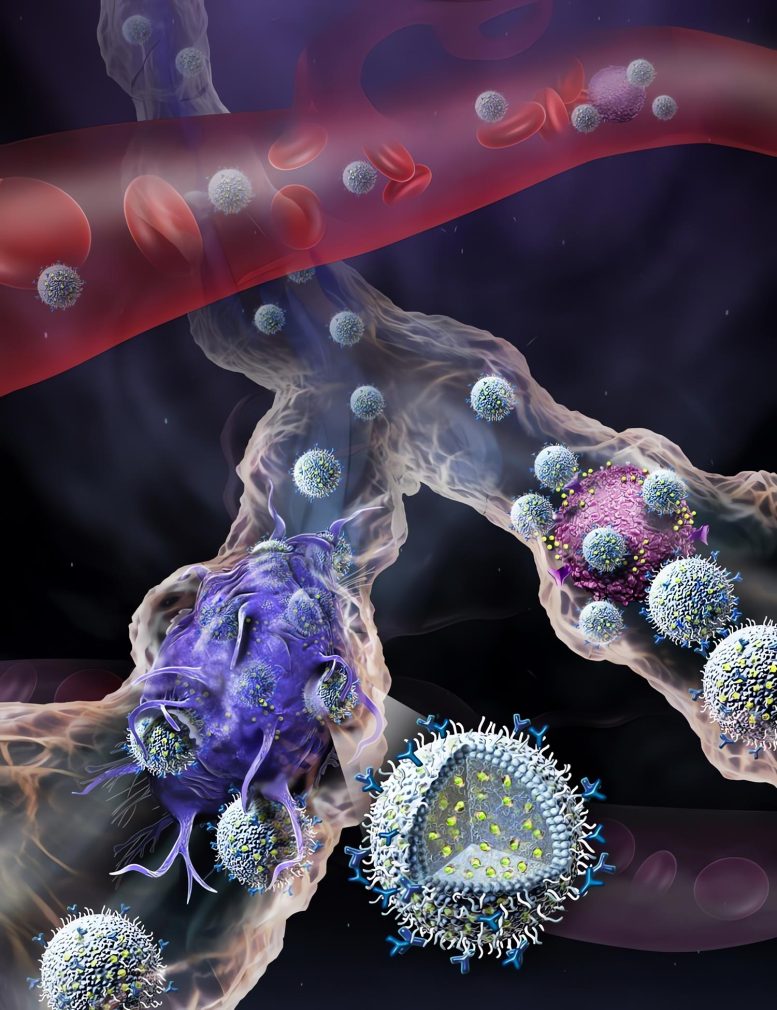
In a new study, Yale researchers used biodegradable nanoparticles called nanogels to deliver relatively low drug doses to mice with lupus, increasing the median survival time of lupus-prone mice and mice that already had severe kidney damage.
Scientists at Yale University have designed and tested a drug delivery system that shows early promise for improved treatment of lupus and other chronic, uncured autoimmune diseases, such as multiple sclerosis and Type 1 diabetes.
In systemic lupus erythematosus, the body attacks itself for largely mysterious reasons, leading to serious tissue inflammation and organ damage. Current drug treatments address symptoms only and can require life-long daily use at toxic doses.
In a study published online on March 1 in The Journal of Clinical Investigation, Yale researchers report using biodegradable nanoparticles to deliver relatively low drug doses that extended the lives of laboratory animals. In tests on mice, the prophylactic use of drug-laden nanoparticles, called nanogels, increased the median survival time of lupus-prone mice by three months and of mice with severe kidney damage, a common consequence of lupus, by two months.
“Three months of a mouse’s life is roughly equivalent to more than eight years of a human life, so this is dramatic,” said Tarek Fahmy, associate professor of biomedical engineering at Yale, a principal investigator of the paper. “We’ll keep at this, because the potential for human benefit is clear and promising.”
Compared with conventional lupus therapies, the biodegradable nanogels proved better at delivering drugs to cells and better at retaining drugs within the body, allowing for significantly lower doses, researchers said. Results also suggest that drug delivery via nanogels works without depleting all white blood cells, leaving recipients less vulnerable to infection.
“We’ve found a very promising starting point,” said Michael Look, a postdoctoral researcher in bioengineering at Yale and the paper’s lead author.
Highly stable, the nanogels are essentially microvessels made of organic materials that transport and release drugs. They can circulate for longer in the body than conventional drugs due to their size and ability to pass biological barriers. And they can be programmed to target specific cells — in the case of lupus, T cells and antigen-presenting cells.
Like existing lupus treatments, they work by deactivating specific immune cells, suppressing their response, and minimizing lupus symptoms.
“We’re especially excited about this work because it is the first in-depth and comprehensive application of a promising nanotechnology for directed immunosuppressant delivery in a heterogeneous autoimmune disease with limited therapeutic options,” said Fahmy. Dr. Joseph Craft, chief of rheumatology at Yale School of Medicine, is also a principal investigator.
The Yale researchers loaded the nanogels with mycophenolic acid, a form of which is used in lupus patients.
The nanogel system has not yet been tested in humans. But the nanogels are made of FDA-approved materials, which could hasten the process involved in preparing them for human use. Nanogels have previously been tested for delivery of cancer drugs.
“We are very excited to see such promising findings resulting from our initial novel research grant to Dr. Fahmy and his colleagues,” said Margaret Dowd, president and CEO of the Lupus Research Institute, which provided financial support for the work. “He came to us with a highly innovative approach to the design of a new drug delivery system that would target disease-causing cells. Like most LRI-funded projects, Dr. Fahmy’s work is opening the door to major advances in treatment for lupus with broader implications for other autoimmune diseases.”
Reference: “Nanogel-based delivery of mycophenolic acid ameliorates systemic lupus erythematosus in mice” by Michael Look, Eric Stern, Qin A. Wang, Leah D. DiPlacido, Michael Kashgarian, Joe Craft and Tarek M. Fahmy, 1 March 2013, Journal of Clinical Investigation.
DOI: 10.1172/JCI65907
Other authors are Eric Stern, Qin A. Wang, Leah D. DiPlacido, and Michael Kashgarian.
Never miss a breakthrough: Join the SciTechDaily newsletter.
Follow us on Google and Google News.
1 Comment
nanopartical drug deliever has been used in America for more than a decade in phsycotropic nuroeleptics like Respiridone just ask the 10’s of thousands of foster children of the states Arizona, Texas, Florida, & Alaska & niave phsyzophrenic patients all overAmerica. Delveloped at the University of India. Im skeptical & leary of putting programmed microcondria in humans.