
Close Menu
    Facebook X (Twitter) Instagram
    SciTechDaily
    • Biology
    • Chemistry
    • Earth
    • Health
    • Physics
    • Science
    • Space
    • Technology
    Facebook X (Twitter) Pinterest YouTube RSS
    SciTechDaily
    Home»Chemistry»Nanorings Uncovered: Astonishing New Building Blocks for Chemistry
    Chemistry

    Nanorings Uncovered: Astonishing New Building Blocks for Chemistry

    By Karlsruhe Institute of TechnologyJanuary 9, 2024No Comments3 Mins Read
    Facebook Twitter Pinterest Telegram LinkedIn WhatsApp Email Reddit
    Share
    Facebook Twitter LinkedIn Pinterest Telegram Email Reddit
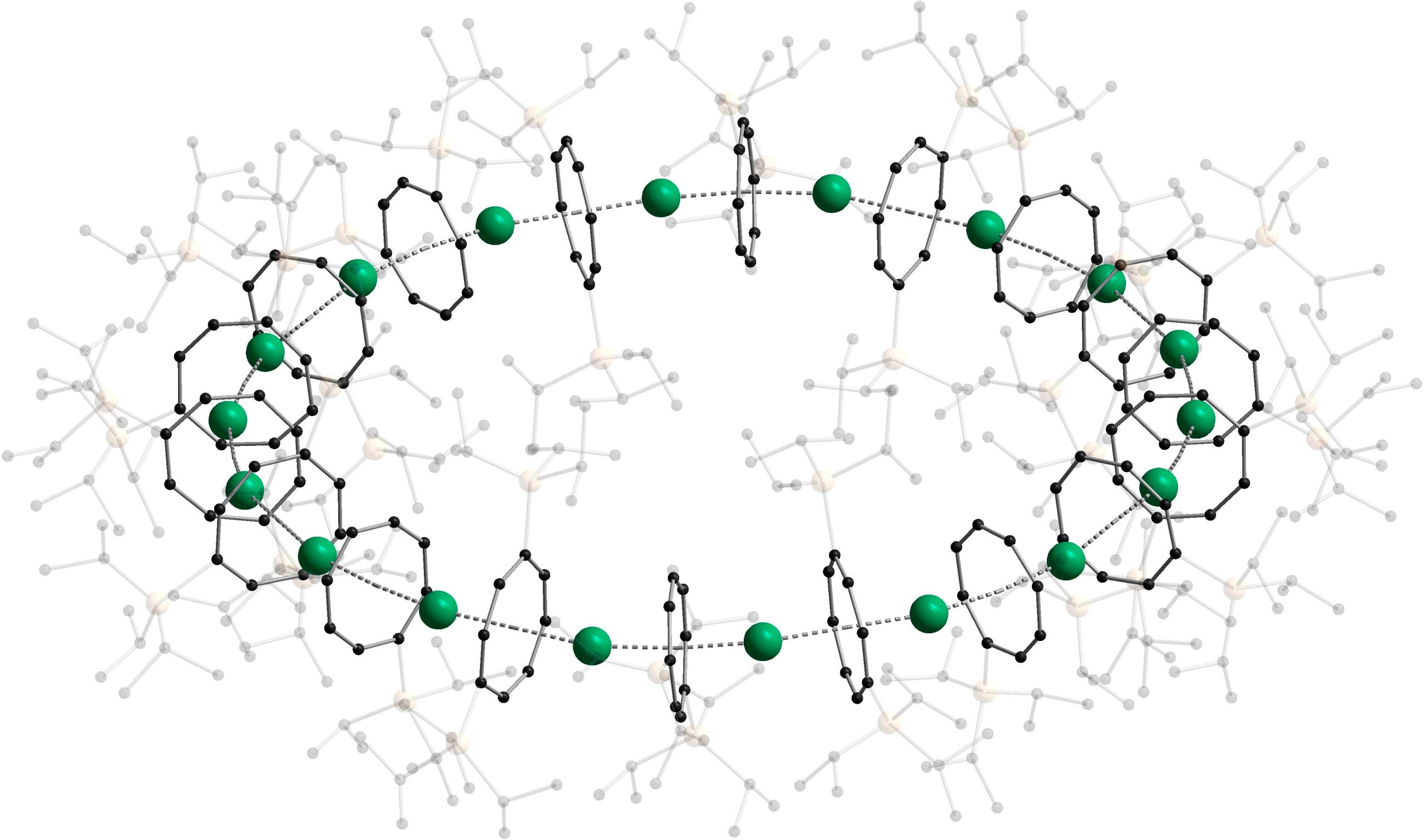
    Cyclocene Molecular Structure
    The new molecular structure in which sandwich complexes form a nano-sized ring is called ‘cyclocene.’ Credit: Nature / AOC, KIT

    New Compounds for Organometallic Chemistry – Sandwich Complexes in the Form of Rings Are Kept Together by Their Own Energy

    Sandwich compounds are special chemical compounds used as basic building blocks in organometallic chemistry. So far, their structure has always been linear. Recently, researchers of Karlsruhe Institute of Technology (KIT) and the University of Marburg were the first to make stacked sandwich complexes form a nano-sized ring. Physical and other properties of these cyclocene structures will now be further investigated.

    Evolution of Sandwich Complexes

    Sandwich complexes were developed about 70 years ago and have a sandwich-like structure. Two flat aromatic organic rings (the “slices of bread”) are filled with a single, central metal atom in between. Like the slices of bread, both rings are arranged in parallel. Adding further layers of ‘bread’ and ‘filling’ produces triple or multiple sandwiches.

    “These compounds are among the most important complexes used in modern organometallic chemistry,” says Professor Peter Roesky from KIT’s Institute for Inorganic Chemistry.

    One of them is the highly stable ferrocene, for which its “fathers” Ernst Otto Fischer and Geoffrey Wilkinson were awarded the Nobel Prize in Chemistry in 1973. Ferrocene consists of an iron ion and two five-membered aromatic organic rings. It is used in synthesis, catalysis, electrochemistry, and polymer chemistry.

    First Nano-Sized Rings

    For some time now, researchers at KIT and the University of Marburg have tried to arrange sandwich complexes in a ring. “We succeeded in producing chains, but no rings,” Roesky says, who coordinated the work of three teams at the two universities.

    “Thanks to the choice of the right ‘slice of bread’ or organic intermediate deck, we have now succeeded in forming nano-sized rings for the first time,” says Professor Manfred Kappes, who heads the Division of Physical Chemistry of Microscopic Systems at KIT, and Professor Florian Weigend, Head of the Applied Quantum Chemistry Unit of the University of Marburg.

    The new nanoring consists of 18 building blocks and has an outer diameter of 3.8 nanometers. Depending on the metal used as the ‘filling’ of the sandwich, an orange-colored photoluminescence results. The new chemical compound was called ‘cyclocene’ by the researchers.

    The Nanoring Is Held Together by Itself

    The three working groups carried out elaborate quantum chemical calculations to find out why the molecules could be arranged in a ring and no longer formed a chain of sandwich complexes. These calculations revealed that the driving force for the ring formation is the energy gained by the ring closure.

    “Our challenge initially was to form a ring. Can other ring sizes be produced? Does this nanostructure possess unusual physical properties? This will be the subject of further research. But it is clear now that we have added a new building block to our toolbox of organometallic chemistry. And this is great,” Roesky says.

    Reference: “Synthesis and properties of cyclic sandwich compounds” by Luca Münzfeld, Sebastian Gillhuber, Adrian Hauser, Sergei Lebedkin, Pauline Hädinger, Nicolai D. Knöfel, Christina Zovko, Michael T. Gamer, Florian Weigend, Manfred M. Kappes and Peter W. Roesky, 2 August 2023, Nature.
    DOI: 10.1038/s41586-023-06192-4

    Never miss a breakthrough: Join the SciTechDaily newsletter.
    Follow us on Google and Google News.

    Karlsruhe Institute of Technology Organic Chemistry
    Share. Facebook Twitter Pinterest LinkedIn Email Reddit

    Related Articles

    Artificial Photosynthesis Breakthrough Transforms Trash Into Fuel and Pharmaceuticals

    Revolutionary Catalyst Mimics Enzymes for Simpler, More Efficient Production

    Catalyst Magic: Game-Changing Method for Alkane Activation Discovered in Japan

    New Samarium Catalyst Reduces Costs and Boosts Pharmaceutical Reaction Efficiency

    AI Cracks the Chemistry Code to Better, Longer-lasting Solar Panels

    Carbenes in Space? New Discovery Could Explain Life’s Cosmic Origins

    Superheated Flow Chemistry: A Leap Forward in Organic Synthesis

    Revolutionizing Organic Chemistry: Boronic Acid-Powered Enzyme Yields Groundbreaking Catalysis

    Bionanomachine Breakthrough: A Master Key for Sustainable Chemistry

    Leave A Reply Cancel Reply

    • Facebook
    • Twitter
    • Pinterest
    • YouTube

    Don't Miss a Discovery

    Subscribe for the Latest in Science & Tech!

    Trending News

    New “Nanozyme Hypothesis” Could Rewrite the Story of Life’s Origins

    Anatomy Isn’t Finished: The Human Body Still Holds Secrets

    “Pretty Close to Home”: The Hidden Earthquake Threat Beneath Seattle

    The Surprising Reason You Might Want To Sleep Without a Pillow

    Scientists Say This Natural Hormone Reverses Obesity by Targeting the Brain

    35-Million-Year-Old Mystery: Strange Arachnid Discovered Preserved in Amber

    Is AI Really Just a Tool? It Could Be Altering How You See Reality

    JWST Reveals a “Forbidden” Planet With a Baffling Composition

    Follow SciTechDaily
    • Facebook
    • Twitter
    • YouTube
    • Pinterest
    • Newsletter
    • RSS
    SciTech News
    • Biology News
    • Chemistry News
    • Earth News
    • Health News
    • Physics News
    • Science News
    • Space News
    • Technology News
    Recent Posts
    • Saunas May Do More Than Raise Body Temperature – They Activate Your Immune System
    • Exercise in a Pill? Metformin Shows Surprising Effects in Cancer Patients
    • Saturn’s Magnetic Shield Isn’t What Scientists Expected
    • Hidden Oceans of Magma Could Be Protecting Alien Life
    • After Decades of Searching, Astronomers Finally Track Down the Universe’s Missing Hydrogen
    Copyright © 1998 - 2026 SciTechDaily. All Rights Reserved.
    • Science News
    • About
    • Contact
    • Editorial Board
    • Privacy Policy
    • Terms of Use

    Type above and press Enter to search. Press Esc to cancel.