
Close Menu
    Facebook X (Twitter) Instagram
    SciTechDaily
    • Biology
    • Chemistry
    • Earth
    • Health
    • Physics
    • Science
    • Space
    • Technology
    Facebook X (Twitter) Pinterest YouTube RSS
    SciTechDaily
    Home»Space»NASA and SpaceX Set To Unlock the Universe’s Secrets With SPHEREx Launch in Early 2025
    Space

    NASA and SpaceX Set To Unlock the Universe’s Secrets With SPHEREx Launch in Early 2025

    By Jet Propulsion LaboratoryDecember 12, 2024No Comments3 Mins Read
    Facebook Twitter Pinterest Telegram LinkedIn WhatsApp Email Reddit
    Share
    Facebook Twitter LinkedIn Pinterest Telegram Email Reddit
    NASA Spectro-Photometer for the History of the Universe, Epoch of Reionization and Ices Explorer (SPHEREx) Mission
    The Spectro-Photometer for the History of the Universe, Epoch of Reionization and Ices Explorer (SPHEREx) mission will provide the first all-sky spectral survey. Over a two-year planned mission, the SPHEREx Observatory will collect data on more than 450 million galaxies along with more than 100 million stars in the Milky Way in order to explore the origins of the universe. Credit: NASA

    NASA’s SPHEREx observatory will lend insight into what happened after the Big Bang, measure the glow of galaxies near and far, and search the Milky Way for building blocks of life.

    NASA and SpaceX are planning to launch the SPHEREx astrophysics observatory in late February 2025. SPHEREx, which stands for Spectro-Photometer for the History of the Universe, Epoch of Reionization, and Ices Explorer, will lift off aboard a SpaceX Falcon 9 rocket from Vandenberg Space Force Base in California.

    Roughly the size of a subcompact car, SPHEREx will enter a polar orbit around Earth. From there, it will map the entire sky in 3D by capturing images in every direction, similar to scanning the inside of a globe. The resulting map will feature hundreds of millions of stars and galaxies, displayed in 102 distinct colors, each representing a unique wavelength of light.
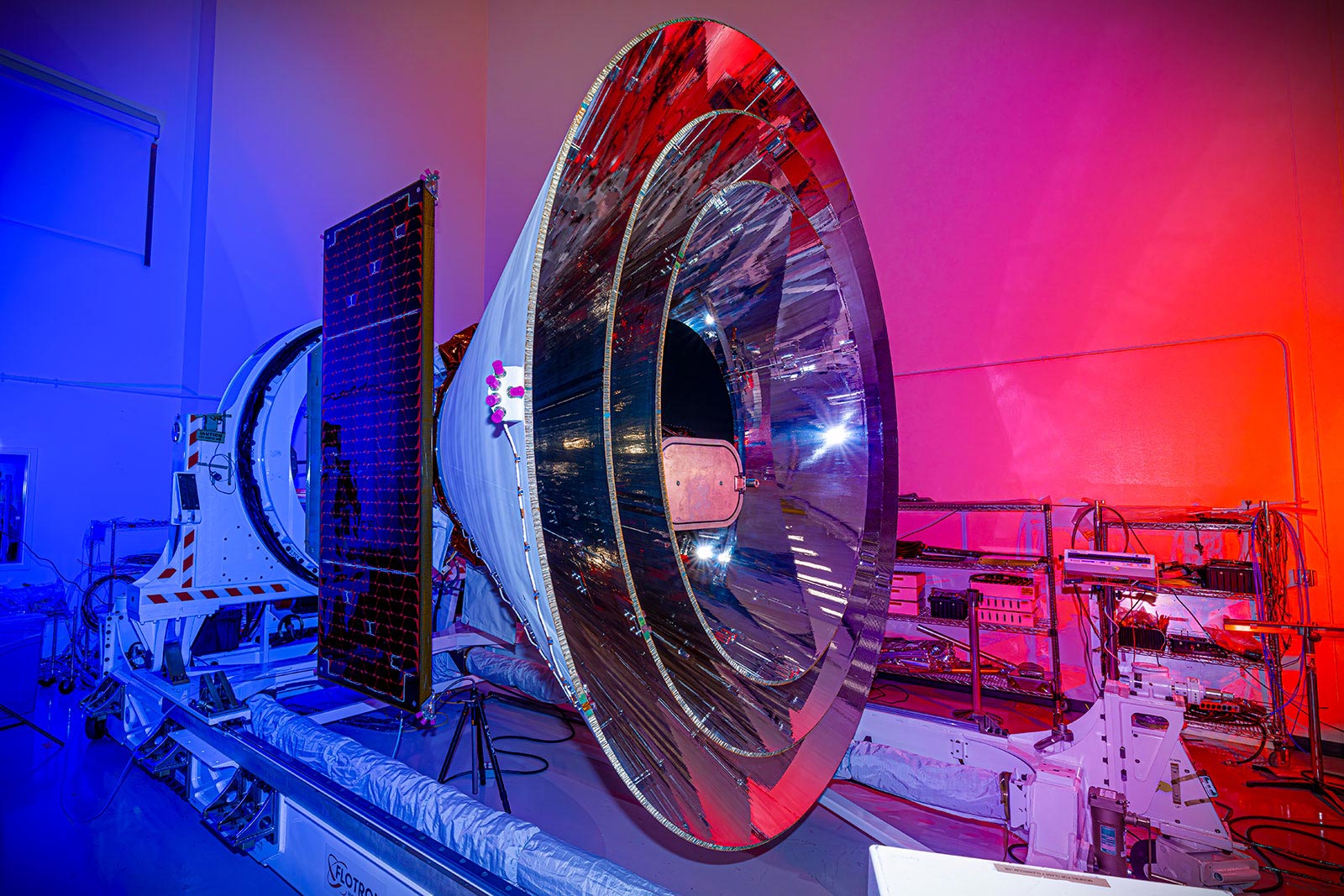
    NASA SPHEREx Space Observatory at BAE Systems
    NASA’s SPHEREx space observatory was photographed at BAE Systems in Boulder, Colorado, in November 2024 after completing environmental testing. The spacecraft’s three concentric cones help direct heat and light away from the telescope and other components, keeping them cool. Credit: BAE Systems

    Scientific Objectives of SPHEREx

    Scientists will use SPHEREx’s all-sky map to achieve the mission’s three key science goals. The first is to shed light on a cosmic phenomenon called inflation, a brief but powerful cosmic event when space itself increased in size by a trillion-trillionfold less than a second after the Big Bang. The observatory will measure the distribution of hundreds of millions of galaxies to improve understanding of what drove inflation and of the physics behind this event.

    The SPHEREx mission will also measure the collective glow from galaxies near and far, including light from hidden galaxies that haven’t been individually observed. This data will provide a more complete picture of all the objects and sources radiating in the universe.

    Exploring Cosmic Ingredients

    Its third key science goal is to search the Milky Way galaxy for icy granules of water, carbon dioxide, and other essential building blocks of life. The mission will help scientists discover the location and abundance of these icy compounds in our galaxy, giving them a better sense of how likely they are to be incorporated into newly forming planets.

    Additional Missions and Management

    Launching as a secondary payload on the same Falcon 9 rocket as SPHEREx will be NASA’s PUNCH mission (Polarimeter to Unify the Corona and Heliosphere). Led by Southwest Research Institute’s office in Boulder, Colorado, and managed by NASA’s Goddard Space Flight Center in Greenbelt, Maryland, PUNCH is a constellation of four small satellites heading to low Earth orbit that will make global, 3D observations of the Sun’s corona to learn how the mass and energy there become solar wind.

    NASA’s Launch Services Program, based at the agency’s Kennedy Space Center, manages the launch service for the SPHEREx and PUNCH missions.

    Never miss a breakthrough: Join the SciTechDaily newsletter.
    Follow us on Google and Google News.

    JPL NASA SpaceX SPHEREx
    Share. Facebook Twitter Pinterest LinkedIn Email Reddit

    Related Articles

    Liftoff! NASA’s Twin Missions Launch to Unravel the Big Bang & Solar Storms

    NASA’s SPHEREx on a Cosmic Ice Hunt: Uncovering the Universe’s Hidden Water

    NASA’s Next Rocket Launch Could Rewrite the Story of the Universe

    March 4 Liftoff: NASA & SpaceX Update Launch Plans for SPHEREx & PUNCH

    NASA’s Next Big Launch Could Unlock the Universe’s Greatest Secrets

    Watch Live: NASA Is Launching a Space Telescope That Could Rewrite the Universe’s Origin Story

    Launching Friday: NASA’s SPHEREx and PUNCH Are Ready to Unlock the Secrets of Space

    Watch Live: SpaceX Launch of Intuitive Machines IM-2 Lunar Lander and NASA’s Lunar Trailblazer

    NASA’s SPHEREx Will Unveil the Hidden Spectrum of the Cosmos

    Leave A Reply Cancel Reply

    • Facebook
    • Twitter
    • Pinterest
    • YouTube

    Don't Miss a Discovery

    Subscribe for the Latest in Science & Tech!

    Trending News

    The Strange “Spacetime Crystal” That Can Suddenly Turn Into a Black Hole

    The Surprising Way Asteroids May Have Helped Life Begin on Earth

    Vast Hidden Structure Discovered Under Miles of Ice in East Antarctica

    A Surprising Discovery Suggests Autism Is Not One Condition

    New Alzheimer’s Discovery Could Change How Scientists Fight the Disease

    Yale Discovery Overturns Long-Held “Evolutionary Dead End” Theory

    UCLA Scientists Uncover a “Hidden Weakness” in Some of the World’s Deadliest Cancers

    Humpback Whale Stuns Scientists With 15,000 Kilometer Journey Across Oceans

    Follow SciTechDaily
    • Facebook
    • Twitter
    • YouTube
    • Pinterest
    • Newsletter
    • RSS
    SciTech News
    • Biology News
    • Chemistry News
    • Earth News
    • Health News
    • Physics News
    • Science News
    • Space News
    • Technology News
    Recent Posts
    • Food Waste Becomes a Powerful Carbon Trap in Climate Breakthrough
    • Battery-Free Artificial Photosynthesis Turns Sunlight, Water, and CO2 Into Fuel
    • How Ancient People Moved a 6-Ton Stone 700 Kilometers to Stonehenge
    • Scientists Finally See How Antibodies Really Attack Viruses
    • The Unexpected Gut Health Risk of Cutting Out Sugar
    Copyright © 1998 - 2026 SciTechDaily. All Rights Reserved.
    • Science News
    • About
    • Contact
    • Editorial Board
    • Privacy Policy
    • Terms of Use

    Type above and press Enter to search. Press Esc to cancel.