

SPHEREx is a groundbreaking NASA telescope that will map the entire sky in infrared, revealing insights into cosmic inflation, galaxy formation, and the ingredients of life in space.
By measuring the total glow of the universe and pinpointing key molecules in our galaxy, it will complement existing telescopes with a broad, all-encompassing view of the cosmos.
A New Era in Cosmic Exploration
NASA’s SPHEREx space observatory is set to launch no earlier than Thursday, February 27, from Vandenberg Space Force Base in California. Designed to give astronomers an unprecedented, wide-angle view of the cosmos, SPHEREx — short for Spectro-Photometer for the History of the Universe, Epoch of Reionization and Ices Explorer — will scan the entire sky in 102 infrared colors. This mission aims to reveal new insights into the origins of the universe, the formation of galaxies, and the fundamental building blocks of life within our own Milky Way.
1. The SPHEREx space telescope will shed light on a cosmic phenomenon called inflation.
In the first tiny fraction of a second after the Big Bang — specifically, within a billionth of a trillionth of a trillionth of a second — the universe expanded at an extraordinary rate, growing a trillion-trillionfold in an instant. This event, known as cosmic inflation, shaped the structure of the universe as we see it today.
SPHEREx will map the distribution of over 450 million galaxies, helping scientists better understand the physics behind this rapid expansion and its lasting impact on the cosmos.
2. The observatory will measure the collective glow from galaxies near and far.
Scientists have tried to estimate the total light output from all galaxies throughout cosmic history by observing individual galaxies and extrapolating to the trillions of galaxies in the universe. The SPHEREx space telescope will take a different approach and measure the total glow from all galaxies, including galaxies too small, too diffuse, or too distant for other telescopes to easily detect.
Combining the measurement of this overall glow with other telescopes’ studies of individual galaxies will give scientists a more complete picture of all the major sources of light in the universe.
3. The mission will search the Milky Way galaxy for essential building blocks of life.
Life as we know it wouldn’t exist without basic ingredients such as water and carbon dioxide. The SPHEREx observatory is designed to find these molecules frozen in interstellar clouds of gas and dust, where stars and planets form.
The mission will pinpoint the location and abundance of these icy compounds in our galaxy, giving researchers a better sense of their availability in the raw materials for newly forming planets.
4. It adds unique strengths to NASA’s fleet of space telescopes.
Space telescopes like NASA’s Hubble and Webb have zoomed in on many corners of the universe to show us planets, stars, and galaxies in high resolution. But some questions — like how much light do all the galaxies in the universe collectively emit? — can be answered only by looking at the big picture.
To that end, the SPHEREx observatory will provide maps that encompass the entire sky. Objects of scientific interest identified by SPHEREx can then be studied in more detail by targeted telescopes like Hubble and Webb.
5. The SPHEREx observatory will make the most colorful all-sky map ever.
The SPHEREx observatory “sees” infrared light. Undetectable to the human eye, this range of wavelengths is ideal for studying stars and galaxies. Using a technique called spectroscopy, the telescope can split the light into its component colors (individual wavelengths), like a prism creates a rainbow from sunlight, in order to measure the distance to cosmic objects and learn about their composition.
With SPHEREx’s spectroscopic map in hand, scientists will be able to detect evidence of chemical compounds, like water ice, in our galaxy. They’ll not only measure the total amount of light emitted by galaxies in our universe, but also discern how bright that total glow was at different points in cosmic history. And they’ll chart the 3D locations of hundreds of millions of galaxies to study how inflation influenced the large-scale structure of the universe today.
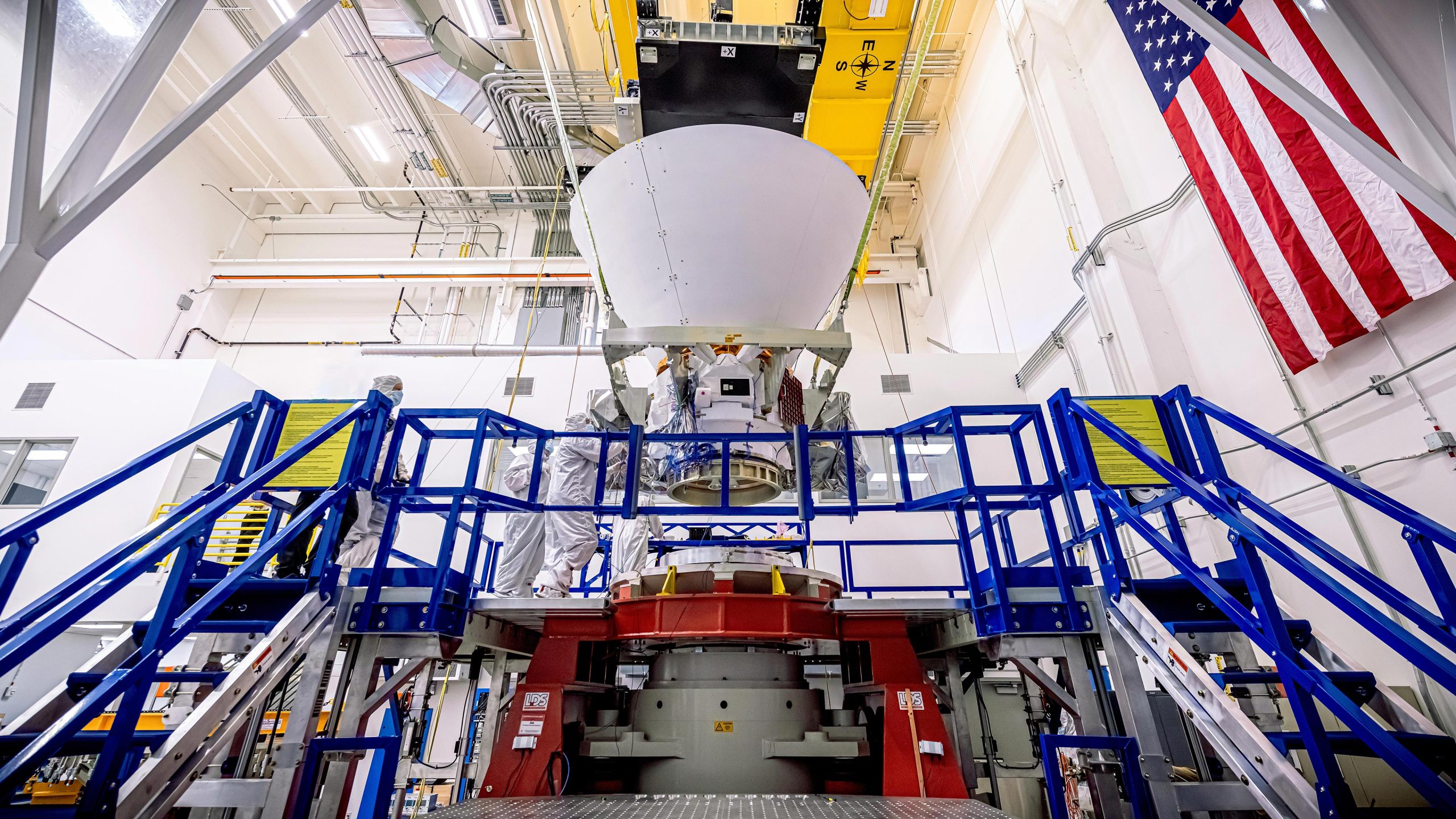
6. The spacecraft’s cone-shaped design helps it stay cold and see faint objects.
The mission’s infrared telescope and detectors need to operate at around minus 350 degrees Fahrenheit (about minus 210 degrees Celsius). This is partly to prevent them from generating their own infrared glow, which might overwhelm the faint light from cosmic sources.
To keep things cold while also simplifying the spacecraft’s design and operational needs, SPHEREx relies on an entirely passive cooling system — no electricity or coolants are used during normal operations. Key to making this feat possible are three cone-shaped photon shields that protect the telescope from the heat of Earth and the Sun, as well as a mirrored structure beneath the shields to direct heat from the instrument out into space. Those photon shields give the spacecraft its distinctive outline.
More About SPHEREx
SPHEREx (Spectro-Photometer for the History of the Universe, Epoch of Reionization, and Ices Explorer) is NASA’s upcoming space telescope designed to provide an unprecedented, full-sky infrared survey of the universe. Managed by NASA’s Jet Propulsion Laboratory (JPL) for the agency’s Astrophysics Division, the mission aims to uncover insights into cosmic inflation, galaxy formation, and the distribution of life-essential molecules in our Milky Way.
The telescope and spacecraft bus were built by BAE Systems (formerly Ball Aerospace), while a team of scientists from 10 U.S. institutions, two in South Korea, and one in Taiwan will analyze its data. The mission’s principal investigator is based at Caltech, which also oversees JPL for NASA. All SPHEREx data will be processed, archived, and made publicly available through the NASA/IPAC Infrared Science Archive, ensuring global access to its groundbreaking discoveries.
Never miss a breakthrough: Join the SciTechDaily newsletter.
Follow us on Google and Google News.