

SPHEREx is scanning the entire sky in 102 infrared colors, beaming weekly data to a public archive so scientists and citizen stargazers alike can trace water, organics, and the universe’s first moments while NASA’s open-science philosophy turbo-charges discovery.
NASA’s newest space telescope, SPHEREx, launched in March with an exciting mission: to create a complete map of the universe. Now in low-Earth orbit, it’s scanning the sky in vivid infrared detail and releasing its data weekly to a public archive—so anyone, from professional astronomers to curious skywatchers, can explore the cosmos.
“Because we’re looking at everything in the whole sky, almost every area of astronomy can be addressed by SPHEREx data,” said Rachel Akeson, the lead for the SPHEREx Science Data Center at IPAC. IPAC is a science and data center for astrophysics and planetary science at Caltech in Pasadena, California.
SPHEREx follows in the footsteps of earlier missions like NASA’s WISE (Wide-field Infrared Survey Explorer), which also mapped the sky. But SPHEREx takes things much further, capturing the universe in 102 different infrared wavelengths, far more than WISE’s four, unlocking a much richer view of space.
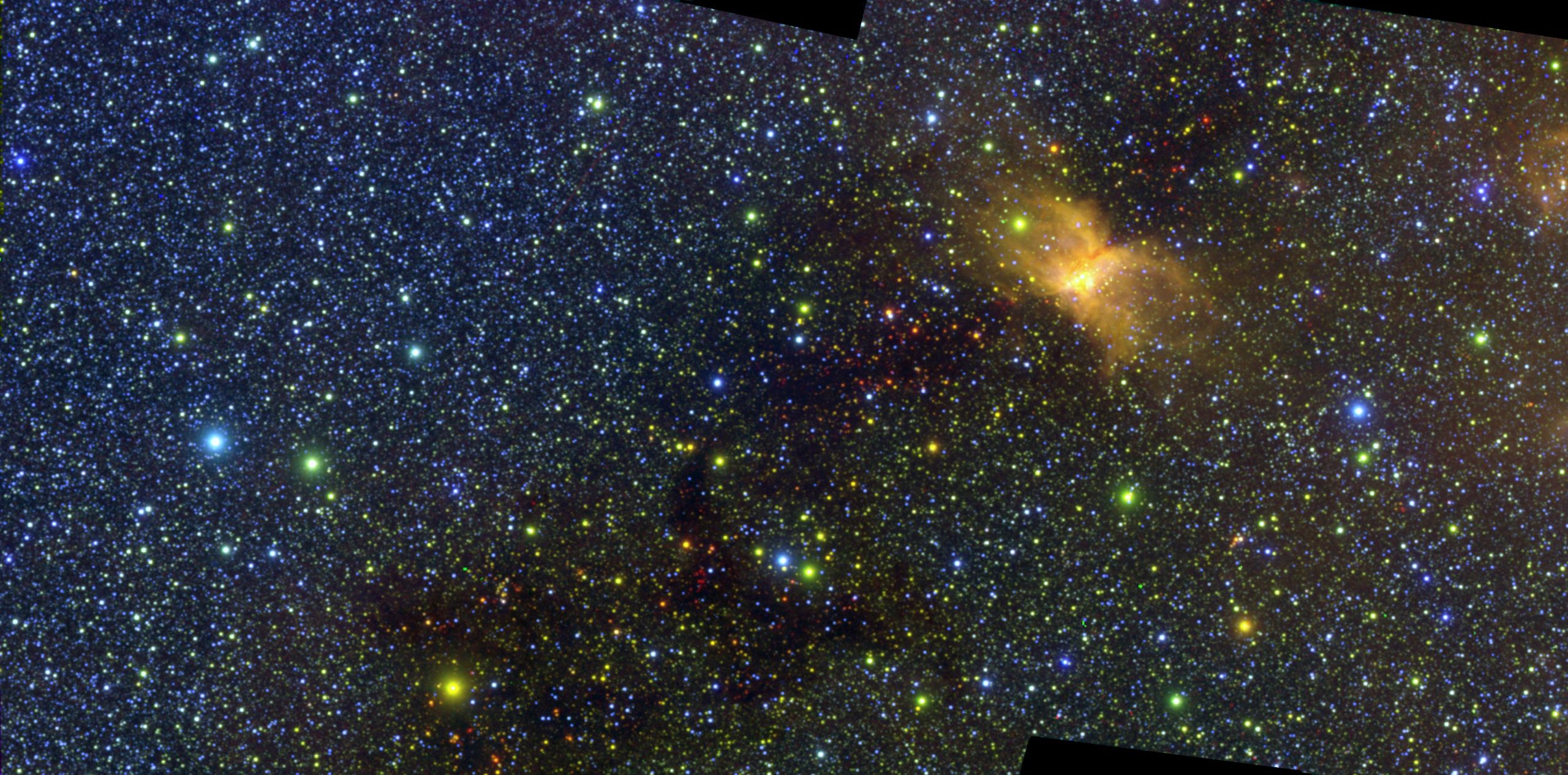
Spectroscopy Reveals Life’s Building Blocks
Using a technique called spectroscopy, SPHEREx combines all those wavelengths to identify specific molecules in space. Scientists will use this data to track frozen water and organic compounds—the essential ingredients for life—across our galaxy.
SPHEREx will also help researchers study how the universe expanded after the Big Bang and measure how much light has been emitted by galaxies across cosmic history. By making its data freely available, the mission opens the door to discoveries far beyond the original scope of the project.
“By making the data public, we enable the whole astronomy community to use SPHEREx data to work on all these other areas of science,” Akeson said.
This animation shows how NASA’s SPHEREx observatory will map the entire sky — a process it will complete four times over its two-year mission. The telescope will observe every point in the sky in 102 different infrared wavelengths, more than any other all-sky survey. SPHEREx’s openly available data will enable a wide variety of astronomical studies. Credit: NASA/JPL-Caltech
Rapid Public Data and Mission Timeline
NASA is committed to the sharing of scientific data, promoting transparency and efficiency in scientific research. In line with this commitment, data from SPHEREx appears in the public archive within 60 days after the telescope collects each observation. The short delay allows the SPHEREx team to process the raw data to remove or flag artifacts, account for detector effects, and align the images to the correct astronomical coordinates.
The team publishes the procedures they used to process the data alongside the actual data products. “We want enough information in those files that people can do their own research,” Akeson said.
During its two-year prime mission, SPHEREx will survey the entire sky twice a year, creating four all-sky maps. After the mission reaches the one-year mark, the team plans to release a map of the whole sky at all 102 wavelengths.

Collaboration, Archives, and Open Science Legacy
In addition to the science enabled by SPHEREx itself, the telescope unlocks an even greater range of astronomical studies when paired with other missions. Data from SPHEREx can be used to identify interesting targets for further study by NASA’s James Webb Space Telescope, refine exoplanet parameters collected from NASA’s TESS (Transiting Exoplanet Survey Satellite), and study the properties of dark matter and dark energy along with ESA’s (European Space Agency’s) Euclid mission and NASA’s upcoming Nancy Grace Roman Space Telescope.

The IPAC archive that hosts SPHEREx data, IRSA (NASA/IPAC Infrared Science Archive), also hosts pointed observations and all-sky maps at a variety of wavelengths from previous missions. The large amount of data available through IRSA gives users a comprehensive view of the astronomical objects they want to study.
“SPHEREx is part of the entire legacy of NASA space surveys,” said IRSA Science Lead Vandana Desai. “People are going to use the data in all kinds of ways that we can’t imagine.”
NASA’s Office of the Chief Science Data Officer leads the open science efforts for the agency. Public sharing of scientific data, tools, research, and software maximizes the impact of NASA’s science missions.

More About SPHEREx
SPHEREx (Spectro-Photometer for the History of the Universe, Epoch of Reionization, and Ices Explorer) is a NASA astrophysics mission designed to map the entire sky in 102 infrared wavelengths. Managed by NASA’s Jet Propulsion Laboratory (JPL) for the agency’s Astrophysics Division, SPHEREx aims to investigate cosmic origins—from the early universe to the building blocks of life.
The mission is a global collaboration, with its science team spread across 10 institutions in the U.S., two in South Korea, and one in Taiwan. Caltech, which manages JPL for NASA, oversaw the integration of the instrument, while the spacecraft and telescope were built by BAE Systems in Boulder, Colorado. The mission’s principal investigator is based at Caltech with a joint appointment at JPL.
SPHEREx data is processed and archived by IPAC at Caltech and will be made publicly available through the NASA-IPAC Infrared Science Archive, enabling researchers worldwide to explore the infrared universe.
Never miss a breakthrough: Join the SciTechDaily newsletter.
Follow us on Google and Google News.