
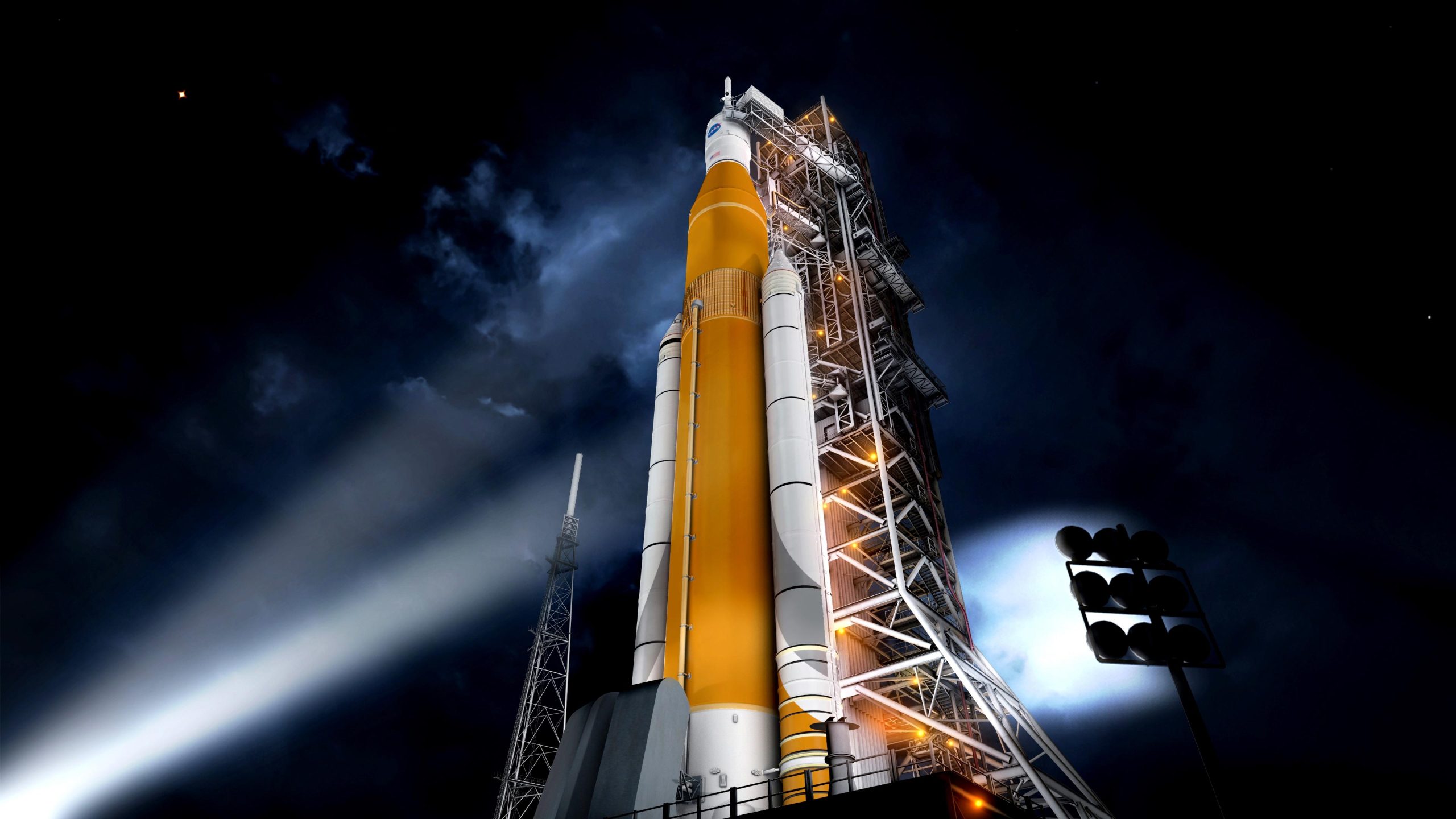
Engineers and technicians are continuing to prepare for the Artemis I wet dress rehearsal test which is slated to begin on April 1 and conclude on April 3.
The wet dress rehearsal will begin at 5 p.m. EDT on April 1 with “call to stations,” when members of the launch control team at Kennedy Space Center in Florida will arrive to the firing rooms in the Launch Control Center and start the approximately two-day test launch countdown. The team will target a two-hour test window that opens at 2:40 p.m. April 3.
The countdown for the wet dress rehearsal will follow a similar timeline as the team will use on the day of launch. Below are the approximate times for countdown milestones during the wet dress rehearsal test. All times below are Eastern.
During the test, the timing for some events on account of several planned operational demonstrations tied to specific capabilities and test objectives may differ from the day of launch countdown. These demonstrations include tests on the cryogenic systems and an approximately three-minute hold inside the terminal count, which would not normally occur on launch day. If needed, the test team also may hold as necessary to verify conditions before resuming the countdown, or use the test window or extend beyond it, if consumables and resources allow them to complete test objectives.
The following activities will occur for the Space Launch System (SLS) rocket, the Orion spacecraft, and supporting ground systems:
Prior to Call to Stations
- The Orion crew module hatch is closed (will occur at ~L-37.5 hours for launch)
- The crew access arm is retracted (will occur at ~L-30 hours for launch)
- Leak checks are completed on the Orion spacecraft and the launch abort system is closed (will occur at ~L-29 hours, 30 minutes for launch)
5 p.m., April 1 – L-45 hours and counting
- The launch team arrives on their stations and the countdown begins (L-45, 40 minutes hours)
- Fill the water tank for the sound suppression system (L-45 hours)
- The Orion spacecraft powered up start (L-41 hours)
- May be powered earlier during the test
- The SLS core stage is powered up (L-35 hours, 20 minutes)
- Final preparations of the four RS-25 engines complete (L-30 hours, 30 minutes)
- Engines will not fire during this test
- Side flame deflectors are moved into place (L-21 hours)
1:40 a.m., April 3 – L-13 hours and counting
- The SLS interim cryogenic propulsion stage (ICPS) is powered up (L-12 hours, 50 minutes)
- All non-essential personnel leave Launch Complex 39B (L-12 hours)
6 a.m. – L-8 hours, 40 minutes and counting
- Built in countdown hold begins and lasts approximately 1.5 hours (L-8 hours, 40 minutes)
- The launch director and mission management team chair conduct a weather and tanking briefing (L-8 hours, 20 minutes)
- The launch director and mission management team chair decide if they are “go” or “no-go” to begin tanking the rocket (L-7 hours, 50 minutes)
6:40 a.m. – L-8 hours and counting
- 7:20 a.m.: Core stage LOX chilldown start (L-7 hours, 20 minutes)
- 8:15 a.m.: Core stage LOX slow fill start (L-6 hours, 25 minutes)
- 8:30 a.m.: Core stage LOX fast fill start (L-6 hours, 10 minutes)
- 8:35 a.m.: Core stage LH2 chilldown start (L-6 hours, 5 minutes)
- 8:40 a.m.: Core stage LH2 slow fill start (L-6 hours)
- 9:00 a.m.: Core stage LH2 fast fill start (L-5 hours, 40 minutes)
10:10 a.m. – L-4 hours, 30 minutes and counting
- 10:10 a.m.: Core stage LH2 topping start (L-4 hours, 30 minutes)
- 10:15 a.m.: ICPS LH2 chilldown (L-4 hours, 25 minutes)
- 10:15 a.m.: Core stage LH2 replenish start (L-4 hours 25 minutes)
- 10:20 a.m.: Orion communications system activation start (RF to Mission control) (L-4 hours, 20 minutes)
- 10:40 a.m.: ICPS LH2 fast fill (L-4 hours)
11:10 a.m. – L-3 hours, 30 minutes and counting
- 11:15 a.m.: Core stage LOX topping start (L-3 hours, 25 minutes)
- 11:20 a.m.: Core stage LOX replenish start (L-3 hours, 20 minutes)
- 11:20 a.m.: ICPS LOX chilldown start (L-3 hours, 20 minutes)
- 11:25 a.m.: ICPS LH2 validation and leak test start (L-3 hours, 15 minutes)
- 11:40 a.m.: ICPS LH2 tanks load topping start (L-3 hours)
- 11:40 a.m.: ICPS/SLS telemetry data verified with mission control and SLS Engineering Support Center (L-3 hours)
- 12 p.m.: ICPS LH2 replenish start (L-2 hours, 40 minutes)
- 12 p.m.: ICPS LOX validation and leak test (L-2 hours, 40 minutes)
- 12:20 p.m.: ICPS LOX topping start (L-2 hours, 20 minutes)
- 12:30 p.m.: ICPS LOX replenish start (L-2 hours, 10 minutes)
- 12:40 p.m.: WDR-specific core stage LOX/LH2 stop flow and recover test (L-2 hours through L-55 minutes)
2 p.m. – L-40 minutes and holding
- 2 p.m.: Final NASA Test Director briefing is held
- 2 p.m.: Built in 30-minute countdown hold begins
- 2:25 p.m.: The launch director polls the team to ensure they are “go” for terminal count for test purposes
2:30 p.m. – T-10 minutes and counting (WDR Run 1)
- 2:34 p.m.
- Orion ascent pyros are armed (T-6 minutes)
- Orion set to internal power (T-6 minutes)
- Core Stage LH2 terminate replenish (T-5 minutes, 57 seconds)
- 2:36 p.m.
- Core Stage auxiliary power unit starts (T-4 minutes)
- Core stage LOX terminate replenish (T-4 minutes)
- ICPS LOX terminate replenish (T-3 minutes, 30 seconds)
- 2:38 p.m.
- ICPS switches to internal battery power (T-1 minute, 56 seconds)
- Core stage switches to internal power (T-1 minute, 30 seconds)
- ICPS enters terminal countdown mode (T-1 minute, 20 seconds)
- 2:39 p.m.
- ICPS LH2 terminate replenish (T-50 seconds)
- Ground launch sequencer sends “cut-off” command (T-33 seconds)
Perform Critical Safing and Planned Recycle back to T-10 minutes and holding (takes approximately one hour)
T-10 minutes and counting (WDR Run 2)
- Orion ascent pyrotechnics are armed (T-6 minutes)
- Orion set to internal power (T-6 minutes)
- Core Stage LH2 terminate replenish (T-5 minutes, 57 seconds)
- Core Stage auxiliary power unit starts (T-4 minutes)
- Core stage LOX terminate replenish (T-4 minutes)
- ICPS LOX terminate replenish (T-3 minutes, 30 seconds)
- ICPS switches to internal battery power (T-1 minute, 56 seconds)
- Core stage switches to internal power (T-1 minute, 30 seconds)
- ICPS enters terminal countdown mode (T-1 minute, 20 seconds)
- ICPS LH2 terminate replenish (T-50 seconds)
- Ground launch sequencer sends “Go for automated launch sequencer” command (T-33 seconds)
- Core stage flight computer to automated launching sequencer (T-30 seconds)
- Ground launch sequencer manual cut-off at T-9.34 seconds
Proceed with Critical Safing Operations
Proceed with Core Stage and ICPS Cryogenic Fuel Drain Operations
Never miss a breakthrough: Join the SciTechDaily newsletter.
Follow us on Google and Google News.