
Close Menu
    Facebook X (Twitter) Instagram
    SciTechDaily
    • Biology
    • Chemistry
    • Earth
    • Health
    • Physics
    • Science
    • Space
    • Technology
    Facebook X (Twitter) Pinterest YouTube RSS
    SciTechDaily
    Home»Space»Final Piece of Rocket Hardware Added to Artemis I Stack
    Space

    Final Piece of Rocket Hardware Added to Artemis I Stack

    By Jennifer Harbaugh, NASAOctober 14, 2021No Comments4 Mins Read
    Facebook Twitter Pinterest Telegram LinkedIn WhatsApp Email Reddit
    Share
    Facebook Twitter LinkedIn Pinterest Telegram Email Reddit
    Space Launch System Rocket Orion Stage Adapter
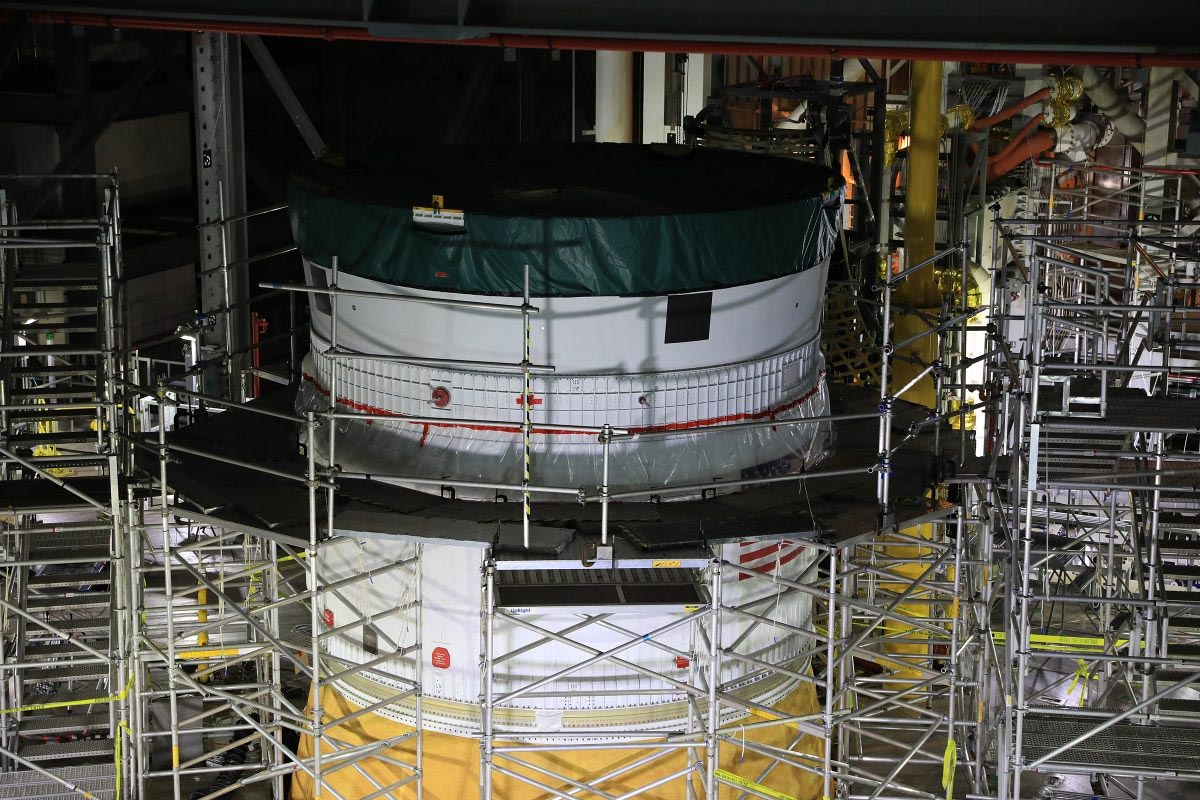
    After successfully completing the integrated modal test, technicians removed the Space Launch System (SLS) rocket’s Orion stage adapter structural test article and the Mass simulator for Orion. Then, they moved the Orion stage adapter flight hardware to the Vehicle Assembly Building at NASA’s Kennedy Space Center in Florida. On October 9, the Orion stage adapter was connected to the top of the Interim Cryogenic Propulsion Stage (ICPS) that provides the power to send Orion to the Moon. Soon, Orion, which rides on top of SLS, will be stacked to complete the Artemis I spaceship. Artemis I is the first integrated flight of SLS and Orion. This uncrewed flight test will be followed by Artemis II, which will be the first mission to send astronauts on a mission to orbit the Moon. Credit: NASA

    The last piece of Space Launch System (SLS) rocket hardware has been added to the stack at NASA’s Kennedy Space Center in Florida. Crews with NASA’s Exploration Ground Systems and contractor Jacobs added the Orion stage adapter to the top of the rocket inside the spaceport’s Vehicle Assembly Building. To complete the Artemis I stack, crews will soon add the Orion spacecraft and its launch abort system on top of the Orion stage adapter.

    The Orion stage adapter, built at NASA’s Marshall Space Flight Center in Huntsville, Alabama connects Orion to the Interim Cryogenic Propulsion Stage (ICPS), which was built by Boeing and United Launch Alliance at ULA’s factory in Decatur, Alabama. During the mission, the ICPS will fire one RL10 engine in a maneuver called trans-lunar injection, or TLI, to send Orion speeding toward the Moon.
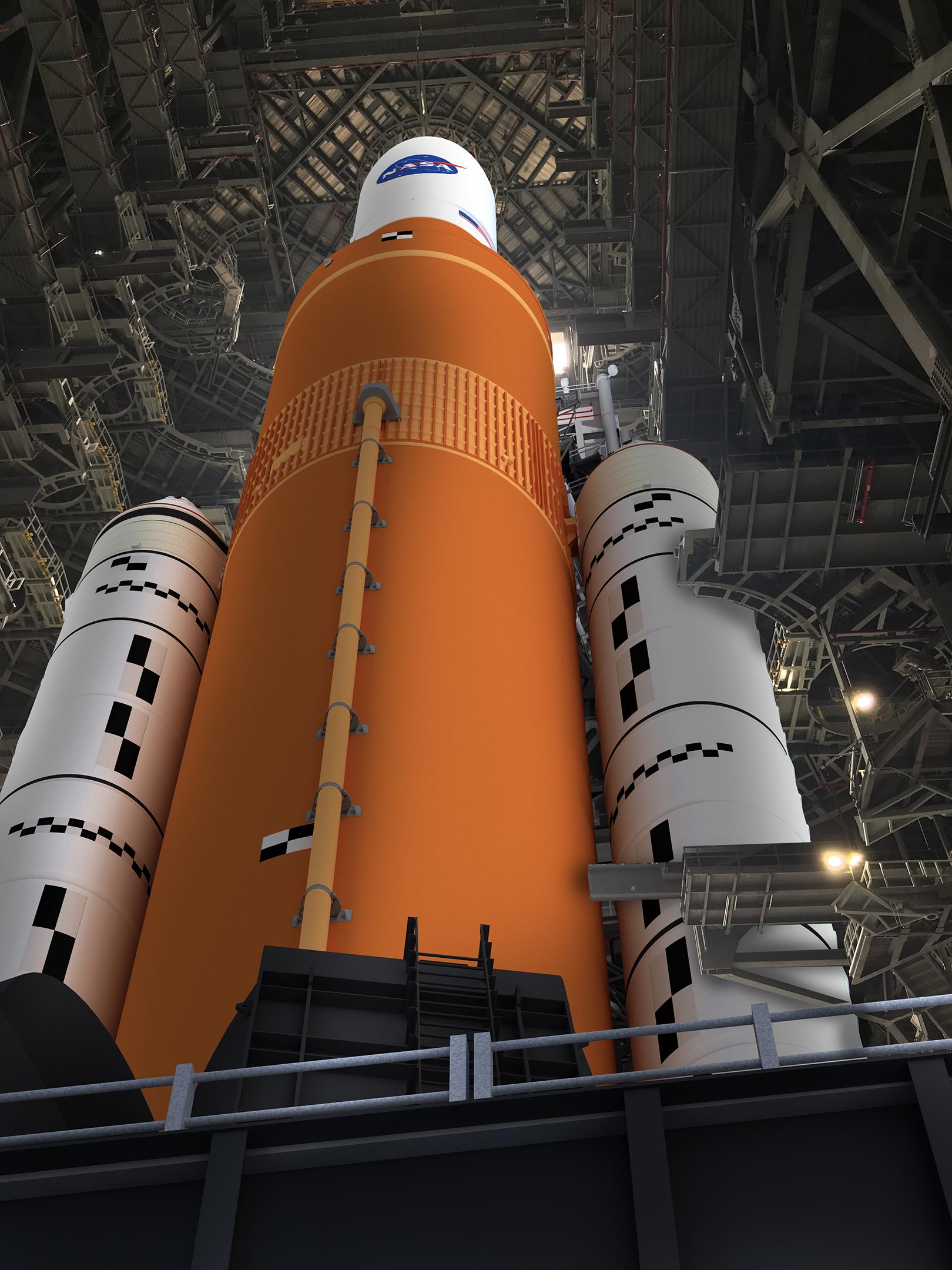
    SLS in Block 1 Cargo Configuration Inside VAB
    This illustration shows NASA’s Space Launch System (SLS) in its Block 1 configuration inside the Vehicle Assembly Building at NASA’s Kennedy Space Center in Florida. From top to bottom, the entire rocket measures about 312 feet (95 meters) high and has the capability of lifting payloads with a mass of more than 26 metric tons (57,000 pounds). Credit: NASA

    As Orion heads to the Moon for its mission, the ICPS will separate from Orion and then deploy 10 secondary payloads that are riding to space inside the Orion stage adapter. These CubeSats have their own propulsion systems that will take them on missions to the Moon and other destinations in deep space.

    While the ICPS and Orion stage adapter are making it possible for SLS to send its first science payloads to space on this uncrewed mission, they only will be used for the first three Artemis missions. The Exploration Upper Stage (EUS), a more powerful stage with four RL10 engines, will be used on future Artemis missions. The EUS can send 83,000 pounds (38,000 kilograms) to the Moon, which is 40 percent more weight than the ICPS. The EUS makes it possible to send Orion, astronauts, and larger and heavier co-manifested payloads to the Moon.

    SLS Exploration Upper Stage Infographic
    NASA’s Space Launch System (SLS) rocket delivers propulsion in stages to send NASA’s Orion spacecraft and heavy cargo to the Moon for the Artemis lunar missions. At liftoff, the core stage and twin solid rocket boosters fire to propel the rocket off the launch pad send it into orbit. Once in orbit, the upper stage provides the in-space propulsion to set the spacecraft on a precise trajectory. While the rocket’s core stage design will remain the same for each of the Artemis missions, the rocket’s upper stage is selected to meet various mission requirements and goals. For the first three Artemis missions, including the mission that will land the first woman and the next man on the Moon by 2024, SLS will utilize an interim cryogenic propulsion stage with one RL10 engine to send Orion to the Moon. Later missions with the evolved SLS Block 1B rocket configuration will use an exploration upper stage with larger fuel tanks and four RL10 engines to send a crewed Orion and large cargos to the Moon. Credit: NASA/Kevin O’Brien

    Artemis I will be followed by a series of increasingly complex missions. With Artemis, NASA will land the first woman and the first person of color on the lunar surface and establish long-term exploration at the Moon in preparation for human missions to Mars. SLS and NASA’s Orion spacecraft, along with the commercial human landing system and the Gateway in orbit around the Moon, are NASA’s backbone for deep space exploration. SLS is the only rocket that can send Orion, astronauts, and supplies to the Moon in a single mission.

    Never miss a breakthrough: Join the SciTechDaily newsletter.
    Follow us on Google and Google News.

    ARTEMIS Mission NASA Rocket Space Launch System
    Share. Facebook Twitter Pinterest LinkedIn Email Reddit

    Related Articles

    NASA’s Artemis II Is on the Launch Pad and the Moon Is Next

    NASA Fires Up RS-25 at 111% Power for Artemis Moon Launches

    NASA Integrated Testing for Artemis I Moon Mission Continues

    NASA Artemis I Space Launch System (SLS) Rocket and Orion Spacecraft Integrated Testing Update

    NASA Awards Artemis Contract for Future SLS Mega Moon Rocket Boosters

    NASA to Roll Out Artemis Mega Moon Rocket for First Time

    NASA’s Powerful SLS Rocket Fully Stacked for Artemis I Moon Mission – Liftoff for Deep Space in February 2022

    One Step Closer: Orion Spacecraft Stacked on Top SLS Rocket for NASA’s Artemis I Mission

    NASA Readies for Future Artemis Moon Missions With SLS Rocket Engine Test Series

    Leave A Reply Cancel Reply

    • Facebook
    • Twitter
    • Pinterest
    • YouTube

    Don't Miss a Discovery

    Subscribe for the Latest in Science & Tech!

    Trending News

    Scientists Call for a Complete Rethink of Alzheimer’s Treatment

    Scientists Identify Molecular Switch That Lets Exercise Reverse Muscle Aging

    Why Your Most Vivid Dreams Might Be the Key to Deep, Restful Sleep

    A Bright Star Hid a Massive Secret for 50 Years: Mystery of Gamma Cassiopeiae Finally Solved

    Scientists Identify Protein That Slows Key Effects of Aging

    Revolutionary Submarine Mysteriously Disappears Without a Trace – Scientists Are Now Preparing for a Bold Return

    Why Drinking More Water Isn’t Enough To Stop Kidney Stones

    New Study Reveals Surprising Effect of Drinking Coffee at Night

    Follow SciTechDaily
    • Facebook
    • Twitter
    • YouTube
    • Pinterest
    • Newsletter
    • RSS
    SciTech News
    • Biology News
    • Chemistry News
    • Earth News
    • Health News
    • Physics News
    • Science News
    • Space News
    • Technology News
    Recent Posts
    • Why Aging Lungs Turn Mild Infections Into Life-Threatening Illness
    • Lost Bronze Age Mines Unearthed in Spain Transform Bronze Age History
    • First New Dinosaur Species Found in Korea in 15 Years Surprises Scientists
    • Tyrannosaurus Tooth Found Embedded in Dinosaur Skull Reveals Brutal Prehistoric Attack
    • This Supervolcano Is Refilling With Magma After 7,300 Years
    Copyright © 1998 - 2026 SciTechDaily. All Rights Reserved.
    • Science News
    • About
    • Contact
    • Editorial Board
    • Privacy Policy
    • Terms of Use

    Type above and press Enter to search. Press Esc to cancel.