
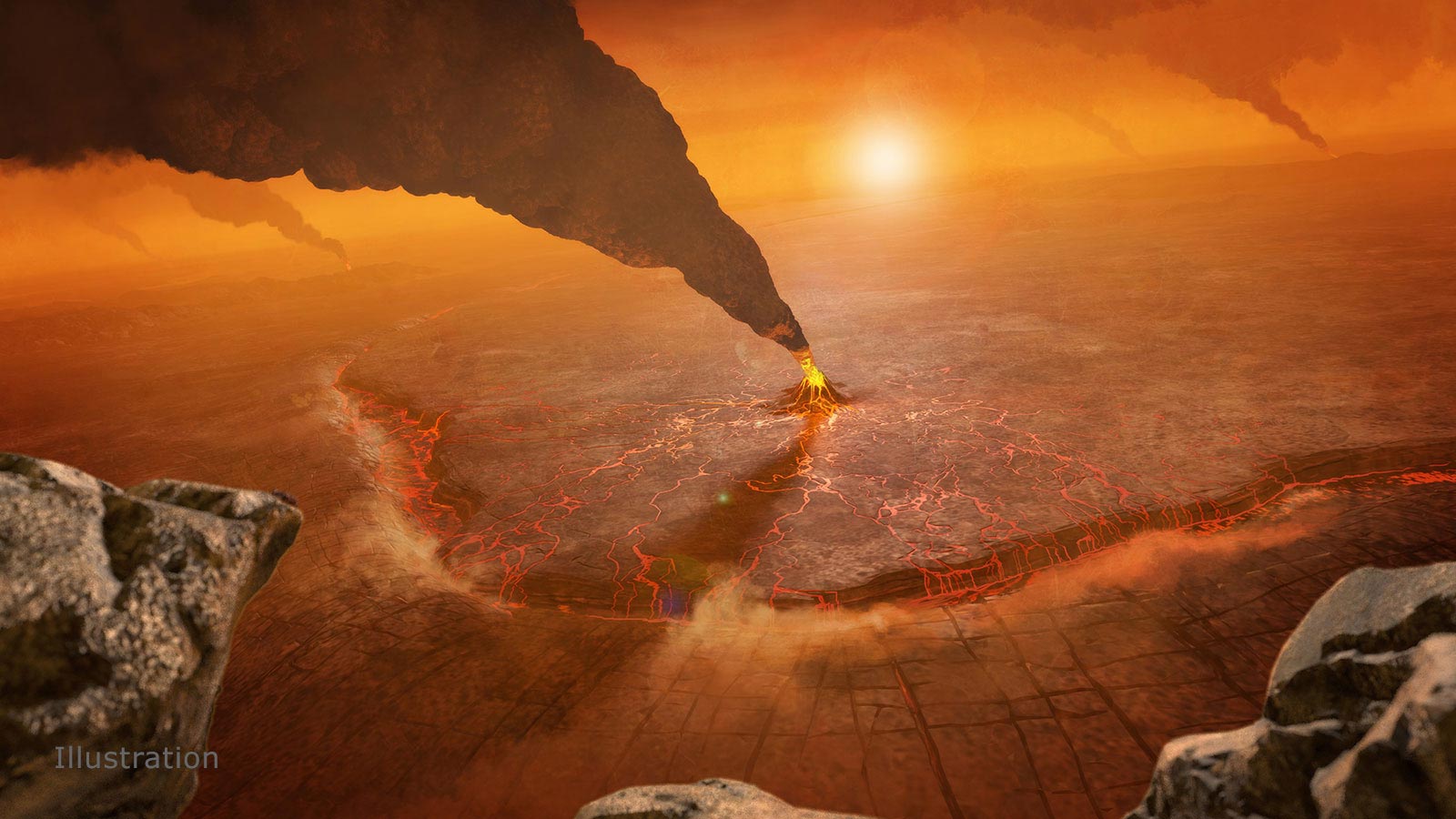
New research reveals that Venus may still be geologically alive, with massive circular features pointing to hot plumes stirring deep beneath its crust.
Vast, circular features on the surface of Venus may be signs that the planet is still geologically active. That’s according to new research based on data collected over 30 years ago by NASA’s Magellan spacecraft. Unlike Earth, where giant plates of crust shift and recycle through a process called plate tectonics, Venus doesn’t have these moving plates. But its surface is still being reshaped—likely by molten rock rising from deep within the planet.
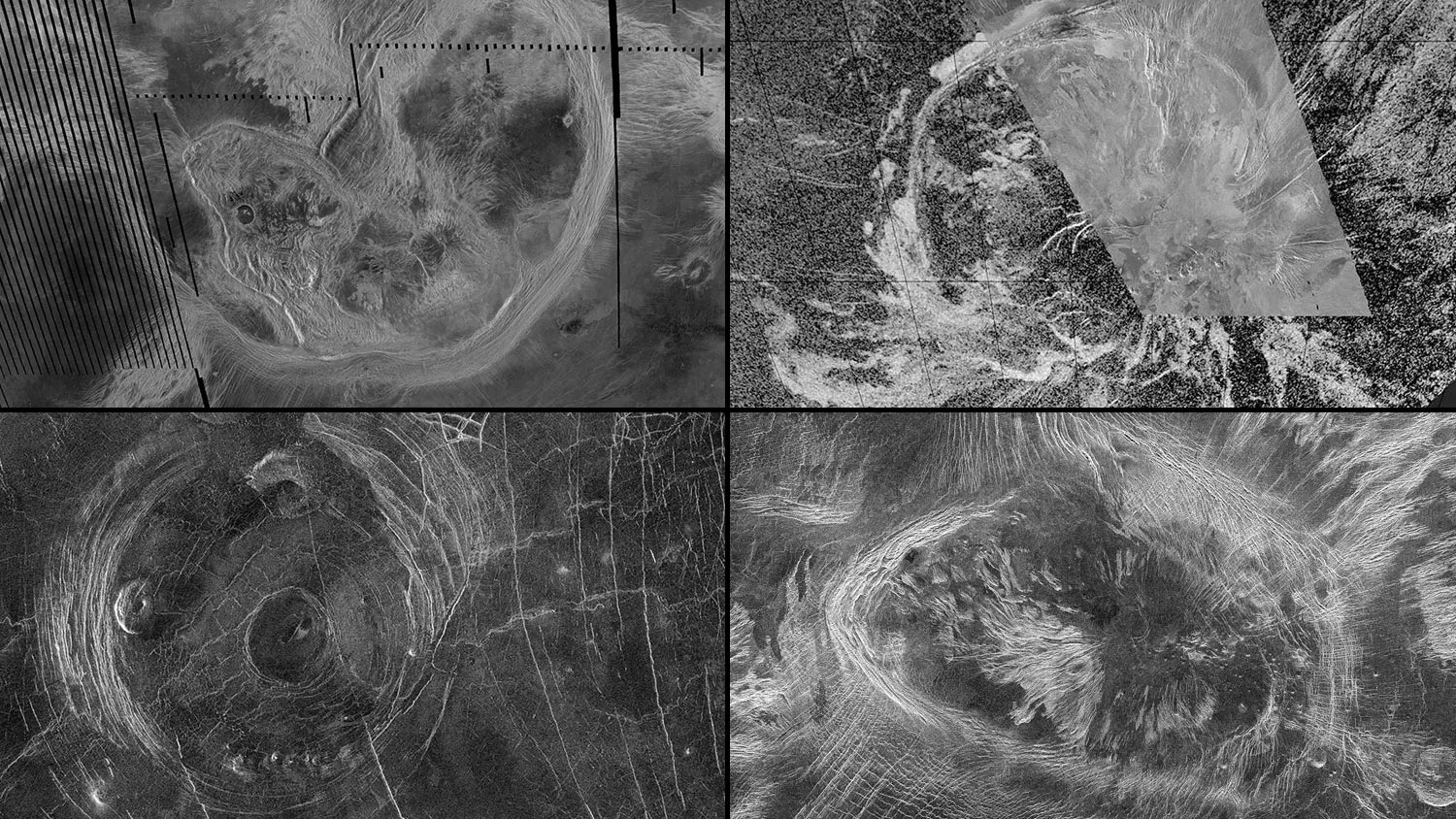
To explore what’s driving this activity, scientists focused on mysterious structures called coronae. These are massive, oval-shaped formations that can span hundreds of miles. They’re believed to form when hot, buoyant material from Venus’ interior pushes upward, distorting the surface. Surrounding each corona is a system of fractures that hints at powerful forces beneath. So far, researchers have identified hundreds of these features across the planet.
Magellan Data Offers New Clues
The new study, published in Science Advances, reveals fresh evidence that many of these coronae are still being shaped by underground forces. The findings come from NASA’s Magellan mission, which orbited Venus in the early 1990s and delivered the most detailed maps of the planet’s surface and gravity field to date.
“Coronae are not found on Earth today; however, they may have existed when our planet was young and before plate tectonics had been established,” said the study’s lead author, Gael Cascioli, assistant research scientist at the University of Maryland, Baltimore County, and NASA’s Goddard Space Flight Center in Greenbelt, Maryland. “By combining gravity and topography data, this research has provided a new and important insight into the possible subsurface processes currently shaping the surface of Venus.”
Anticipating VERITAS: The Next Venus Mission
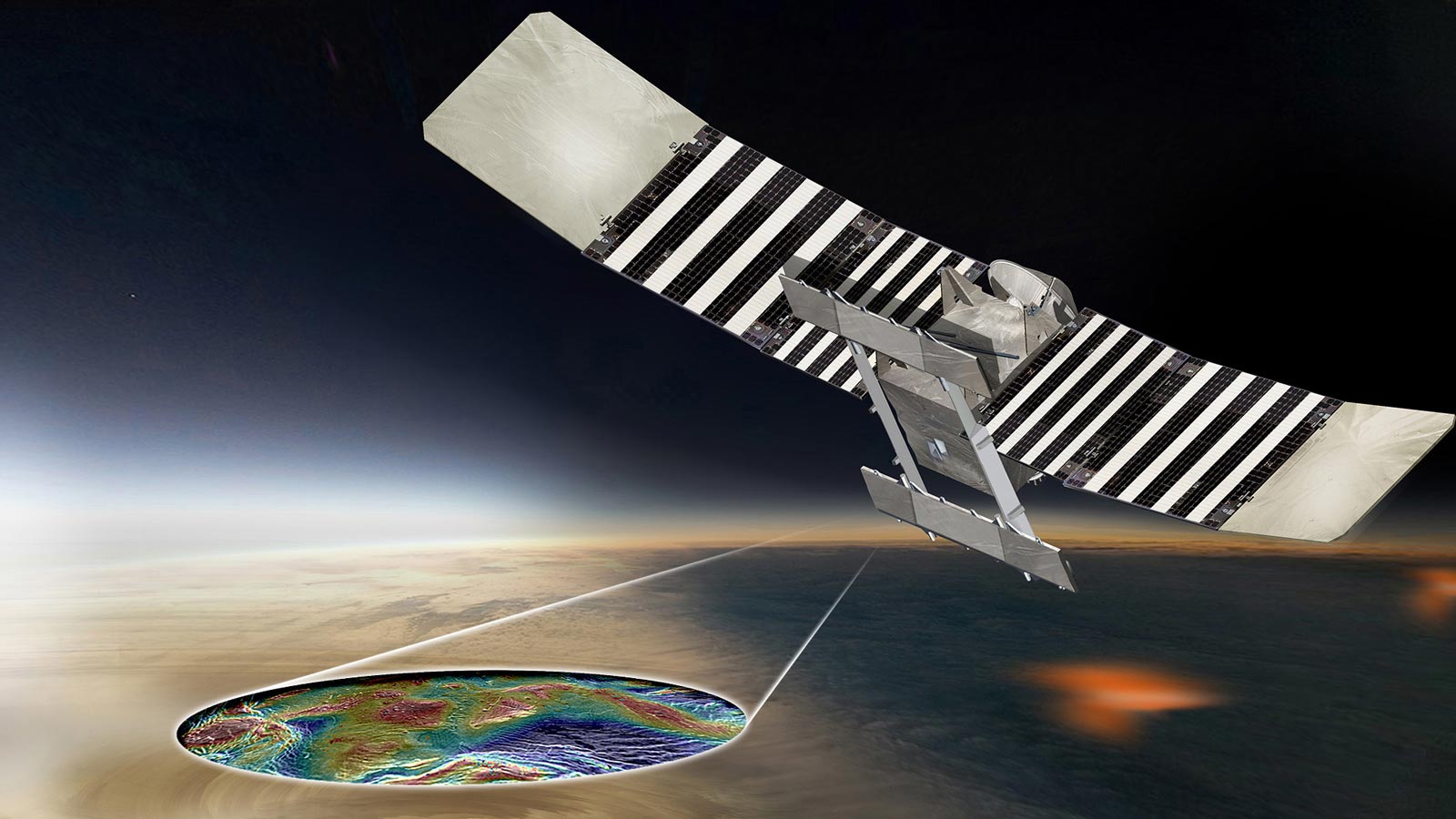
As members of NASA’s forthcoming VERITAS (Venus Emissivity, Radio science, InSAR, Topography, and Spectroscopy) mission, Cascioli and his team are particularly interested in the high-resolution gravity data the spacecraft will provide. Study coauthor Erwan Mazarico, also at Goddard, will co-lead the VERITAS gravity experiment when the mission launches no earlier than 2031.
Unraveling the Origins of Coronae
Managed by NASA’s Jet Propulsion Laboratory in Southern California, Magellan used its radar system to see through Venus’ thick atmosphere and map the topography of its mountains and plains. Of the geological features the spacecraft mapped, coronae were perhaps the most enigmatic: It wasn’t clear how they formed. In the years since, scientists have found many coronae in locations where the planet’s lithosphere is thin and heat flow is high.
“Coronae are abundant on Venus. They are very large features, and people have proposed different theories over the years as to how they formed,” said coauthor Anna Gülcher, Earth and planetary scientist at the University of Bern in Switzerland. “The most exciting thing for our study is that we can now say there are most likely various and ongoing active processes driving their formation. We believe these same processes may have occurred early in Earth’s history.”
The researchers developed sophisticated 3D geodynamic models that demonstrate various formation scenarios for plume-induced coronae and compared them with the combined gravity and topography data from Magellan. The gravity data proved crucial in helping the researchers detect less dense, hot, and buoyant plumes under the surface — information that couldn’t be discerned from topography data alone. Of the 75 coronae studied, 52 appear to have buoyant mantle material beneath them that is likely driving tectonic processes.
Unique Venusian Tectonic Activity Explained
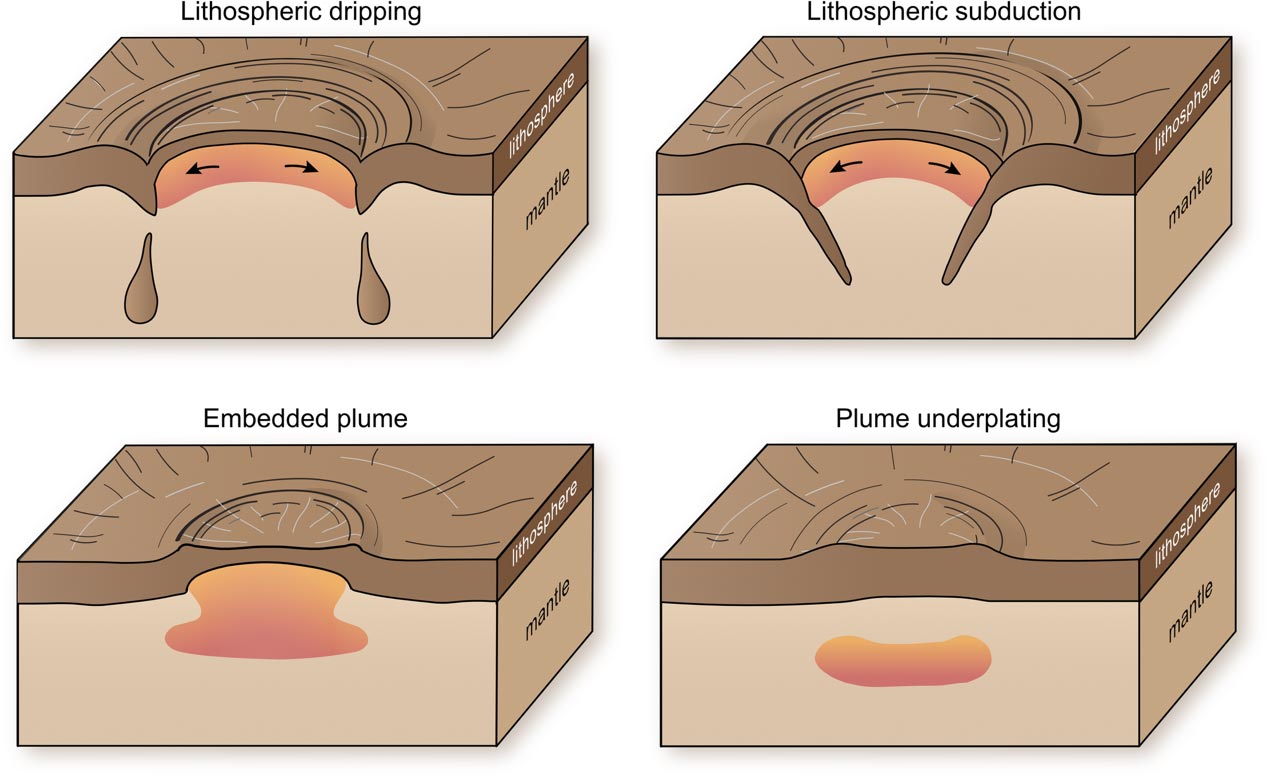
One key process is subduction: On Earth, it happens when the edge of one tectonic plate is driven beneath the adjacent plate. Friction between the plates can generate earthquakes, and as the old rocky material dives into the hot mantle, the rock melts and is recycled back to the surface via volcanic vents.
On Venus, a different kind of subduction is thought to occur around the perimeter of some coronae. In this scenario, as a buoyant plume of hot rock in the mantle pushes upward into the lithosphere, surface material rises and spreads outward, colliding with surrounding surface material and pushing that material downward into the mantle.
Another tectonic process known as lithospheric dripping could also be present, where dense accumulations of comparatively cool material sink from the lithosphere into the hot mantle. The researchers also identify several places where a third process may be taking place: A plume of molten rock beneath a thicker part of the lithosphere potentially drives volcanism above it.
Revisiting Magellan Data with Fresh Eyes
This work marks the latest instance of scientists returning to Magellan data to find that Venus exhibits geologic processes that are more Earth-like than originally thought. Recently, researchers were able to spot erupting volcanoes, including vast lava flows that vented from Maat Mons, Sif Mons, and Eistla Regio in radar images from the orbiter.
While those images provided direct evidence of volcanic action, the authors of the new study will need sharper resolution to draw a complete picture about the tectonic processes driving corona formation. “The VERITAS gravity maps of Venus will boost the resolution by at least a factor of two to four, depending on location — a level of detail that could revolutionize our understanding of Venus’ geology and implications for early Earth,” said study coauthor Suzanne Smrekar, a planetary scientist at JPL and principal investigator for VERITAS.
Reference: “A spectrum of tectonic processes at coronae on Venus revealed by gravity and topography” by Gael Cascioli, Anna J. P. Gülcher, Erwan Mazarico and Suzanne E. Smrekar, 14 May 2025, Science Advances.
DOI: 10.1126/sciadv.adt5932
VERITAS (Venus Emissivity, Radio science, InSAR, Topography, and Spectroscopy) is NASA’s ambitious mission to peel back the dense veil of Venus and reveal the planet’s hidden geologic secrets. Managed by the Jet Propulsion Laboratory (JPL), VERITAS is designed to revolutionize our understanding of Earth’s sister planet by investigating its surface composition, topography, and internal structure with unprecedented detail.
The spacecraft will carry a synthetic aperture radar to generate high-resolution 3D global maps of Venus, helping scientists detect surface features and tectonic activity across the planet. Complementing this, a near-infrared spectrometer will analyze the planet’s surface chemistry to determine what Venus is made of, crucial for identifying different rock types and active volcanic regions.
Additionally, VERITAS will employ a radio tracking system to measure Venus’ gravitational field, allowing scientists to probe the planet’s internal structure, from crust to core. Together, these tools aim to pinpoint geologically active zones and unravel the tectonic and volcanic processes that may still be shaping Venus today.
Set to launch no earlier than 2031, VERITAS promises to deliver the clearest and most comprehensive picture of Venus since NASA’s Magellan mission, advancing our understanding of how rocky planets evolve, including Earth itself.
Never miss a breakthrough: Join the SciTechDaily newsletter.
Follow us on Google and Google News.
4 Comments
If it has signs it’s God’s work at hand
No irrelevant organized magic superstition on popular science sites, please.
I wonder if venus really has life because some picture of the surface of the venus are their are some strange things that are the evedence that shows that venus has life.
Need more about space science