
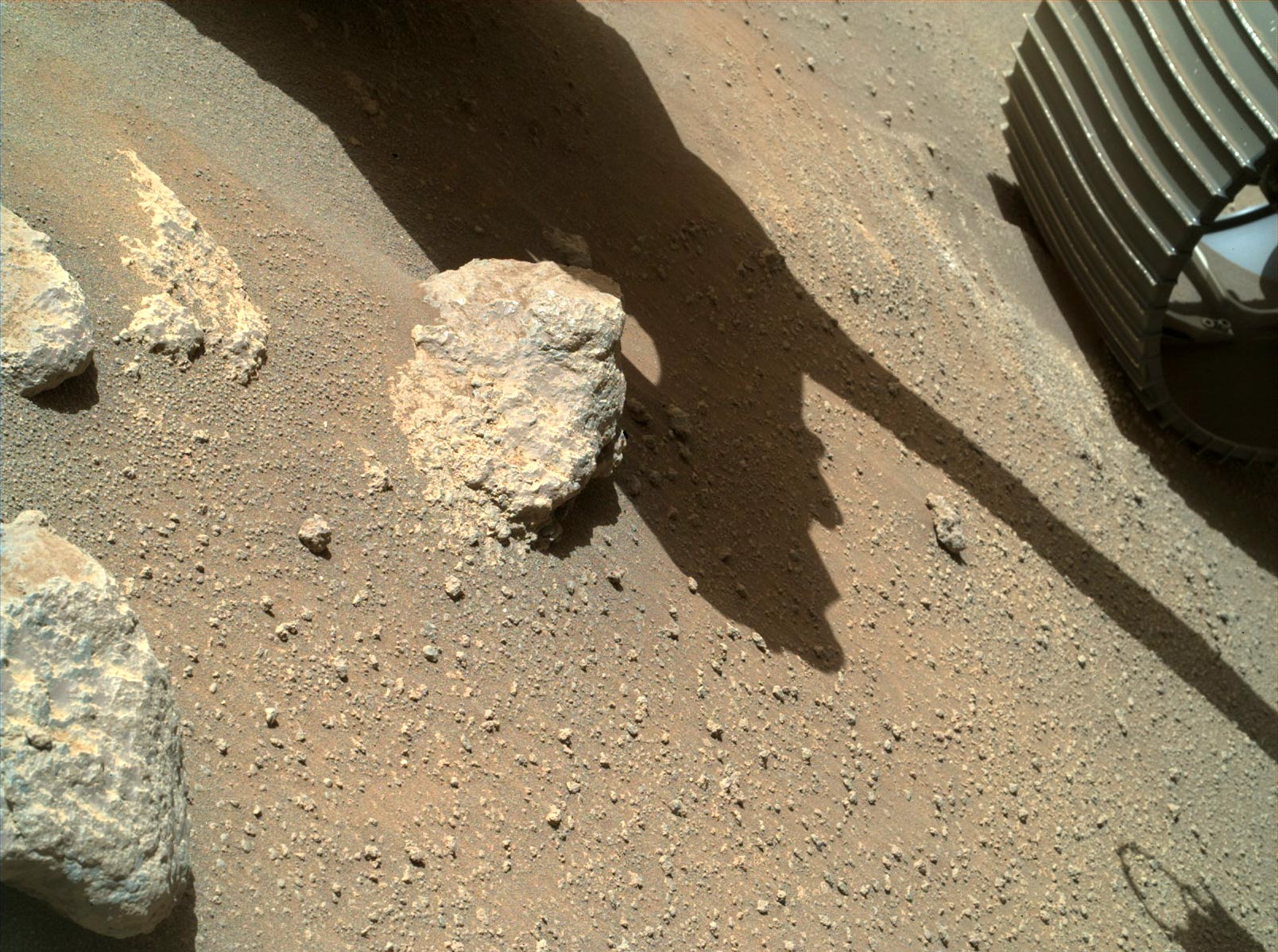
The NASA Mars 2020 mission team is addressing the challenge of removing pebbles from the Perseverance rover’s bit carousel by testing operational sequences on Earth and implementing a mitigation strategy on Mars.
They performed imaging and testing, including the unusual step of dumping the contents of a sample tube back onto Mars, and are planning further tests to ensure the pebbles are managed effectively.
Execution of Mitigation Strategy
NASA’s Mars 2020 mission team has been working methodically and thoroughly, making good progress on understanding the best path forward to remove the uninvited pebbles from Perseverance’s bit carousel. Over the previous weekend, and earlier this week, operational sequences were developed and tested to remove these rocky interlopers.
With terrestrial experimentation complete, we have begun executing our mitigation strategy on Mars. On January 12 we did a detailed image survey of the ground below Perseverance. This was done so we would have a good idea what rocks and pebbles already exist down there before some more – from our bit carousel – join them in the not-so-distant future.
Unexpected Sample Return
With this below-chassis, preliminary imaging, in hand, the team embarked on a maneuver with our robotic arm I never imagined we would perform – ever. Simply put, we are returning the remaining contents of Sample Tube 261 (our latest cored-rock sample) back to its planet of origin. Although this scenario was never designed or planned for prior to launch, it turns out dumping a core from an open tube is a fairly straightforward process (at least during Earth testing). We sent commands up yesterday, and later on today the rover’s robotic arm will simply point the open end of the sample tube toward the surface of Mars and let gravity do the rest.
I imagine your next question is, “Why are you dumping out the contents of the sample tube?” The answer is that, at present, we are not certain how much cored rock continues to reside in Tube 261. And while this rock will never make my holiday card list, the science team really seems to like it. So if our plans go well with our pebble mitigation (see below), we may very well attempt to core “Issole” (the rock from which this sample was taken) again.
Continuing Pebble Mitigation
This brings me to the next steps in our pebble mitigation strategy: we’re sending up commands to the rover later today, ordering it to do two rotation tests of the bit carousel. These tests (the first, a small rotation; the second, larger) will execute this weekend. Our expectations are that these rotations – and any subsequent pebble movement – will help guide our team, providing them the necessary information on how to proceed. Still, to be thorough, we are also commanding the rover to take a second set of under-chassis images, just in case one or more pebbles happen to pop free.
Analyzing Outcomes and Next Steps
We expect the data and imagery from these two rotation tests to be sent to Earth by next Tuesday, January 18. From there, we’ll analyze and further refine our plans. If I had to ballpark it, I would estimate we’ll be at our current location another week or so – or even more if we decide to re-sample Issole.
So there you have it. The Perseverance team is exploring every facet of the issue to ensure that we not only get rid of this rocky debris but also prevent a similar reoccurrence during future sampling. Essentially, we are leaving no rock unturned in the pursuit of these four pebbles.
Written by Jennifer Trosper, Project Manager at NASA’s Jet Propulsion Laboratory
Never miss a breakthrough: Join the SciTechDaily newsletter.
Follow us on Google and Google News.
2 Comments
Interesting.
Future sampling technology needs to be reimagined. To ensure pebbles don’t clog up the sampling and sample collections.
Having travelled such Long distance , it is surprising that the robotic arm can’t pick up pebbles and Martian rock samples as well and bring the same back for analysis.
Don’t know why the sample of pebbles and Rocks need to stored in a test tube. There can be other storage devices which can be used?
Maybe I have rocks in my head!!
Views expressed are personal.Not binding anyone.
Good resarch