
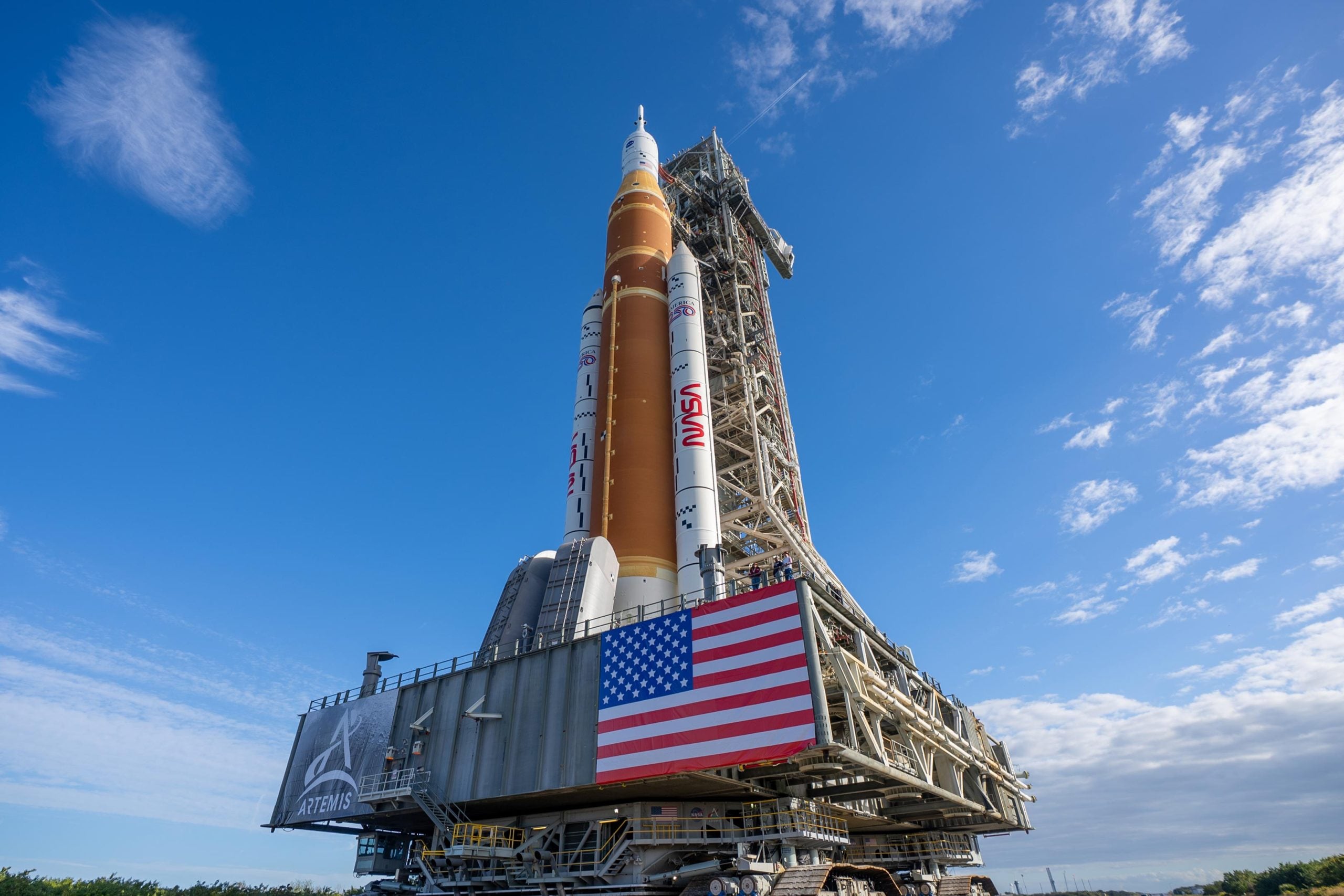
NASA says America’s push back to the Moon is accelerating, with Artemis II poised to launch a new era of U.S. space leadership.
One year into President Donald J. Trump’s second term, NASA reports clear progress across human spaceflight, scientific research, aeronautics, and advanced technologies. Agency leaders describe these developments as the early stages of a renewed era of American leadership in space, supported by defined national priorities and major investment through the Working Families Tax Cut Act.
Since President Trump was sworn in as the 47th President of the United States, NASA has refined its mission in line with his national space policy. That direction has reinforced U.S. leadership beyond Earth while speeding up work in exploration, discovery, and innovation. With stronger emphasis on human spaceflight, scientific achievement, and national capability, the agency says it is operating with renewed focus and confidence.
Foundations Laid During the First Term
NASA’s current momentum builds on initiatives launched during President Trump’s first term. During that period, the United States created the U.S. Space Force, launched the Artemis campaign, and established the Artemis Accords, which now include 60 signatory nations and continue to expand. The administration also oversaw the return of American astronauts to space from U.S. soil after the end of the space shuttle program.
With a formal National Space Policy and the Working Family Tax Cut Act in place, NASA now has the guidance, funding, and authority it says are necessary to pursue an ambitious long-term vision.
Missions, Science, and New Technology
During the first year of the President’s second term, NASA completed two human spaceflight missions, launched 15 science missions, and carried out a successful test flight of a new experimental X-plane. At the same time, work has advanced across a wide range of areas, including lunar exploration, Earth science, planetary defense, next-generation aircraft, and technologies designed to support future missions to Mars.
The agency is also preparing for a major milestone. NASA plans to launch the Artemis II mission, which will send astronauts around the Moon for the first time in more than five decades. That flight is intended to lay the groundwork for a sustained American return to the lunar surface. Agency leaders say these achievements reflect a workforce encouraged to move quickly, pursue ambitious goals, and deliver tangible results.
Leadership Perspective on NASA’s Direction
“In the first year of this administration, NASA has moved with clarity, purpose, and momentum, advancing President Trump’s bold vision for American leadership in space,” said NASA Administrator Jared Isaacman. “From strengthening our focus on human spaceflight and preparing for the first deep space exploration by NASA astronauts in more than half a century, to accelerating innovation across science, technology, and national capability, the President has provided the clearest executive direction for NASA since the Kennedy era. President Trump’s National Space Policy sharpened our mission, aligned our priorities, and empowered our workforce to move faster and think bigger. Because of that leadership, NASA is confidently delivering on a future of American space superiority for generations to come.”
Looking Ahead to the Moon and Beyond
NASA officials say the agency is well positioned to build on its recent progress. Under President Trump’s leadership, American astronauts are expected to return to the Moon by 2028 and begin establishing a lasting human presence supported by a lunar base. NASA also plans to continue launching science and discovery missions, including placing the Nancy Grace Roman Space Telescope into operation before the end of the year.
In support of long-term exploration goals, the agency is advancing nuclear power and propulsion technologies intended to enable deep space missions and expand what is possible beyond Earth orbit.
With a clearly defined mission, a motivated workforce, and growing partnerships with industry and international allies, NASA enters the second year of President Trump’s second term focused on extending American leadership in space and pursuing discoveries that could shape the future for decades to come.
Never miss a breakthrough: Join the SciTechDaily newsletter.
Follow us on Google and Google News.
9 Comments
heh, heh: the only, and I mean only, reason the US all of a sudden has a new love for the moon, is bc China is going there.
Wow, so much trumpian propaganda!
Didnt even read the article. Before publishing
Didnt even read the article before publishing. Propaganda.
How stars are born has never been solved. Gas pressure will always exceed the gravity of gas. Put up a pretty picture and try to rehash nonsense.
NASA is little more than a parasite, self-perpetuating propaganda machine and an utter waste of money. No manned missions for half a century and now I see articles claiming it is ‘racing back to the moon’ all containing launch dates years in the future.
Private companies would be able to launch moon mission much faster and at a greatly reduced cost. Elon Musk comes to mind. Hell, even Bezos would be better than NASA.
the special effects should be spectacular this time s/
Article doesn’t say who the author is. Is this an official NASA release or just written by someone in the White House?
Just read the first paragraph and was turned off by the propaganda. Not what I expect to find in SciTechDaily