
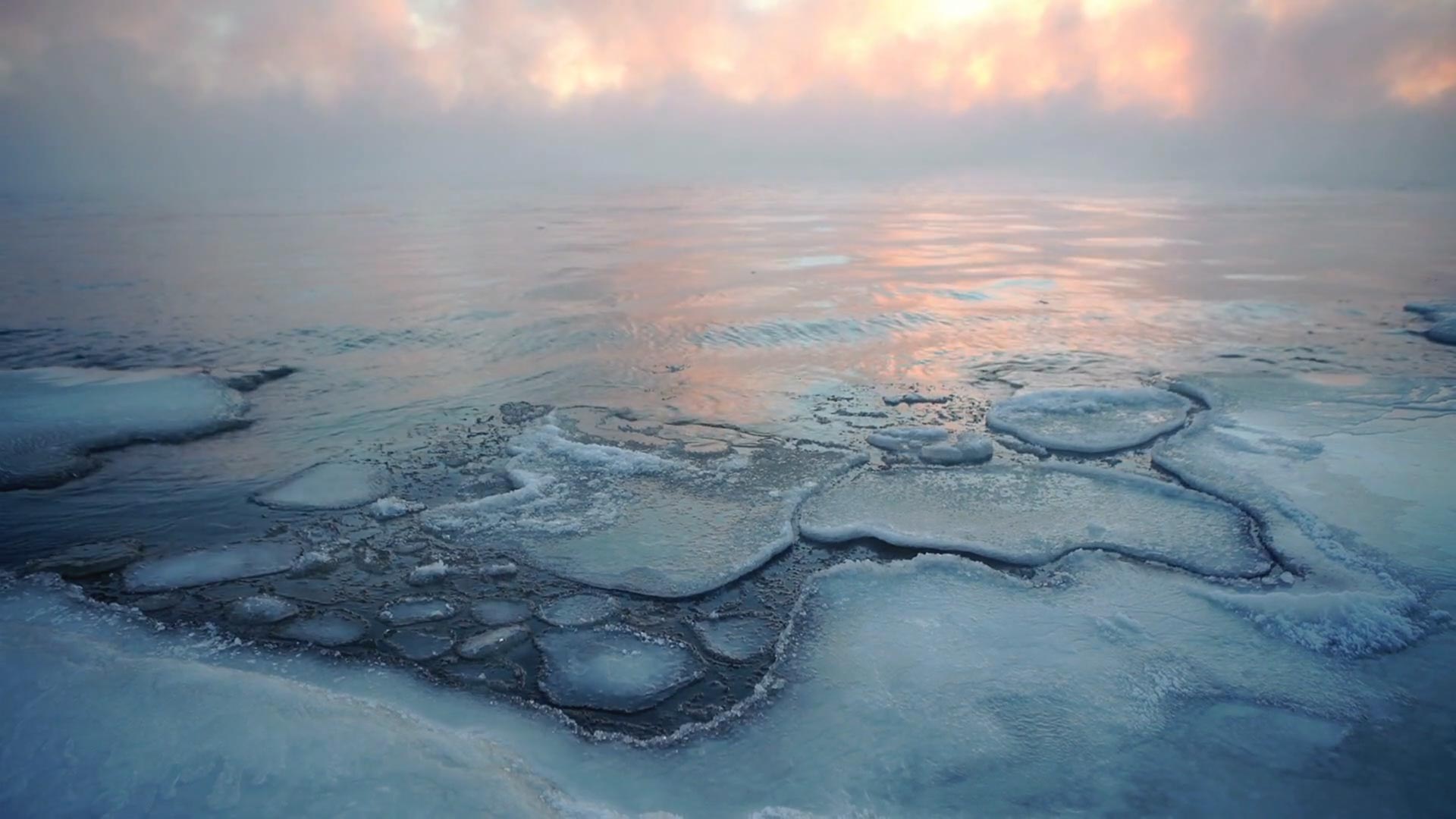
Arctic winter sea ice reached its lowest extent on record at its annual peak on March 22, 2025, while global ice coverage also hit a record low in mid-February.
On March 22, 2025, Arctic sea ice reached its lowest winter maximum on record, according to NASA and the National Snow and Ice Data Center (NSIDC) at the University of Colorado Boulder. The ice extent peaked at 5.53 million square miles (14.33 million square kilometers), falling below the previous record low of 5.56 million square miles (14.41 million square kilometers) set in 2017.
Arctic sea ice typically expands during the dark, frigid winter months. However, in recent years, less new ice has formed, and the accumulation of multi-year ice has declined. This winter continued the long-term downward trend observed over the past several decades. The 2025 maximum was 510,000 square miles (1.32 million square kilometers) below the 1981–2010 average.
Observations since 1978 show that ice cover has declined at both poles, leading to a downward trend in the total ice cover over the entire planet. In February 2025, global ice fell to the smallest area ever recorded. Credit: Mark Subbaro/NASA’s Scientific Visualization Studio
In 2025, summer ice in the Antarctic retreated to 764,000 square miles (1.98 million square kilometers) on March 1, tying for the second lowest minimum extent ever recorded. That’s 30% below the 1.10 million square miles (2.84 million square kilometers) that was typical in the Antarctic prior to 2010. Sea ice extent is defined as the total area of the ocean with at least 15% ice concentration.
Consequences and Monitoring Challenges
The reduction in ice in both polar regions has led to another milestone — the total amount of sea ice on the planet reached an all-time low. Globally, ice coverage in mid-February of this year declined by more than a million square miles (2.5 million square kilometers) from the average before 2010. Altogether, Earth is missing an area of sea ice large enough to cover the entire continental United States east of the Mississippi.
Ice cover ebbs and flows through the seasons in the Arctic (left) and the Antarctic (right). Overall, ice cover has declined since scientists started tracking it half a century ago. Credit: Trent Schindler/NASA’s Scientific Visualization Studio
“We’re going to come into this next summer season with less ice to begin with,” said Linette Boisvert, an ice scientist at NASA’s Goddard Space Flight Center in Greenbelt, Maryland. “It doesn’t bode well for the future.”
Scientists primarily rely on satellites in the Defense Meteorological Satellite Program, which measure Earth’s radiation in the microwave range. This natural radiation is different for open water and for sea ice — with ice cover standing out brightly in microwave-based satellite images. Microwave scanners can also penetrate through cloud cover, allowing for daily global observations. The DMSP data are augmented with historical sources, including data collected between 1978 and 1985 with the Nimbus-7 satellite that was jointly operated by NASA and the National Oceanic and Atmospheric Administration.
“It’s not yet clear whether the Southern Hemisphere has entered a new norm with perennially low ice or if the Antarctic is in a passing phase that will revert to prior levels in the years to come,” said Walt Meier, an ice scientist with NSIDC.
Never miss a breakthrough: Join the SciTechDaily newsletter.
Follow us on Google and Google News.
5 Comments
“On March 22, 2025, Arctic sea ice reached its lowest winter maximum on record, … The ice extent peaked at 5.53 million square miles .., falling below the previous record low of 5.56 million square miles … set in 2017.”
As usual, there is no confidence interval (margin of error) presented for the nominal values. Are the differences statistically significant? It isn’t mentioned. Just eyeballing the graph suggests that the highs for about 2015-2020 do not have a statistically significant difference from the 2025 nominal value. The graph suggests that there was a step downwards about 2005, and that it has been relatively constant since then.
One swallow does not make a Spring.
Ah well. All I can say is that the glaciers across which I used to walk to work in 1973 has become a lake.But statistically it wasn’t much of a significant glaciers, as glaciers go.
how horrible
if we’re not careful life might start living in that lake
And of course, there will always be big industry gas and oil repeating the lie that 8 billion people using gas and oil has no negative affect on the atmosphere or the planet, as every year it gets hotter, and hotter, and hotter. If we, as the people of the planet, refuse to do anything about Global warming, we deserve everything that’s coming our way.
To make such a bold, unequivocal claim I presume you have incontrovertible proof that Big Oil is knowingly lying and that there is no question about what will happen in the future.
Have you ever made money at the race tracks with your enviable gift of being able to see the future?
If you were to put your finger on a hot plate heated to 70 deg F, leave the room and come back in 30 minutes and test it again, would you be able to even tell if the plate had changed its temperature by 2 deg F, either way, and be able to tell which way? Two degrees is about how much the world has gotten “hotter, and hotter, and hotter” over the last century. I doubt it very much.
https://pmc.ncbi.nlm.nih.gov/articles/PMC10695924/
Exaggerating is really no different from the behavior of “The Boy Who Cried,’Wolf!'”