
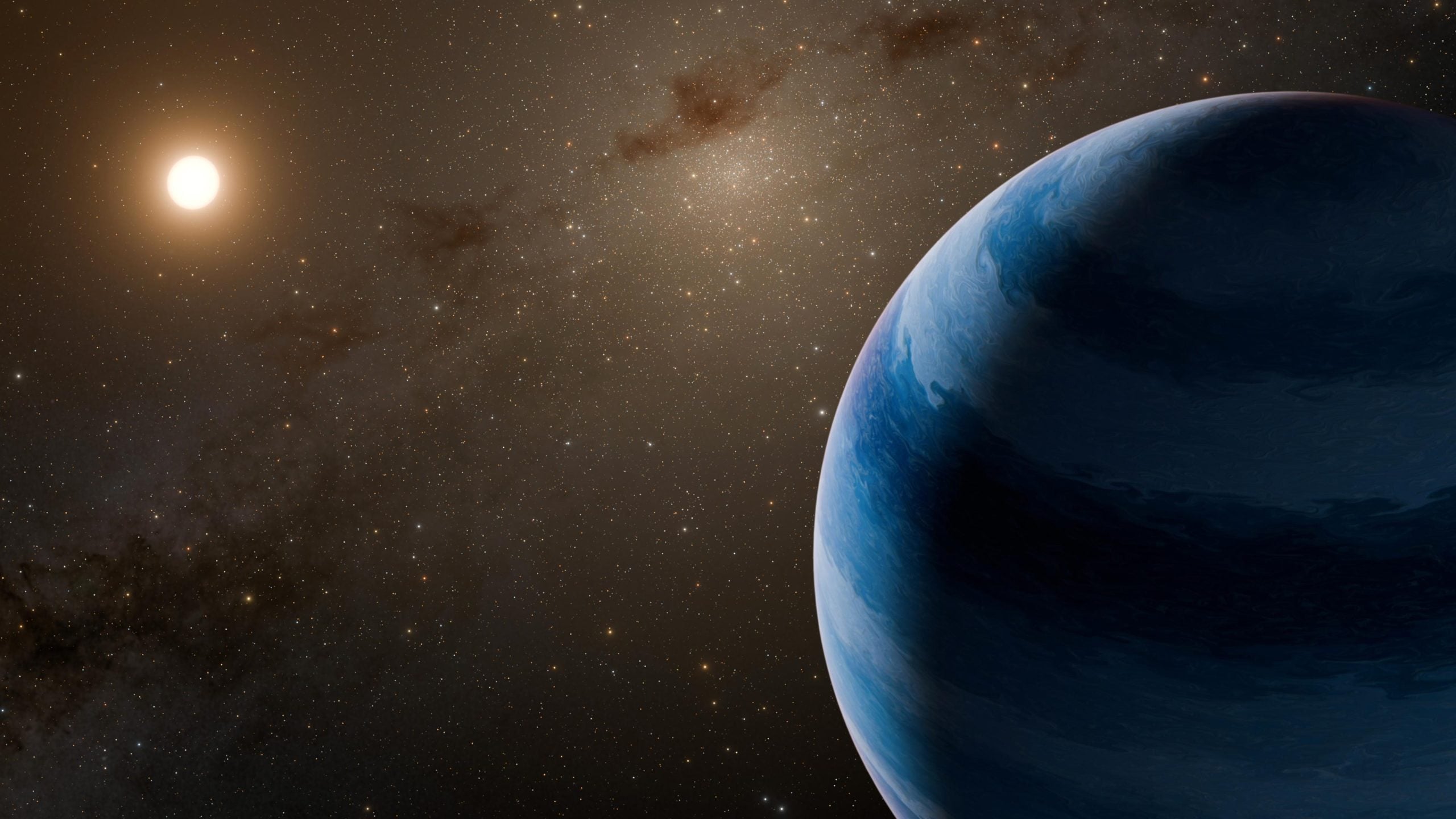
A star racing through the Milky Way may have a planet in tow, setting a new speed record for exoplanet systems.
Using microlensing, astronomers spotted the pair moving at over 1.2 million mph. Scientists are working to confirm whether it’s a true star-planet system or a rogue planet with a moon. If fast enough, it may one day leave the galaxy entirely.
A Record-Breaking Fast Exoplanet System
Astronomers may have found a small, fast-moving star racing through the center of our galaxy — possibly with a planet in orbit. If confirmed, this would be the fastest-known exoplanet system, traveling nearly twice as fast as our solar system through the Milky Way.
The system is estimated to be moving at an incredible speed of at least 1.2 million miles per hour (540 kilometers per second).
“We think this is a so-called super-Neptune world orbiting a low-mass star at a distance that would lie between the orbits of Venus and Earth if it were in our solar system,” said Sean Terry, a postdoctoral researcher at the University of Maryland, College Park and NASA’s Goddard Space Flight Center in Greenbelt, Maryland. Since the star is so feeble, that’s well outside its habitable zone. “If so, it will be the first planet ever found orbiting a hypervelocity star.”
The findings, led by Terry, were published in The Astronomical Journal on February 10.
A Star on the Move
The pair of objects was first spotted indirectly in 2011 thanks to a chance alignment. A team of scientists combed through archived data from MOA (Microlensing Observations in Astrophysics) – a collaborative project focused on a microlensing survey conducted using the University of Canterbury Mount John Observatory in New Zealand — in search of light signals that betray the presence of exoplanets, or planets outside our solar system.
Microlensing occurs because the presence of mass warps the fabric of space-time. Any time an intervening object appears to drift near a background star, light from the star curves as it travels through the warped space-time around the nearer object. If the alignment is especially close, the warping around the object can act like a natural lens, amplifying the background star’s light.

Unraveling the Mystery of Mass
In this case, microlensing signals revealed a pair of celestial bodies. Scientists determined their relative masses (one is about 2,300 times heavier than the other), but their exact masses depend on how far away they are from Earth. It’s sort of like how the magnification changes if you hold a magnifying glass over a page and move it up and down.
“Determining the mass ratio is easy,” said David Bennett, a senior research scientist at the University of Maryland, College Park and NASA Goddard, who co-authored the new paper and led the original study in 2011. “It’s much more difficult to calculate their actual masses.”
Two Theories: Star with a Planet or Rogue Planet with a Moon?
The 2011 discovery team suspected the microlensed objects were either a star about 20 percent as massive as our Sun and a planet roughly 29 times heavier than Earth, or a nearer “rogue” planet about four times Jupiter’s mass with a moon smaller than Earth.
To figure out which explanation is more likely, astronomers searched through data from the Keck Observatory in Hawaii and ESA’s (European Space Agency’s) Gaia satellite. If the pair were a rogue planet and moon, they’d be effectively invisible – dark objects lost in the inky void of space. But scientists might be able to identify the star if the alternative explanation were correct (though the orbiting planet would be much too faint to see).
They found a strong suspect located about 24,000 light-years away, putting it within the Milky Way’s galactic bulge — the central hub where stars are more densely packed. By comparing the star’s location in 2011 and 2021, the team calculated its high speed.
Could This System Escape the Galaxy?
But that’s just its 2D motion; if it’s also moving toward or away from us, it must be moving even faster. Its true speed may even be high enough to exceed the galaxy’s escape velocity of just over 1.3 million miles per hour, or about 600 kilometers per second. If so, the planetary system is destined to traverse intergalactic space many millions of years in the future.
“To be certain the newly identified star is part of the system that caused the 2011 signal, we’d like to look again in another year and see if it moves the right amount and in the right direction to confirm it came from the point where we detected the signal,” Bennett said.
“If high-resolution observations show that the star just stays in the same position, then we can tell for sure that it is not part of the system that caused the signal,” said Aparna Bhattacharya, a research scientist at the University of Maryland, College Park and NASA Goddard who co-authored the new paper. “That would mean the rogue planet and exomoon model is favored.”
The Future of Fast-Moving Exoplanet Discoveries
NASA’s upcoming Nancy Grace Roman Space Telescope will help us find out how common planets are around such speedy stars, and may offer clues to how these systems are accelerated. The mission will conduct a survey of the galactic bulge, pairing a large view of space with crisp resolution.
“In this case, we used MOA for its broad field of view and then followed up with Keck and Gaia for their sharper resolution, but thanks to Roman’s powerful view and planned survey strategy, we won’t need to rely on additional telescopes,” Terry said. “Roman will do it all.”
Reference: “A Candidate High-velocity Exoplanet System in the Galactic Bulge” by Sean K. Terry, Jean-Philippe Beaulieu, David P. Bennett, Aparna Bhattacharya, Jon Hulberg, Macy J. Huston, Naoki Koshimoto, Joshua W. Blackman, Ian A. Bond, Andrew A. Cole, Jessica R. Lu, Clément Ranc, Natalia E. Rektsini and Aikaterini Vandorou, 10 February 2025, The Astronomical Journal.
DOI: 10.3847/1538-3881/ad9b0f
Never miss a breakthrough: Join the SciTechDaily newsletter.
Follow us on Google and Google News.
8 Comments
Better call it sport’s star
I think the “planet” is an intergalactic spaceship and the “sun” is its energy source, if you don’t believe me, just ask Avi Loeb.
not astronomy in imperial units 😭
I want more info. is there a possibility of life?
Will it collide with earth?
So faster than the speed of light just for laughs around 1.4c ?
Definitely a spaceship styled, habited planet, with their own mini sun.
But, is that how fast all of them are? Or are they running from something, that’s a scary thought seeing how big the planet is, or maybe they’re just moving to a new location?
Perhaps the Borg collective moved from square crafts to round ones?
I I I want real pictures.