
When it launches in October, the agency’s Europa Clipper spacecraft will carry a richly layered dispatch that includes more than 2.6 million names submitted by the public.
Following in NASA’s storied tradition of sending inspirational messages into space, the agency has special plans for Europa Clipper, which later this year will launch toward Jupiter’s moon Europa. The moon shows strong evidence of an ocean under its icy crust, with more than twice the amount of water of all of Earth’s oceans combined. A triangular metal plate on the spacecraft will honor that connection to Earth in several ways.
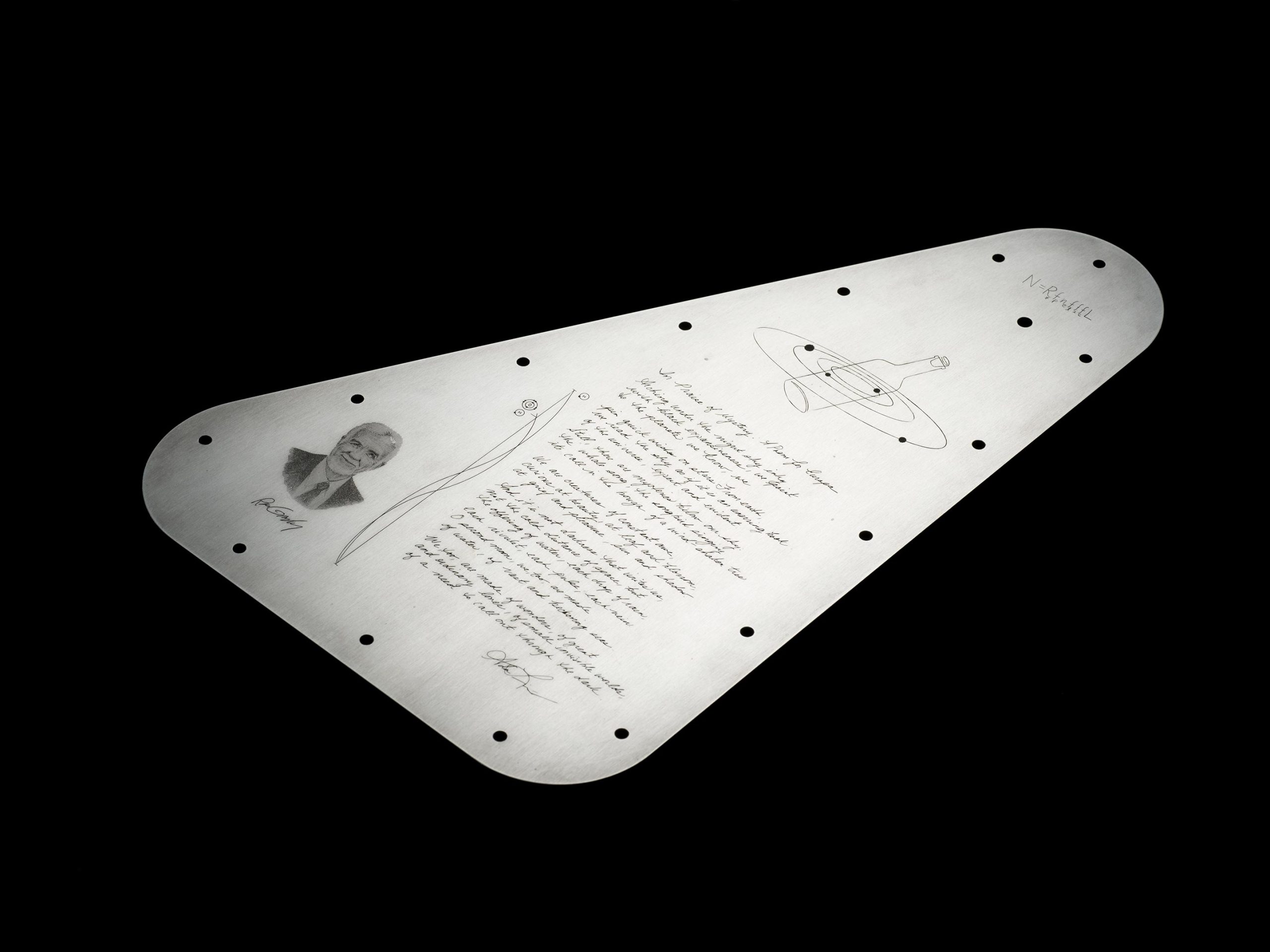
At the heart of the artifact is an engraving of U.S. Poet Laureate Ada Limón’s handwritten “In Praise of Mystery: A Poem for Europa,” along with a silicon microchip stenciled with more than 2.6 million names submitted by the public. The microchip will be the centerpiece of an illustration of a bottle amid the Jovian system – a reference to NASA’s “Message in a Bottle” campaign, which invited the public to send their names with the spacecraft.
A ‘Golden Record’ for Europa
Made of the metal tantalum and measuring about 7 by 11 inches (18 by 28 centimeters), the plate features graphic elements on both sides. The outward-facing panel features art that highlights Earth’s connection to Europa. Linguists collected recordings of the word “water” spoken in 103 languages, from families of languages around the world. The audio files were converted into waveforms (visual representations of sound waves) and etched into the plate. The waveforms radiate out from a symbol representing the American Sign Language sign for “water.”
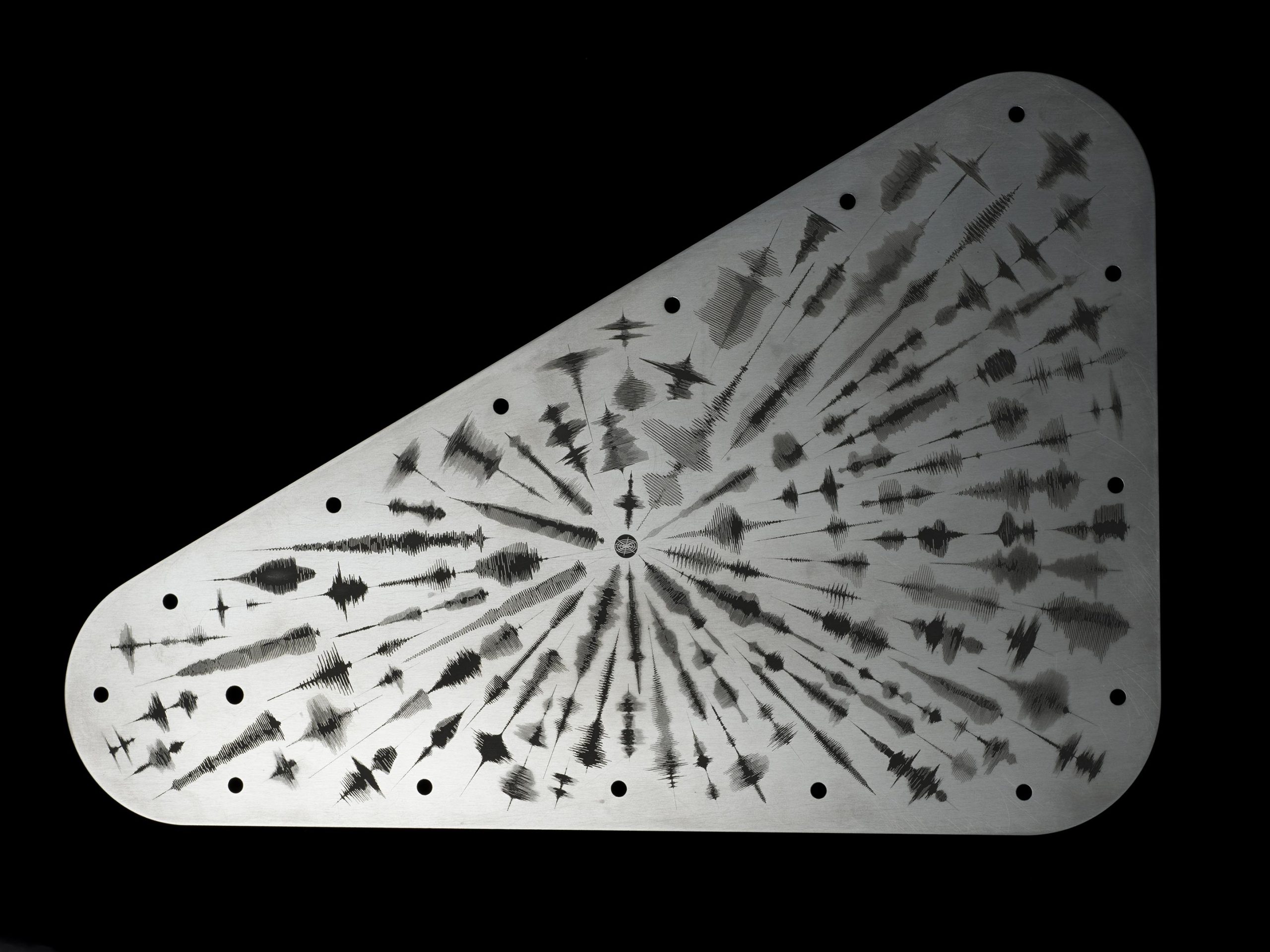
To hear audio of the spoken languages and see the sign, go to: go.nasa.gov/MakeWaves.
In the spirit of the Voyager spacecraft’s Golden Record, which carries sounds and images to convey the richness and diversity of life on Earth, the layered message on Europa Clipper aims to spark the imagination and offer a unifying vision.
“The content and design of Europa Clipper’s vault plate are swimming with meaning,” said Lori Glaze, director of the Planetary Science Division at NASA Headquarters in Washington. “The plate combines the best humanity has to offer across the universe – science, technology, education, art, and math. The message of connection through water, essential for all forms of life as we know it, perfectly illustrates Earth’s tie to this mysterious ocean world we are setting out to explore.”
Reaching Out to the Cosmos
In 2030, after a 1.6-billion-mile (2.6-billion-kilometer) journey, Europa Clipper will begin orbiting Jupiter, making 49 close flybys of Europa. To determine if there are conditions that could support life, the spacecraft’s powerful suite of science instruments will gather data about the moon’s subsurface ocean, icy crust, thin atmosphere, and space environment. The electronics for those instruments are housed in a massive metal vault designed to protect them from Jupiter’s punishing radiation. The commemorative plate will seal an opening in the vault.
Learn more about how Europa Clipper’s vault plate engravings were designed and the inspiration for the plate’s multilayered message. Credit: NASA/JPL-Caltech
Because searching for habitable conditions is central to the mission, the Drake Equation is etched onto the plate as well – on the inward-facing side. Astronomer Frank Drake developed the mathematical formulation in 1961 to estimate the possibility of finding advanced civilizations beyond Earth. The equation has inspired and guided research in astrobiology and related fields ever since.
In addition, artwork on the inward-facing side of the plate will include a reference to the radio frequencies considered plausible for interstellar communication, symbolizing how humanity uses this radio band to listen for messages from the cosmos. These particular frequencies match the radio waves emitted in space by the components of water and are known by astronomers as the “water hole.” On the plate, they are depicted as radio emission lines.
Finally, the plate includes a portrait of one of the founders of planetary science, Ron Greeley, whose early efforts to develop a Europa mission two decades ago laid the foundation for Europa Clipper.
“We’ve packed a lot of thought and inspiration into this plate design, as we have into this mission itself,” says Project Scientist Robert Pappalardo of NASA’s Jet Propulsion Laboratory in Southern California. “It’s been a decades-long journey, and we can’t wait to see what Europa Clipper shows us at this water world.”
Once assembly of Europa Clipper has been completed at JPL, the spacecraft will be shipped to NASA’s Kennedy Space Center in Florida in preparation for its October launch.
More About the Mission
Europa Clipper’s main science goal is to determine whether there are places below Jupiter’s icy moon, Europa, that could support life. The mission’s three main science objectives are to determine the thickness of the moon’s icy shell and its surface interactions with the ocean below, to investigate its composition, and to characterize its geology. The mission’s detailed exploration of Europa will help scientists better understand the astrobiological potential for habitable worlds beyond our planet.
Never miss a breakthrough: Join the SciTechDaily newsletter.
Follow us on Google and Google News.
4 Comments
Not the near-useless Drake Equation…
It would be better for humanity if NASA spent money on health and well-being of all life on earth than send more JUNK into space
Ok. So what’s the timeline on ‘solving all the earth problems’? Ten years? Fifteen? We can do both.
A glorified message in a bottle. In the sea it’s usually the pirates that pick up those…