
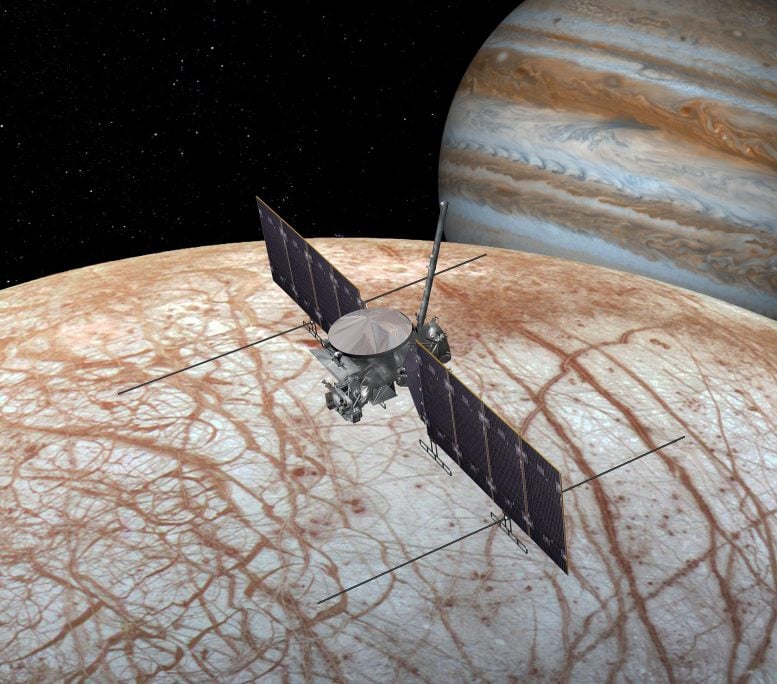
To explore the mysterious ice-encrusted moon Europa, the mission will need to endure bombardment by radiation and high-energy particles surrounding Jupiter.
When NASA’s Europa Clipper begins orbiting Jupiter to investigate whether its ice-encased moon, Europa, has conditions suitable for life, the spacecraft will pass repeatedly through one of the most punishing radiation environments in our solar system.
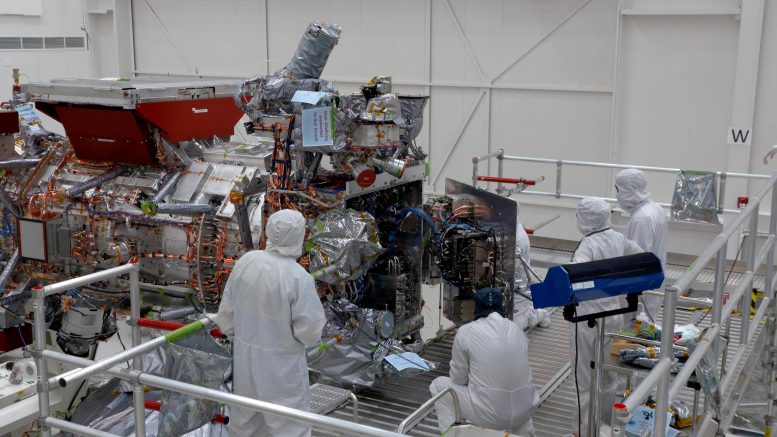
Hardening the spacecraft against potential damage from that radiation is no easy task. But on October 7, the mission put the final piece of the spacecraft’s “armor” in place when it sealed the vault, a container specially designed to shield Europa Clipper’s sophisticated electronics. The probe is being put together, piece by piece, in the Spacecraft Assembly Facility at NASA’s Jet Propulsion Laboratory (JPL) in Southern California ahead of its launch in October 2024.
Join team members from NASA’s Europa Clipper mission behind the scenes in a clean room at NASA’s Jet Propulsion Laboratory to learn about the design of this spacecraft that will visit Europa, an icy moon of Jupiter. Europa Clipper Project Manager Jordan Evans and Deputy Science Manager Trina Ray explain how scientists’ questions translate into hardware, and they provide an update on the build in JPL’s clean room, pointing out hardware that will connect the spacecraft to the rocket, the main communication antenna, and cameras. Credit: NASA Jet Propulsion Laboratory
“Closing the vault is a major milestone,” said Kendra Short, Europa Clipper’s deputy flight system manager at JPL. “It means we’ve got everything in there that we have to have in there. We’re ready to button it up.”
Just under a half-inch (1 centimeter) thick, the aluminum vault houses the electronics for the spacecraft’s suite of science instruments. The alternative of shielding each set of electronic parts individually would add cost and weight to the spacecraft.
“The vault is designed to reduce the radiation environment to acceptable levels for most of the electronics,” said JPL’s Insoo Jun, the co-chair of the Europa Clipper Radiation Focus Group and an expert on space radiation.
Punishing Radiation
Jupiter’s gigantic magnetic field is 20,000 times as strong as Earth’s and spins rapidly in time with the planet’s 10-hour rotation period. This field captures and accelerates charged particles from Jupiter’s space environment to create powerful radiation belts. The radiation is a constant, physical presence – a kind of space weather – bombarding everything in its sphere of influence with damaging particles.
“Jupiter has the most intense radiation environment other than the Sun in the solar system,” Jun said. “The radiation environment is affecting every aspect of the mission.”
That’s why when the spacecraft arrives at Jupiter in 2030, Europa Clipper won’t simply park in orbit around Europa. Instead, like some previous spacecraft that studied the Jovian system, it will make a wide-ranging orbit of Jupiter itself to move away from the planet and its harsh radiation as much as possible. During those looping orbits of the planet, the spacecraft will fly past Europa nearly 50 times to gather scientific data.
The radiation is so intense that scientists believe it modifies the surface of Europa, causing visible color changes, said Tom Nordheim, a planetary scientist at JPL who specializes in icy outer moons – Europa as well as Saturn’s Enceladus.
“Radiation on the surface of Europa is a major geologic modification process,” Nordheim said. “When you look at Europa – you know, the reddish-brown color – scientists have shown that this is consistent with radiation processing.”
Chaotic Icescape
So even as engineers work to keep radiation out of Europa Clipper, scientists like Nordheim and Jun hope to use the space probe to study it.
“With a dedicated radiation monitoring unit, and using opportunistic radiation data from its instruments, Europa Clipper will help reveal the unique and challenging radiation environment at Jupiter,” Jun said.
Nordheim zeroes in on Europa’s “chaos terrain,” areas where blocks of surface material appear to have broken apart, rotated, and moved into new positions, in many cases preserving preexisting linear fracture patterns.
Deep beneath the moon’s icy surface is a vast liquid-water ocean, scientists believe, that could offer a habitable environment for life. Some areas of Europa’s surface show evidence of material transport from the subsurface to the surface. “We need to understand the context of how radiation modified that material,” Nordheim said. “It can alter the chemical makeup of the material.”
The Power of Heat
Because Europa’s ocean is locked inside an envelope of ice, any possible life forms would not be able to rely directly on the Sun for energy, as plants do on Earth. Instead, they’d need an alternative energy source, such as heat or chemical energy. Radiation raining down on Europa’s surface could help provide such a source by creating oxidants, such as oxygen or hydrogen peroxide, as the radiation interacts with the surface ice layer.
Over time, these oxidants could be transported from the surface to the interior ocean. “The surface could be a window into the subsurface,” Nordheim said. A better understanding of such processes could provide a key to unlock more of the Jupiter system’s secrets, he added: “Radiation is one of the things that makes Europa so interesting. It’s part of the story.”
Europa Clipper Mission
Europa Clipper’s main science goal is to determine whether there are places below Jupiter’s icy moon, Europa, that could support life. The mission’s three main science objectives are to determine the thickness of the moon’s icy shell and its surface interactions with the ocean below, to investigate its composition, and to characterize its geology. The mission’s detailed exploration of Europa will help scientists better understand the astrobiological potential for habitable worlds beyond our planet.
Never miss a breakthrough: Join the SciTechDaily newsletter.
Follow us on Google and Google News.