
Close Menu
    Facebook X (Twitter) Instagram
    SciTechDaily
    • Biology
    • Chemistry
    • Earth
    • Health
    • Physics
    • Science
    • Space
    • Technology
    Facebook X (Twitter) Pinterest YouTube RSS
    SciTechDaily
    Home»Space»NASA’s Curiosity Rover Will Test Percussive Drilling on Mars
    Space

    NASA’s Curiosity Rover Will Test Percussive Drilling on Mars

    By Andrew Good, Jet Propulsion LaboratoryMay 18, 2018No Comments3 Mins Read
    Facebook Twitter Pinterest Telegram LinkedIn WhatsApp Email Reddit
    Share
    Facebook Twitter LinkedIn Pinterest Telegram Email Reddit
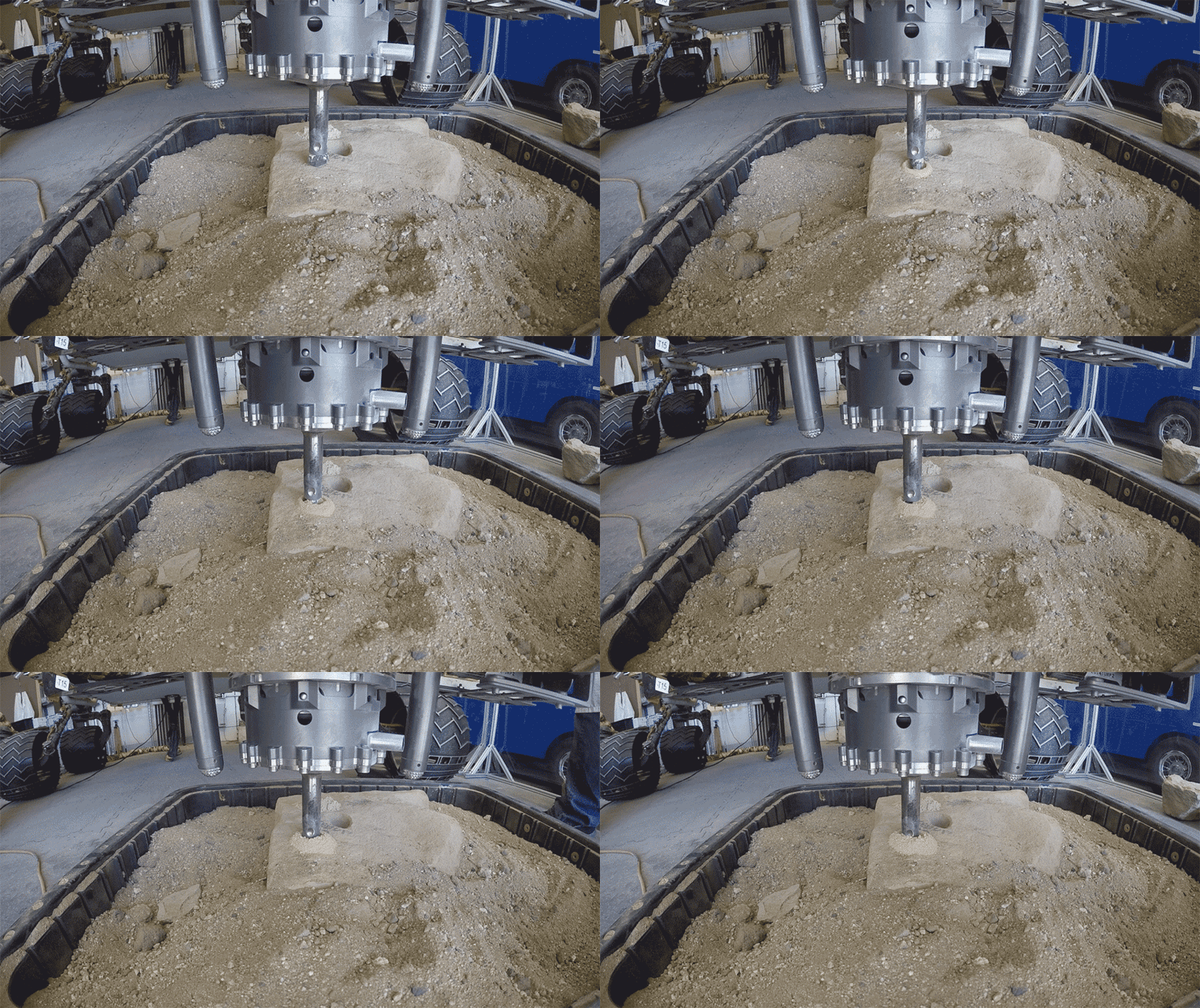
    Curiosity Rover Will Test Percussive Drilling on Mars
    A test of a new percussive drilling technique at NASA’s JPL. Later this week, NASA’s Curiosity rover will test percussive drilling on Mars for the first time since December 2016. Credit: NASA/JPL-Caltech

    NASA’s Curiosity rover could soon be drilling rocks on Mars again. Engineers have been working for the past year to restore the rover’s full drilling capabilities, which were hampered in 2016 due to a mechanical problem. Later this weekend, they’ll be adding percussion to a new technique already in use on Mars.

    This new technique is called Feed Extended Drilling, or FED. It lets Curiosity drill more like the way a person would at home, using the force of its robotic arm to push its drill bit forward as it spins. The new version of FED adds a hammering force to the drill bit.

    The drill was tested with the FED technique without percussion at the end of February. It didn’t successfully produce a rock sample, but did provide valuable results for engineers at NASA’s Jet Propulsion Laboratory in Pasadena, California. Data from the percussive tests, currently planned for Saturday night, will help them continue to refine the drill technique over the coming months.

    “This is our next big test to restore drilling closer to the way it worked before,” said Steven Lee, Curiosity deputy project manager at JPL. “Based on how it performs, we can fine-tune the process, trying things like increasing the amount of force we apply while drilling.”

    The strategy has been to prototype these new methods while on the go, Lee said. If percussive drilling successfully produces a sample this week, the team will immediately begin testing a new process for delivering that sample to the rover’s internal laboratories. In the meantime, engineers at JPL will continue tweaking the extended drilling technique. At the same time, they’re developing new ways to improve the drill’s performance.

    This week’s test will serve double duty by potentially producing important science, said Curiosity Project Scientist Ashwin Vasavada of JPL. The rover has been making its way along Vera Rubin Ridge toward an uphill area enriched in clay minerals that the science team is eager to explore. In anticipation of being able to obtain samples, the rover reversed direction in mid-April, heading toward a location just downhill from the ridge.

    “We’ve purposely driven backwards because the team believes there’s high value in drilling a distinct kind of rock that makes up a 200-foot-thick [about 60 meters] layer below the ridge,” Vasavada said. “We’re fortunately in a position to drive back a short way and still pick up a target on the top of this layer.”

    The rock type would fill a gap in the science team’s knowledge about Mount Sharp; they would ultimately like to analyze samples of all the major rock types they encounter with the rover’s laboratories.

    “Every layer of Mount Sharp reveals a chapter in Mars’ history. Without the drill, our first pass through this layer was like skimming the chapter. Now we get a chance to read it in detail,” Vasavada added.

    Never miss a breakthrough: Join the SciTechDaily newsletter.
    Follow us on Google and Google News.

    Astronomy Curiosity Rover Mars Planetary Science
    Share. Facebook Twitter Pinterest LinkedIn Email Reddit

    Related Articles

    Curiosity Rover Photographs Diverse Rocks

    Curiosity Prepares to Take Its First Scoop of Soil for Analysis

    Curiosity Finds Ancient Streambed on Mars

    NASA’s Curiosity Prepares for Use of Its Arm and Tools

    Curiosity Sends Back Radioed Words and New Telephoto View of Mars

    Curiosity’s ChemCam Laser Yields Good Results

    NASA’s Curiosity Readies for First Drive on Mars

    Color HiRISE Image of Curiosity Rover on Mars

    First 360-Degree Color Panorama From NASA’s Curiosity Mars Rover

    Leave A Reply Cancel Reply

    • Facebook
    • Twitter
    • Pinterest
    • YouTube

    Don't Miss a Discovery

    Subscribe for the Latest in Science & Tech!

    Trending News

    Common Laxative May Help Reverse Depression-Related Brain Fog

    Younger Generations Are Aging Faster – and It May Be Fueling a Surge in Cancer

    New Discovery Could Unlock Quantum Computers the Size of a Coin

    Shingles Vaccine Linked to 24% Lower Dementia Risk in Older Adults

    Scientists Found a Wordle Trick That Solves 99% of Puzzles

    A Hidden Galaxy Called Shadow Blaster May Explain One of Astronomy’s Biggest Mysteries

    These 3 Common Sleep Habits May Be Aging Your Brain Faster

    Rare Goblin Shark Spotted Alive in Its Natural Habitat for the First Time

    Follow SciTechDaily
    • Facebook
    • Twitter
    • YouTube
    • Pinterest
    • Newsletter
    • RSS
    SciTech News
    • Biology News
    • Chemistry News
    • Earth News
    • Health News
    • Physics News
    • Science News
    • Space News
    • Technology News
    Recent Posts
    • New Fossils Show the Arctic Was an Evolutionary Powerhouse During the Age of Dinosaurs
    • What Happened to Australasia’s Lost Crocodiles? New Research Reveals a Dramatic Extinction Story
    • 520-Million-Year-Old Fossils Solve One of Evolution’s Biggest Mysteries
    • This Extraordinary Desert Mouse Defies Aging – and It Could Change Human Longevity
    • A Simple Blood Test Can Reveal the True Age of Your Brain, Heart, and Other Organs
    Copyright © 1998 - 2026 SciTechDaily. All Rights Reserved.
    • Science News
    • About
    • Contact
    • Editorial Board
    • Privacy Policy
    • Terms of Use

    Type above and press Enter to search. Press Esc to cancel.