
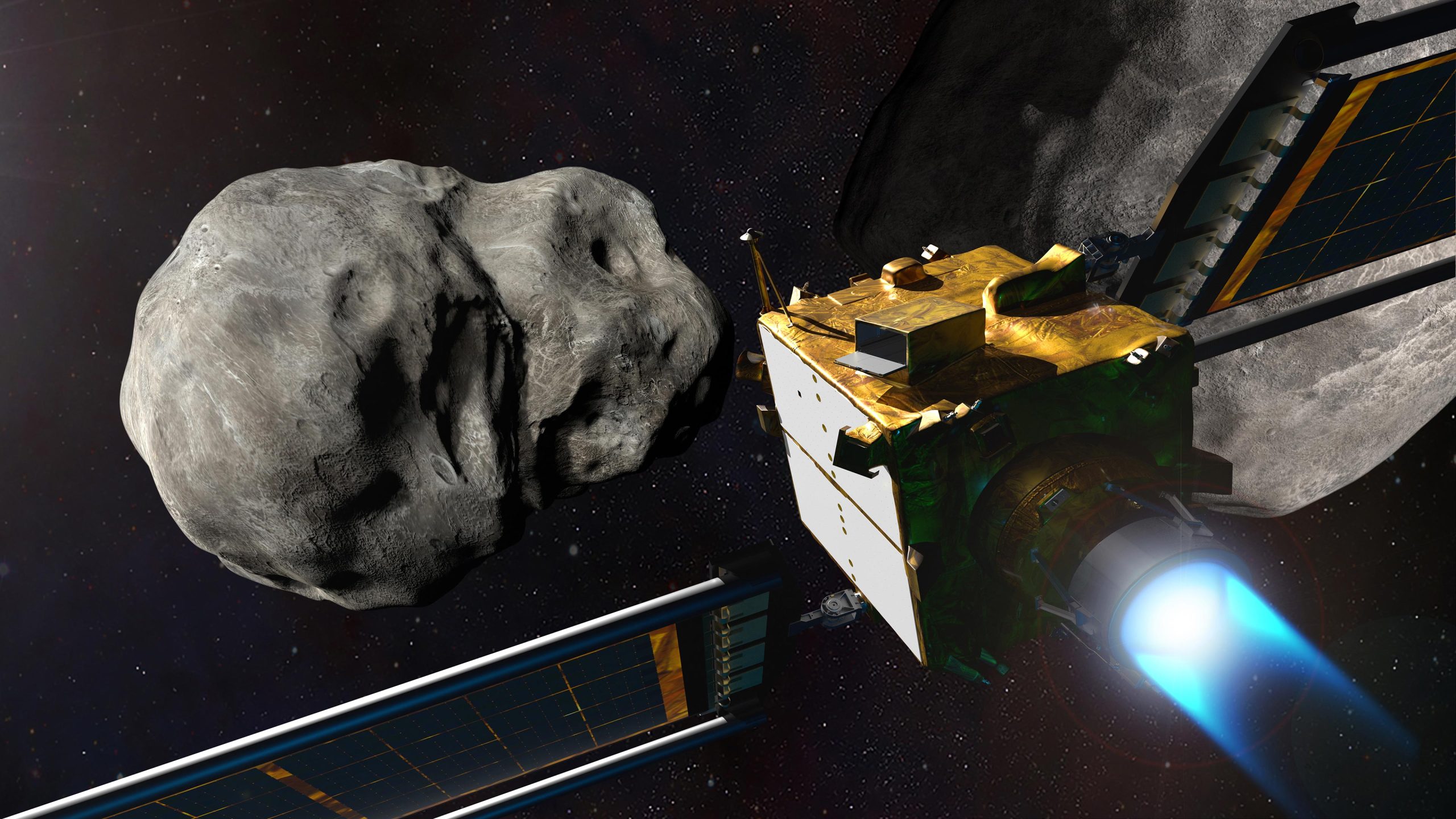
Credit: NASA/Johns Hopkins APL/Steve Gribben
Following NASA’s DART mission, which successfully tested asteroid deflection techniques by colliding with the moonlet Dimorphos, extensive research has revealed insights into the geological features and evolutionary history of the Didymos asteroid system.
Studies have characterized the surface and interior of these celestial bodies, examined their formation processes, and assessed their response to impacts. These findings not only provide a clearer understanding of binary asteroid systems but also enhance planetary defense strategies.
In the months that followed NASA’s Double Asteroid Redirection Test (DART) mission, which sent a spacecraft to intentionally collide with an asteroid moonlet, the science team verified that kinetic impact was a viable deflection technique, proving one effective method of preventing future asteroid strikes on Earth.
Since then, researchers have continued studying data collected from the successful experiment, focusing specifically on surface features of the binary asteroid system, composed of moonlet Dimorphos and parent asteroid Didymos.
In recently published papers in Nature Communications, the team explored the geology of the asteroid system encountered in 2022 to characterize its origin and evolution, and constrain its physical characteristics. Researchers from the Johns Hopkins Applied Physics Laboratory (APL) in Laurel, Maryland, with team members from several international partner institutions led five papers that provided a detailed overview and interpretation of the geological findings.
Based on the internal and surface properties described in Barnouin et al. (2024), this video demonstrates how the spin-up of asteroid Didymos could have led to the growth of its equatorial ridge and the formation of the smaller asteroid Dimorphos, seen orbiting the former near the end of the clip. Particles are colored according to their speeds, with the scale shown at the top, along with the continually changing spin period of Didymos. Credit: University of Michigan/Yun Zhang and Johns Hopkins APL/Olivier Barnouin
APL scientists Olivier Barnouin and Ronald-Louis Ballouz led a paper that analyzed the geology[1] of both asteroids and drew conclusions about their surface materials and interior properties. From images captured by DART and its accompanying LICIACube CubeSat contributed by the Italian Space Agency (ASI), the team observed the smaller asteroid Dimorphos’ topography, which featured boulders of varying sizes.
In comparison, the larger asteroid Didymos was smoother at lower elevations, although rocky at higher elevations, with more craters than Dimorphos. The authors inferred that Dimorphos likely spun off from Didymos in a “large mass shedding event.” There are natural processes that can accelerate the spins of small asteroids, and there is growing evidence that these processes may be responsible for reshaping these bodies or even forcing material to be spun off their surfaces.
Analysis suggested that both Didymos and Dimorphos have weak surface characteristics, which led the team to posit that Didymos has a surface age 40-130 times older than Dimorphos, with the former estimated to be 12.5 million years old and the latter less than 300,000 years old. The low surface strength of Dimorphos likely contributed to DART’s significant impact on its orbit.
“The images and data that DART collected at the Didymos system provided a unique opportunity for a close-up geological look at a near-Earth asteroid binary system,” said Barnouin. “From these images alone, we were able to infer a great deal of information on geophysical properties of both Didymos and Dimorphos, and expand our understanding of the formation of these two asteroids. We also better understand why DART was so effective in moving Dimorphos.”
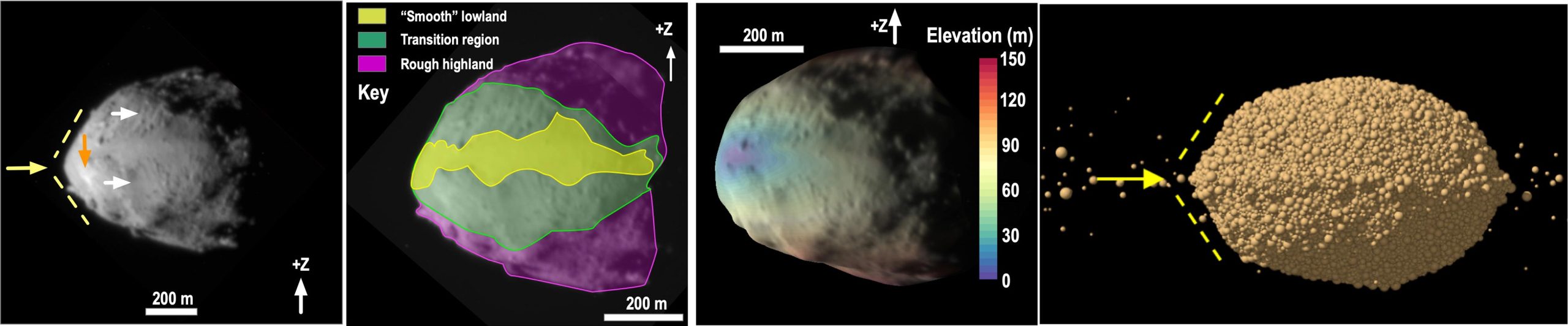
Maurizio Pajola, of the National Institute for Astrophysics (INAF), and co-authors led a paper comparing the shapes and sizes[2] of the various boulders and their distribution patterns on the two asteroids’ surfaces. They determined that the physical characteristics of Dimorphos indicate it formed in stages, likely of material inherited from its parent asteroid Didymos. That conclusion reinforces the prevailing theory that some binary asteroid systems arise from shed remnants of a larger primary asteroid accumulating into a new asteroid moonlet.
Alice Lucchetti, also of INAF, and colleagues found that thermal fatigue[3] — the gradual weakening and cracking of a material caused by heat — could rapidly break up boulders on the surface of Dimorphos, generating surface lines and altering the physical characteristics of this type of asteroid more quickly than previously thought. The DART mission was likely the first observation of such a phenomenon on this type of asteroid.
Supervised by ISAE-SUPAERO researcher Naomi Murdoch and colleagues, students Jeanne Bigot and Pauline Lombardo led a paper that determined Didymos’ bearing capacity[4] — the surface’s ability to support applied loads — to be at least 1,000 times lower than that of dry sand on Earth or lunar soil. This is considered an important parameter for understanding and predicting the response of a surface, including for the purposes of displacing an asteroid.
Colas Robin, also of ISAE-SUPAERO, and co-authors analyzed the surface boulders on Dimorphos,[5] comparing them with those on other rubble pile asteroids, including Itokawa, Ryugu and Bennu. The researchers found the boulders shared similar characteristics, suggesting all these types of asteroids formed and evolved in a similar fashion. The team also noted that “the elongated nature of the boulders around the DART impact site implies that they were likely formed through impact processing.”
These latest findings form a more robust overview of the origins of the Didymos system and add to the understanding of how such planetary bodies were formed. They also provide new insights into why DART was so effective in shifting Dimorphos’ orbit. As the European Space Agency’s (ESA) Hera mission prepares to revisit DART’s collision site in 2026 to further analyze the aftermath of the first-ever planetary defense test, this research provides a series of tests for what Hera will find, and contributes to current and future exploration missions while bolstering planetary defense capabilities.
In five new Nature Communications papers, the team behind NASA’s successful DART mission sheds new light on the structure and origins of the asteroid system encountered in 2022.
- The Geology and Evolution of the Near-Earth Binary Asteroid System (65803) Didymos
- Evidence for Multi-Fragmentation and Mass Shedding of Boulders on Rubble-Pile Binary Asteroid System (65803) Didymos
- Fast Boulder Fracturing by Thermal Fatigue Detected on Stony Asteroids
- The Bearing Capacity of Asteroid (65803) Didymos Estimated from Boulder Tracks
- Mechanical Properties of Rubble Pile asteroids (Dimorphos, Itokawa, Ryugu, and Bennu) Through Surface Boulder Morphological Analysis
References:
- “The geology and evolution of the Near-Earth binary asteroid system (65803) Didymos” by Olivier Barnouin, Ronald-Louis Ballouz, Simone Marchi, Jean-Baptiste Vincent, Harrison Agrusa, Yun Zhang, Carolyn M. Ernst, Maurizio Pajola, Filippo Tusberti, Alice Lucchetti, R. Terik Daly, Eric Palmer, Kevin J. Walsh, Patrick Michel, Jessica M. Sunshine, Juan L. Rizos, Tony L. Farnham, Derek C. Richardson, Laura M. Parro, Naomi Murdoch, Colas Q. Robin, Masatoshi Hirabayashi, Tomas Kahout, Erik Asphaug, Sabina D. Raducan, Martin Jutzi, Fabio Ferrari, Pedro Henrique Aragao Hasselmann, Adriano CampoBagatin, Nancy L. Chabot, Jian-Yang Li, Andrew F. Cheng, Michael C. Nolan, Angela M. Stickle, Ozgur Karatekin, Elisabetta Dotto, Vincenzo Della Corte, Elena Mazzotta Epifani, Alessandro Rossi, Igor Gai, Jasinghege Don Prasanna Deshapriya, Ivano Bertini, Angelo Zinzi, Josep M. Trigo-Rodriguez, Joel Beccarelli, Stavro Lambrov Ivanovski, John Robert Brucato, Giovanni Poggiali, Giovanni Zanotti, Marilena Amoroso, Andrea Capannolo, Gabriele Cremonese, Massimo Dall’Ora, Simone Ieva, Gabriele Impresario, Michèle Lavagn, Dario Modenini, Pasquale Palumbo, Davide Perna, Simone Pirrotta, Paolo Tortora, Marco Zannoni and Andrew S. Rivkin, 30 July 2024, Nature Communications.
DOI: 10.1038/s41467-024-50146-x - “Evidence for multi-fragmentation and mass shedding of boulders on rubble-pile binary asteroid system (65803) Didymos” by M. Pajola, F. Tusberti, A. Lucchetti, O. Barnouin, S. Cambioni, C. M. Ernst, E. Dotto, R. T. Daly, G. Poggiali, M. Hirabayashi, R. Nakano, E. Mazzotta Epifani, N. L. Chabot, V. Della Corte, A. Rivkin, H. Agrusa, Y. Zhang, L. Penasa, R.-L. Ballouz, S. Ivanovski, N. Murdoch, A. Rossi, C. Robin, S. Ieva, J. B. Vincent, F. Ferrari, S. D. Raducan, A. Campo-Bagatin, L. Parro, P. Benavidez, G. Tancredi, Ö. Karatekin, J. M. Trigo-Rodriguez, J. Sunshine, T. Farnham, E. Asphaug, J. D. P. Deshapriya, P. H. A. Hasselmann, J. Beccarelli, S. R. Schwartz, P. Abell, P. Michel, A. Cheng, J. R. Brucato, A. Zinzi, M. Amoroso, S. Pirrotta, G. Impresario, I. Bertini, A. Capannolo, S. Caporali, M. Ceresoli, G. Cremonese, M. Dall’Ora, I. Gai, L. Gomez Casajus, E. Gramigna, R. Lasagni Manghi, M. Lavagna, M. Lombardo, D. Modenini, P. Palumbo, D. Perna, P. Tortora, M. Zannoni and G. Zanotti, 30 July 2024, Nature Communications.
DOI: 10.1038/s41467-024-50148-9 - “Fast boulder fracturing by thermal fatigue detected on stony asteroids” by A. Lucchetti, S. Cambioni, R. Nakano, O. S. Barnouin, M. Pajola, L. Penasa, F. Tusberti, K. T. Ramesh, E. Dotto, C. M. Ernst, R. T. Daly, E. Mazzotta Epifani, M. Hirabayashi, L. Parro, G. Poggiali, A. Campo Bagatin, R.-L. Ballouz, N. L. Chabot, P. Michel, N. Murdoch, J. B. Vincent, Ö. Karatekin, A. S. Rivkin, J. M. Sunshine, T. Kohout, J.D.P. Deshapriya, P.H.A. Hasselmann, S. Ieva, J. Beccarelli, S. L. Ivanovski, A. Rossi, F. Ferrari, C. Rossi, S. D. Raducan, J. Steckloff, S. Schwartz, J. R. Brucato, M. Dall’Ora, A. Zinzi, A. F. Cheng, M. Amoroso, I. Bertini, A. Capannolo, S. Caporali, M. Ceresoli, G. Cremonese, V. Della Corte, I. Gai, L. Gomez Casajus, E. Gramigna, G. Impresario, R. Lasagni Manghi, M. Lavagna, M. Lombardo, D. Modenini, P. Palumbo, D. Perna, S. Pirrotta, P. Tortora, M. Zannoni and G. Zanotti, 30 July 2024, Nature Communications.
DOI: 10.1038/s41467-024-50145-y - “The bearing capacity of asteroid (65803) Didymos estimated from boulder tracks” by J. Bigot, P. Lombardo, N. Murdoch, D. J. Scheeres, D. Vivet, Y. Zhang, J. Sunshine, J. B. Vincent, O. S. Barnouin, C. M. Ernst, R. T. Daly, C. Sunday, P. Michel, A. Campo-Bagatin, A. Lucchetti, M. Pajola, A. S. Rivkin and N. L. Chabot, 30 July 2024, Nature Communications.
DOI: 10.1038/s41467-024-50149-8 - “Mechanical properties of rubble pile asteroids (Dimorphos, Itokawa, Ryugu, and Bennu) through surface boulder morphological analysis” by Colas Q. Robin, Alexia Duchene, Naomi Murdoch, Jean-Baptiste Vincent, Alice Lucchetti, Maurizio Pajola, Carolyn M. Ernst, R. Terik Daly, Olivier S. Barnouin, Sabina D. Raducan, Patrick Michel, Masatochi Hirabayashi, Alexander Stott, Gabriela Cuervo, Erica R. Jawin, Josep M. Trigo-Rodriguez, Laura M. Parro, Cecily Sunday, Damien Vivet, David Mimoun, Andrew S. Rivkin and Nancy L. Chabot, 30 July 2024, Nature Communications.
DOI: 10.1038/s41467-024-50147-w
APL managed the DART mission for NASA’s Planetary Defense Coordination Office as a project of the agency’s Planetary Missions Program Office. NASA provided support for the mission from several centers, including the Jet Propulsion Laboratory in Southern California; Goddard Space Flight Center in Greenbelt, Maryland; Johnson Space Center in Houston; Glenn Research Center in Cleveland; and Langley Research Center in Hampton, Virginia.
Never miss a breakthrough: Join the SciTechDaily newsletter.
Follow us on Google and Google News.
1 Comment
Impacting asteroids works.
What traveled around in some circles for over a decade was the “Gravity Tractor.” Hilariously misguided but was given a hearing by NASA and people who should have known better.
Amazing.