

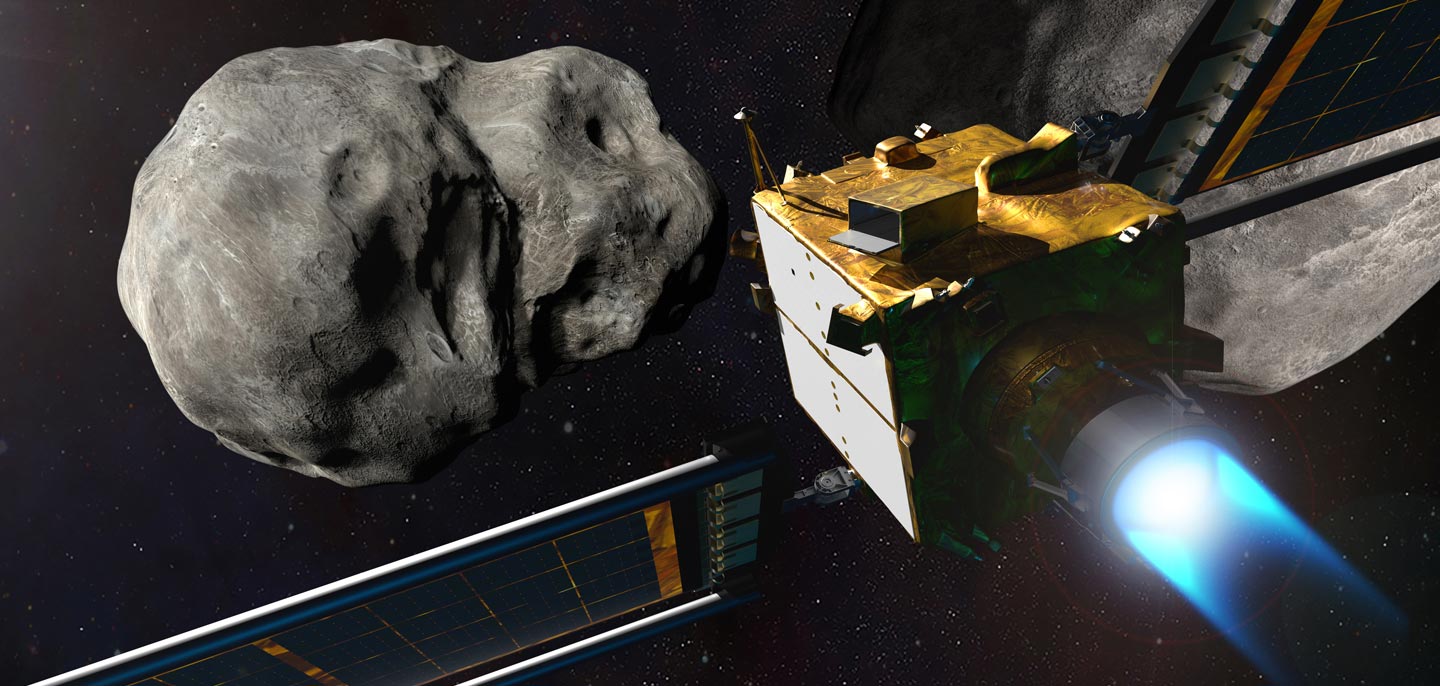
NASA’s Double Asteroid Redirection Test, or DART, is the world’s first full-scale planetary defense test, demonstrating one method of asteroid deflection technology. True to its name, DART is a focused mission, proving that a spacecraft can autonomously navigate to a target asteroid and intentionally collide with it (called a kinetic impact) at roughly 4 miles per second (6 kilometers per second). Its target, which poses no threat to Earth, is the asteroid moonlet Dimorphos (Greek for “two forms”), which orbits a larger asteroid named Didymos (Greek for “twin”).
As part of NASA’s larger planetary defense strategy, DART will simultaneously test new technologies and provide important data to enhance our modeling and predictive capabilities and help us better prepare for an asteroid that might pose a threat to Earth, should one be discovered.
NASA will provide coverage of the upcoming prelaunch and launch activities for the agency’s first planetary defense test mission, the Double Asteroid Redirection Test (DART). The mission will help determine if intentionally crashing a spacecraft into an asteroid is an effective way to change its course. DART’s target asteroid is not a threat to Earth.
DART is scheduled to launch no earlier than 1:20 a.m. EST Wednesday, November 24 (10:20 p.m. PST Tuesday, November 23) on a SpaceX Falcon 9 rocket from Vandenberg Space Force Base in California.
Live launch coverage on NASA Television will begin at 12:30 a.m. EST Wednesday, November 24, 2021 (9:30 p.m. PST Tuesday, November 23, 2021), on NASA Television, the NASA app, and the agency’s website, with prelaunch and science briefings beginning Sunday, November 21.
The spacecraft is designed to direct itself to impact an asteroid while traveling at a speed of roughly 15,000 miles per hour (24,000 kilometers per hour). Its target is the asteroid moonlet Dimorphos (Greek for “two forms”), which orbits a larger asteroid named Didymos (Greek for “twin”). In fall 2022, DART will impact Dimorphos to change its orbit within the Didymos binary asteroid system. The Didymos system is the ideal candidate for DART because it poses no actual impact threat to Earth, and scientists can measure the change in Dimorphos’ orbit with ground-based telescopes.
Full mission coverage is as follows (all times Eastern):
Sunday, November 21
4 p.m. – DART investigation and engineering briefing on NASA TV with the following participants:
- Lori Glaze, director of NASA’s Science Mission Directorate’s Planetary Science Division at NASA Headquarters in Washington
- Tom Statler, DART program scientist, NASA’s Science Mission Directorate’s Planetary Science Division, NASA Headquarters
- Andy Rivkin, DART investigation team lead, Johns Hopkins Applied Physics Laboratory
- Betsy Congdon, DART mechanical systems engineer, Johns Hopkins Applied Physics Laboratory
- Simone Pirrotta, Light Italian Cubesat for Imaging of Asteroids (LICIACube) project manager, Italian Space Agency
Monday, November 22
7 p.m. – DART prelaunch news conference on NASA TV with the following participants:
- Thomas Zurbuchen, associate administrator, NASA’s Science Mission Directorate, NASA Headquarters
- Lindley Johnson, planetary defense officer, NASA’s Planetary Defense Coordination Office, NASA Headquarters
- Ed Reynolds, DART project manager, Johns Hopkins Applied Physics Laboratory
- Omar Baez, senior launch director, Launch Services Program, NASA’s Kennedy Space Center in Florida
- Julianna Scheiman, director for civil satellite missions, SpaceX
- Capt. Maximillian Rush, weather officer, Space Launch Delta 30, Vandenberg Space Force Base
Tuesday, November 23
4 p.m. – NASA Science Live, with the following participants:
- Lori Glaze, director of NASA’s Science Mission Directorate’s Planetary Science Division at NASA Headquarters
- Nancy Chabot, DART coordination lead, John Hopkins University Applied Physics Laboratory
- Joshua Ramirez Rodriguez, telecommunications subsystem integration and test lead engineer, Johns Hopkins Applied Physics Laboratory
This event will stream live on the agency’s Facebook, Twitter and YouTube channels. Members of the public can participate live by submitting questions in the comment section of the streams, or by using #AskNASA.
Wednesday, November 24
12:30 a.m. – NASA TV live launch coverage begins.
Audio only of the news conferences and launch coverage will be carried on the NASA “V” circuits, which may be accessed by dialing 321-867-1220, -1240, -1260 or -7135. On launch day, “mission audio,” the launch conductor’s countdown activities without NASA TV launch commentary, will be carried on 321-867-7135.
Planetary Defender Campaign
To allow the public to share in the excitement of DART, NASA has launched the Planetary Defenders campaign. Participants can answer a short series of questions about planetary defense to earn their planetary defender certificate, which they can download or print, as well as a digital badge to share on social media using the hashtag #PlanetaryDefender.
Public Participation
Members of the public can register to attend the launch virtually. NASA’s virtual guest program for DART includes curated launch resources, a behind-the-scenes look at the mission, and the opportunity for a virtual guest launch passport stamp.
Virtual NASA Social
As we finalize launch preparations, we are excited to invite the public to join our virtual NASA Social for the #DARTMission on Facebook. Stay up to date on the latest mission activities, interact with NASA and DART team members in real-time, and watch the launch of the SpaceX Falcon 9 rocket that will boost DART toward its destination.
Never miss a breakthrough: Join the SciTechDaily newsletter.
Follow us on Google and Google News.