
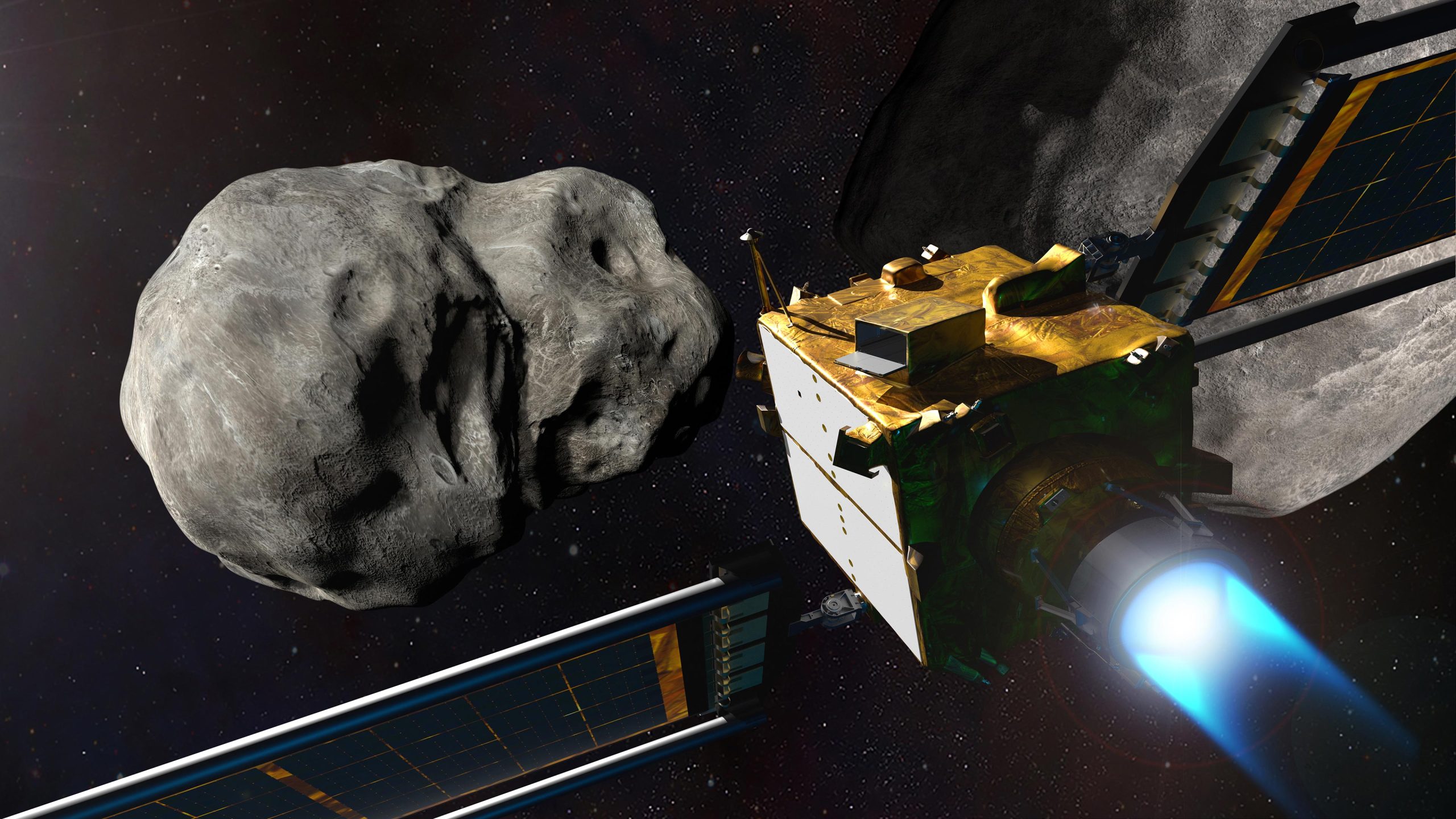
Astronomers at the University of Maryland found that a surprising burst of rocky debris released during the DART mission carried three times more momentum than the spacecraft. This discovery offers valuable new insights for improving future planetary defense strategies.
When NASA’s DART spacecraft struck the asteroid moon Dimorphos in September 2022, it not only achieved its goal of shifting the asteroid’s orbit but also triggered the release of a large number of boulders. These fragments carried more than three times the momentum of the spacecraft itself.
Led by the University of Maryland, a team of astronomers discovered that although the mission confirmed kinetic impactors can effectively redirect an asteroid, the expelled debris generated forces in unexpected directions. These dynamics could pose challenges for future deflection strategies. Their findings, published in the Planetary Science Journal, suggest that asteroid redirection is a much more complicated process than originally believed.
“We succeeded in deflecting an asteroid, moving it from its orbit,” said Tony Farnham, the study’s lead author and a research scientist in the Department of Astronomy at UMD. “Our research shows that while the direct impact of the DART spacecraft caused this change, the boulders ejected gave an additional kick that was almost as big. That additional factor changes the physics we need to consider when planning these types of missions.”
High-speed boulder tracking and unusual patterns
Using data captured by LICIACube, a small Italian spacecraft that documented the aftermath of the DART impact, astronomers tracked 104 boulders ranging in size from 0.2 to 3.6 meters in radius. These boulders were seen moving away from Dimorphos at speeds reaching 52 meters per second (116 miles per hour). From this imagery, the researchers were able to calculate the three-dimensional positions and velocities of the debris.
“We saw that the boulders weren’t scattered randomly in space,” Farnham said. “Instead, they were clustered in two pretty distinct groups, with an absence of material elsewhere, which means that something unknown is at work here.”

Roughly 70% of the observed boulders formed a large cluster moving southward at high speeds and low angles relative to the asteroid’s surface. The team suspects these fragments originated from specific impact points, possibly from larger surface boulders that were broken apart by DART’s solar panels shortly before the main body of the spacecraft collided with Dimorphos.
Tracing the source of ejected fragments
“DART’s solar panels likely hit two big boulders, called Atabaque and Bodhran, on the asteroid,” explained the paper’s second author, Jessica Sunshine, a professor of astronomy and geology at UMD. “Evidence suggests that the southern cluster of ejected material is probably made up of fragments from Atabaque, a 3.3-meter-radius boulder.”
Sunshine, who also served as deputy principal investigator for the UMD-led NASA Deep Impact mission, compared DART’s results with Deep Impact’s, noting how surface features and target composition fundamentally shape impact outcomes.
“Deep Impact hit a surface that was essentially very small, uniform particles, so its ejecta was relatively smooth and continuous,” Sunshine explained. “And here, we see that DART hit a surface that was rocky and full of large boulders, resulting in chaotic and filamentary structures in its ejecta patterns. Comparing these two missions side-by-side gives us this insight into how different types of celestial bodies respond to impacts, which is crucial to ensuring that a planetary defense mission is successful.”
Orbital changes and future mission planning
The momentum from the DART impact’s ejected boulders was primarily perpendicular to the spacecraft’s trajectory, meaning that it could have tilted Dimorphos’ orbital plane by up to one degree and potentially sent the asteroid tumbling erratically in space. The team’s work on understanding the effect of the boulder debris will be key to the European Space Agency’s Hera mission, which will arrive at the Didymos-Dimorphos system in 2026.
“Data gathered from LICIACube provides additional perspectives on impact events, especially as DART was originally designed to solely rely on Earth-based observations,” Farnham said. “Hera will do the same by giving us another direct view of the impact’s aftermath, relying on the predictions we’ve made using data gathered from DART.”
Farnham noted that these multiple perspectives and close-up images from LICIACube gave the DART team information that would have been impossible to detect from Earth, including data on the asteroid boulders. This new study suggests the importance of considering those variables in planning future asteroid deflection missions.
“If an asteroid was tumbling toward us, and we knew we had to move it a specific amount to prevent it from hitting Earth, then all these subtleties become very, very important,” Sunshine added. “You can think of it as a cosmic pool game. We might miss the pocket if we don’t consider all the variables.”
Reference: “High-speed Boulders and the Debris Field in DART Ejecta” by Tony L. Farnham, Jessica M. Sunshine, Masatoshi Hirabayashi, Carolyn M. Ernst, R. Terik Daly, Harrison F. Agrusa, Olivier S. Barnouin, Jian-Yang Li, Kathryn M. Kumamoto, Megan Bruck Syal, Sean E. Wiggins, Evan Bjonnes, Angela M. Stickle, Sabina D. Raducan, Andrew F. Cheng, David A. Glenar, Ramin Lolachi, Timothy J. Stubbs, Eugene G. Fahnstock, Marilena Amoroso, Ivano Bertini, John R. Brucato, Andrea Capannolo, Gabriele Cremonese, Massimo Dall’Ora, Vincenzo Della Corte, J. D. P. Deshapriya, Elisabetta Dotto, Igor Gai, Pedro H. Hasselmann, Simone Ieva, Gabriele Impresario, Stavro L. Ivanovski, Michèle Lavagna, Alice Lucchetti, Francesco Marzari, Elena Mazzotta Epifani, Dario Modenini, Maurizio Pajola, Pasquale Palumbo, Simone Pirrotta, Giovanni Poggiali, Alessandro Rossi, Paolo Tortora, Marco Zannoni, Giovanni Zanotti and Angelo Zinzi, 4 July 2025, The Planetary Science Journal.
DOI: 10.3847/PSJ/addd1a
This research was supported by NASA (Contract No. 80MSFC20D0004), NASA CRESST-II (Award No. 80GSFC24M0006), the U.S. Department of Energy (Contract No. DE-AC52-07NA27344. LLNL-JRNL-2002297), the French National Agency for Research (Contract No. ANR-15-IDEX-01) and the Italian Space Agency (Contract No. 2019-31-HH.0 CUP F84I190012600).
Never miss a breakthrough: Join the SciTechDaily newsletter.
Follow us on Google and Google News.