
Close Menu
    Facebook X (Twitter) Instagram
    SciTechDaily
    • Biology
    • Chemistry
    • Earth
    • Health
    • Physics
    • Science
    • Space
    • Technology
    Facebook X (Twitter) Pinterest YouTube RSS
    SciTechDaily
    Home»Space»NASA’s Juno Spacecraft Takes First Images of Jupiter Moon Ganymede’s North Pole
    Space

    NASA’s Juno Spacecraft Takes First Images of Jupiter Moon Ganymede’s North Pole

    By Jet Propulsion LaboratoryJuly 26, 2020No Comments4 Mins Read
    Facebook Twitter Pinterest Telegram LinkedIn WhatsApp Email Reddit
    Share
    Facebook Twitter LinkedIn Pinterest Telegram Email Reddit
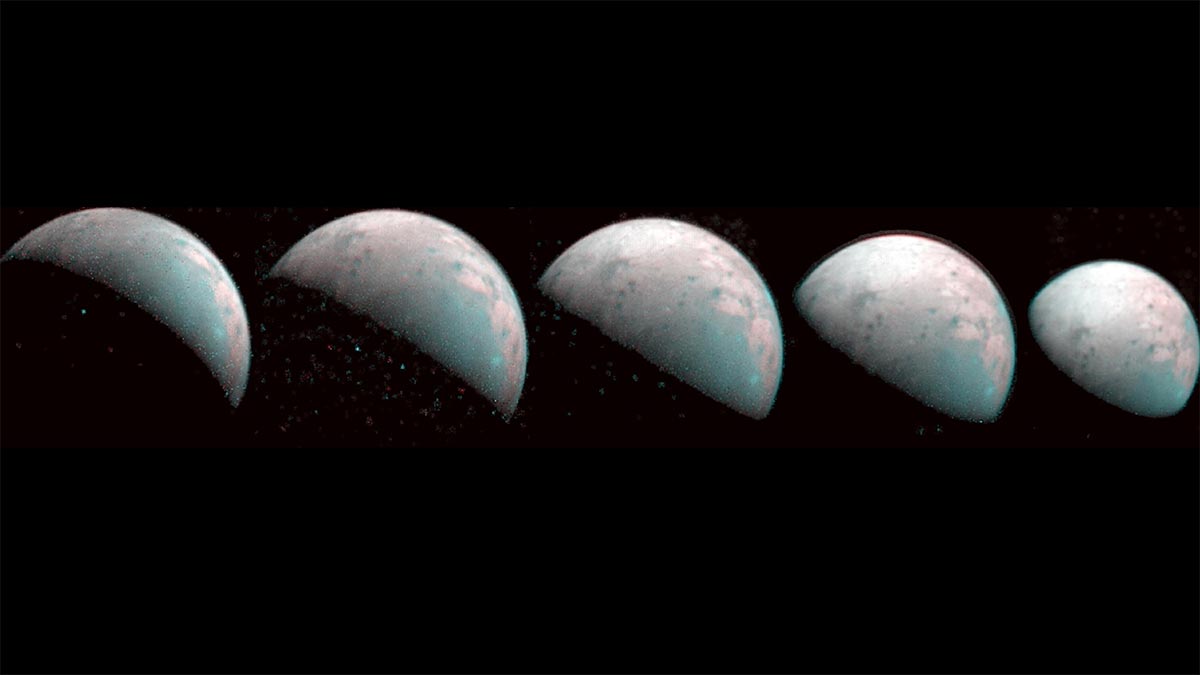
    Jupiter Moon Ganymede North Pole
    These images the JIRAM instrument aboard NASA’s Juno spacecraft took on December 26, 2019, provide the first infrared mapping of Ganymede’s northern frontier. Frozen water molecules detected at both poles have no appreciable order to their arrangement and a different infrared signature than ice at the equator. Credit: NASA/JPL-Caltech/SwRI/ASI/INAF/JIRAM

    Infrared images from Juno provide the first glimpse of Ganymede’s icy north pole.

    On its way inbound for a December 26, 2019, flyby of Jupiter, NASA’s Juno spacecraft flew in the proximity of the north pole of the ninth-largest object in the solar system, the moon Ganymede. The infrared imagery collected by the spacecraft’s Jovian Infrared Auroral Mapper (JIRAM) instrument provides the first infrared mapping of the massive moon’s northern frontier.

    Larger than the planet Mercury, Ganymede consists primarily of water ice. Its composition contains fundamental clues for understanding the evolution of the 79 Jovian moons from the time of their formation to today.

    Ganymede is also the only moon in the solar system with its own magnetic field. On Earth, the magnetic field provides a pathway for plasma (charged particles from the Sun) to enter our atmosphere and create aurora. As Ganymede has no atmosphere to impede their progress, the surface at its poles is constantly being bombarded by plasma from Jupiter’s gigantic magnetosphere. The bombardment has a dramatic effect on Ganymede’s ice.
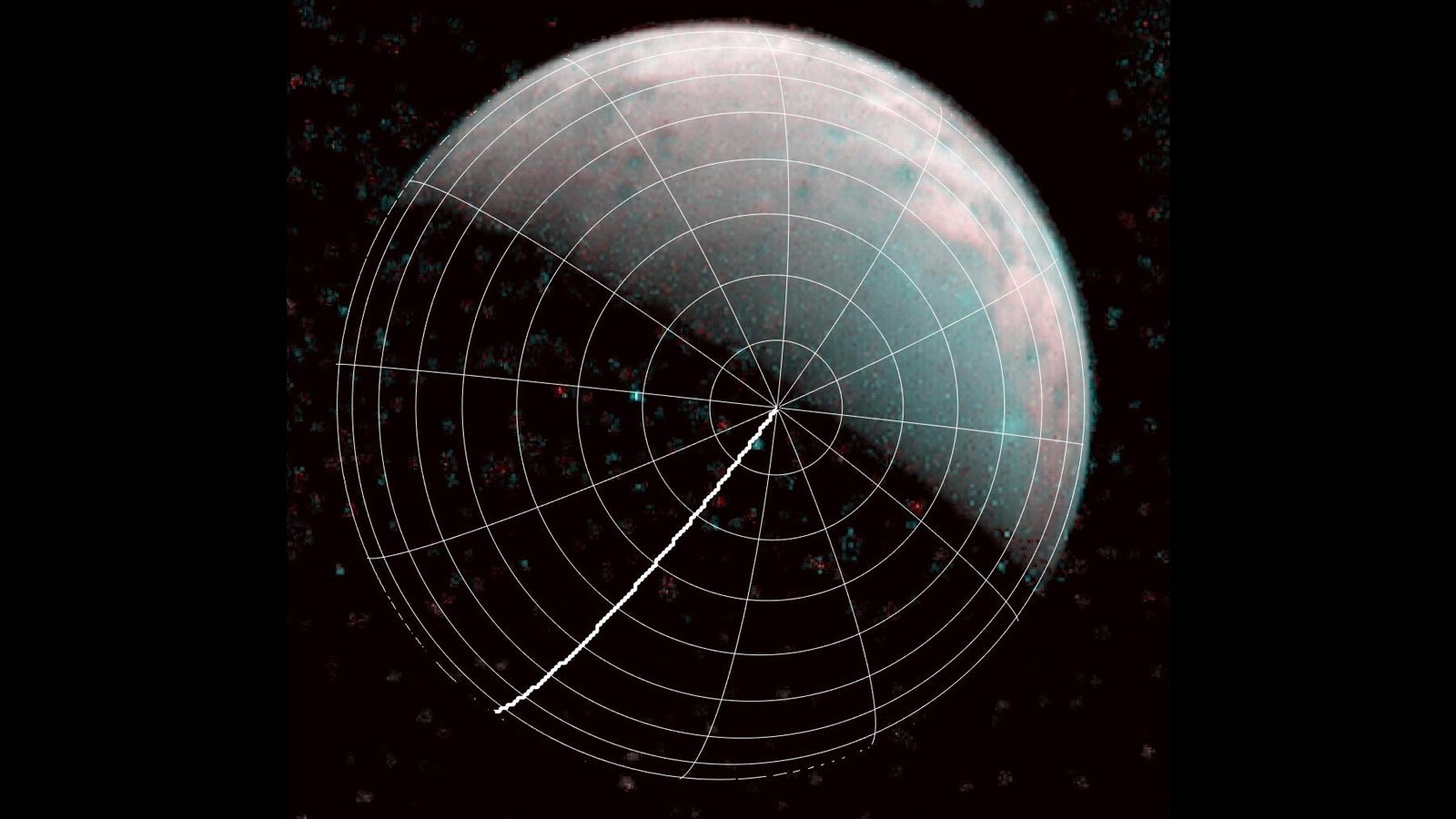
    Ganymede North Pole
    The north pole of Ganymede can be seen in the center of this annotated image taken by the JIRAM infrared imager aboard NASA’s Juno spacecraft on December 26, 2019. The thick line is 0-degrees longitude. Credit: NASA/JPL-Caltech/SwRI/ASI/INAF/JIRAM

    “The JIRAM data show the ice at and surrounding Ganymede’s north pole has been modified by the precipitation of plasma,” said Alessandro Mura, a Juno co-investigator at the National Institute for Astrophysics in Rome. “It is a phenomenon that we have been able to learn about for the first time with Juno because we are able to see the north pole in its entirety.”

    The ice near both poles of the moon is amorphous. This is because charged particles follow the moon’s magnetic field lines to the poles, where they impact, wreaking havoc on the ice there, preventing it from having an ordered (or crystalline) structure. In fact, frozen water molecules detected at both poles have no appreciable order to their arrangement, and the amorphous ice has a different infrared signature than the crystalline ice found at Ganymede’s equator.

    “These data are another example of the great science Juno is capable of when observing the moons of Jupiter,” said Giuseppe Sindoni, program manager of the JIRAM instrument for the Italian Space Agency.

    JIRAM was designed to capture the infrared light emerging from deep inside Jupiter, probing the weather layer down to 30 to 45 miles (50 to 70 kilometers) below Jupiter’s cloud tops. But the instrument can also be used to study the moons Io, Europa, Ganymede, and Callisto (also known collectively as the Galilean moons for their discoverer, Galileo).

    Knowing the top of Ganymede would be within view of Juno on December 26 flyby of Jupiter, the mission team programmed the spacecraft to turn so instruments like JIRAM could see Ganymede’s surface. At the time surrounding its closest approach of Ganymede – at about 62,000 miles (100,000 kilometers) – JIRAM collected 300 infrared images of the surface, with a spatial resolution of 14 miles (23 kilometers) per pixel.

    The secrets of Jupiter’s largest moon revealed by Juno and JIRAM will benefit the next mission to the icy world. The ESA (European Space Agency) JUpiter ICy moons Explorer mission is scheduled to begin a 3 1/2-year exploration of Jupiter’s giant magnetosphere, turbulent atmosphere, and its icy moons Ganymede, Callisto, and Europa beginning in 2030. NASA is providing an Ultraviolet Spectrograph instrument, along with also subsystems and components for two additional instruments: the Particle Environment Package and the Radar for Icy Moon Exploration experiment.

    NASA’s Jet Propulsion Laboratory, a division of Caltech in Pasadena, California, manages the Juno mission for the principal investigator, Scott Bolton, of the Southwest Research Institute in San Antonio. Juno is part of NASA’s New Frontiers Program, which is managed at NASA’s Marshall Space Flight Center in Huntsville, Alabama, for the agency’s Science Mission Directorate in Washington. The Italian Space Agency (ASI) contributed the Jovian Infrared Auroral Mapper. Lockheed Martin Space in Denver built and operates the spacecraft.

    Never miss a breakthrough: Join the SciTechDaily newsletter.
    Follow us on Google and Google News.

    Astronomy JPL Jupiter Moons NASA
    Share. Facebook Twitter Pinterest LinkedIn Email Reddit

    Related Articles

    NASA’s Juno Spacecraft Captures Stunning View of Jupiter’s Moons Io and Europa – And a Crater on Ganymede

    Hear the Eerie Radio Emissions NASA’s Juno Spacecraft Recorded From Jupiter and Its Moon Io

    “Beautiful!” – Ride With NASA’s Juno Spacecraft As It Flies Past the Solar System’s Biggest Moon and Jupiter

    40-Year Mystery Solved: Source of Jupiter’s Strange X-Ray Flares Uncovered

    See the Dramatic First Images NASA’s Juno Spacecraft Captured As It Sailed by the Icy Orb, Ganymede

    Close Encounters of the Jovian Kind: NASA’s Juno to Get a Close Look at Jupiter’s Moon Ganymede

    Jupiter’s Moon Europa May Have an Interior Hot Enough to Fuel Seafloor Volcanoes

    NASA’s Juno Mission Expands Into the Future – To Explore Jupiter and Its Rings and Moons

    Jupiter’s Icy Moon Europa Glows in the Dark

    Leave A Reply Cancel Reply

    • Facebook
    • Twitter
    • Pinterest
    • YouTube

    Don't Miss a Discovery

    Subscribe for the Latest in Science & Tech!

    Trending News

    Scientists Discover Game-Changing New Way To Treat High Cholesterol

    This Small Change to Your Exercise Routine Could Be the Secret to Living Longer

    Scientists Discover 430,000-Year-Old Wooden Tools, Rewriting Human History

    AI Could Detect Early Signs of Alzheimer’s in Under a Minute – Far Before Traditional Tests

    What if Dark Matter Has Two Forms? Bold New Hypothesis Could Explain a Cosmic Mystery

    This Metal Melts in Your Hand – and Scientists Just Discovered Something Strange

    Beef vs. Chicken: Surprising Results From New Prediabetes Study

    Alzheimer’s Breakthrough: Scientists Discover Key Protein May Prevent Toxic Protein Clumps in the Brain

    Follow SciTechDaily
    • Facebook
    • Twitter
    • YouTube
    • Pinterest
    • Newsletter
    • RSS
    SciTech News
    • Biology News
    • Chemistry News
    • Earth News
    • Health News
    • Physics News
    • Science News
    • Space News
    • Technology News
    Recent Posts
    • Revolutionary Imaging Technique Unlocks Secrets of Matter at Extreme Speeds
    • Where Does Mass Come From? Scientists Find Evidence of a New Exotic Nuclear State
    • Quantum Breakthrough: Unhackable Keys Sent Over 120 km Using Quantum Dots
    • Researchers Discover Unknown Beetle Species Just Steps From Their Lab
    • Jellyfish Caught Feasting on Exploding Sea Worms for the First Time
    Copyright © 1998 - 2026 SciTechDaily. All Rights Reserved.
    • Science News
    • About
    • Contact
    • Editorial Board
    • Privacy Policy
    • Terms of Use

    Type above and press Enter to search. Press Esc to cancel.